Stock Analysis · Jardine Matheson Holdings Ltd PK (JMHLY)
Overview
Jardine Matheson Holdings is a large Asian-focused conglomerate. In simple terms, it is a parent company that owns major stakes in several big businesses rather than relying on one single activity. Its portfolio spans food retail, health and beauty stores, home furnishings, convenience stores, motor dealerships, property investment and development, hotels, heavy equipment, engineering, mining services, agribusiness, and financial services. The group’s economic exposure is centered on Greater China and Southeast Asia, with especially important operations in Hong Kong, Singapore, Indonesia, Vietnam, and mainland China.
The structure matters because Jardine Matheson does not earn money from one brand alone. A large share of value comes from listed subsidiaries and associates such as Astra, Hongkong Land, Dairy Farm, Jardine Cycle & Carriage, Mandarin Oriental, and Jardine Pacific/Jardine Motors. That makes the business more diversified than many companies, but also more complex to analyze because results depend on several industries moving in different directions at the same time.
Based on the latest annual reporting structure, the main sources of revenue come from operating subsidiaries, while a meaningful part of profit and asset value also comes from associates and property interests. Revenue mix can vary from year to year, but the broad ranking is generally as follows:
- Astra: approximately 55% to 60% of group revenue. This Indonesian group covers automotive distribution and manufacturing, financial services, heavy equipment and mining, agribusiness, infrastructure, and logistics.
- Dairy Farm: approximately 20% to 25% of group revenue. This includes supermarkets, convenience stores, health and beauty chains, and home furnishings across Asia.
- Jardine Cycle & Carriage and other motor/interests outside Astra: approximately 8% to 12%. This mainly reflects regional automotive distribution and strategic holdings.
- Hongkong Land: approximately 5% to 10% of reported revenue, depending on property sales timing. This business owns and develops premium commercial and residential property, especially in Hong Kong and Singapore.
- Jardine Pacific, Jardine Motors, Mandarin Oriental, and other corporate activities: approximately 5% to 10% combined, including engineering, aviation services, restaurants, luxury hotels, and support operations.
That mix shows why Jardine Matheson is often more of a regional economic proxy than a narrow industry company. Consumer demand, property markets, car sales, commodity-linked activity in Indonesia, and tourism all feed into the group at the same time. Over the last several years, revenue has stayed broadly stable in the mid-$30 billion range, but profit has been much more volatile because property valuations, financing costs, and cyclical businesses can swing sharply.
The business flow highlights a company with fairly stable sales but uneven bottom-line conversion. Revenue has stayed close to the same general range for several years, while operating income fell sharply in 2024 and then recovered strongly in 2025. Net income has been much more volatile than sales, which is a reminder that asset values, interest costs, and cyclical subsidiaries can have a large effect on reported earnings.
Key Figures
| Metric | Value | Sector ⓘ |
|---|---|---|
| Date | Oct 17, 2026 | |
| Context | ||
| Sector | Industrials | |
| Industry | Conglomerates | |
| Market Cap ⓘ | $16.57B | |
| Beta ⓘ | 0.46 | |
Value (Cheapness) | ||
| P/E Ratio ⓘ | 14.96 | 22.10 |
| P/B Ratio ⓘ | 0.59 | 1.97 |
| FCF Yield ⓘ | 42.36% | 6.38% |
| Dividend Yield ⓘ | 4.23% | 1.94% |
| EBIT / EV ⓘ | 17.13% | 4.79% |
| PEG ⓘ | N/A | |
Growth (Business expansion) | ||
| Revenue Growth ⓘ | -6.80% | 9.30% |
| RPS Growth (5Y CAGR) ⓘ | 0.39% | 7.81% |
| EPS Growth (5Y CAGR) ⓘ | -41.21% | -13.06% |
| BVPS Growth (5Y CAGR) ⓘ | -40.87% | 6.14% |
| Margin Growth (5Y Trend) ⓘ | 1.85% | 0.88% |
| FCF Growth (5Y CAGR) ⓘ | -0.93% | 11.01% |
| DPS Growth (5Y CAGR) ⓘ | 8.59% | 9.48% |
Quality (Business durability) | ||
| ROIC (Latest) ⓘ | N/A | 10.84% |
| ROA (Latest) ⓘ | 1.44% | 5.41% |
| ROIC (5Y Median) ⓘ | 6.34% | 9.38% |
| ROA (5Y Median) ⓘ | 0.77% | 4.95% |
| Net Debt / EBIT (Latest) ⓘ | 2.25 | 2.08 |
| Net Debt / EBIT (5Y Median) ⓘ | 3.72 | 2.27 |
| Net Debt / EBITDA (Latest) ⓘ | 1.19 | 1.39 |
| Net Debt / Assets ⓘ | 12.22% | 19.28% |
| EBITDA / Interest ⓘ | 6.10 | 9.58 |
| Operating Margin (Latest) ⓘ | 6.59% | 10.50% |
| Operating Margin (5Y Median) ⓘ | 11.16% | 10.29% |
| Debt to Equity (Latest) ⓘ | 61.84% | 65.48% |
| Profit Margin (Latest) ⓘ | 3.40% | 6.67% |
| Free Cash Flow (Latest) ⓘ | $7.02B | |
Momentum (Price trend) | ||
| 3Y Return ⓘ | +52.01% | +61.68% |
| 12M Return (excl. last month) ⓘ | -1.70% | +12.58% |
| 6M Return ⓘ | -19.56% | 0.00% |
| Price vs. 200-Day MA ⓘ | -13.37% | +0.02% |
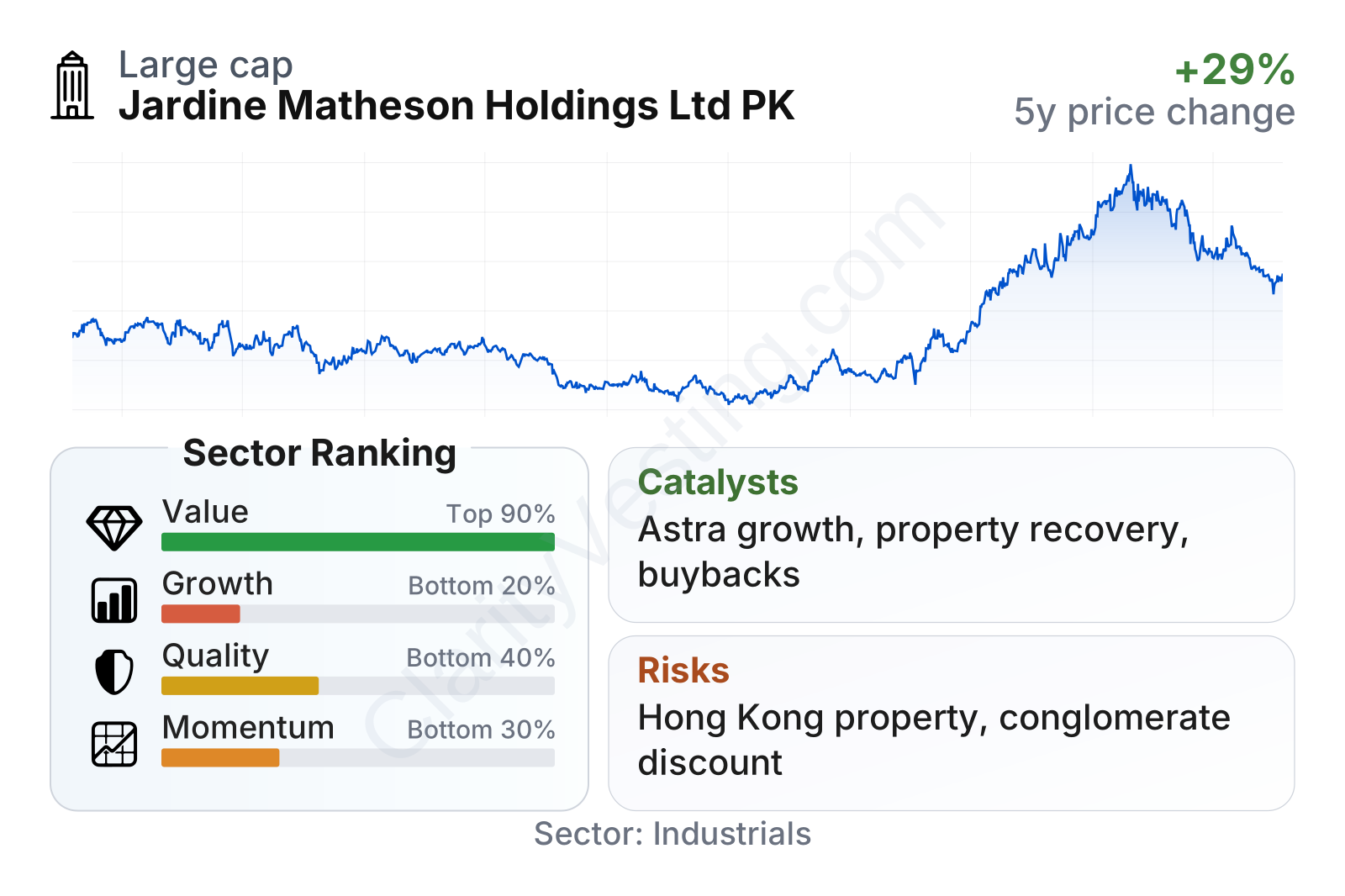
Jardine Matheson is a large-cap company with relatively low share-price volatility, reflected in a beta well below 1. On valuation measures, it screens cheaply versus much of the industrials sector: earnings multiple, price-to-book, cash flow yield, and EBIT-to-enterprise value all point to a lower market rating than the sector median. The main reason is not hard to see in the broader metrics. Growth ranks near the bottom of the sector, profitability is only moderate, and recent market momentum has been weak even after a strong rebound from 2025 into early 2026. In short, the table paints a picture of a diversified asset-heavy group that looks inexpensive on current fundamentals, but not because it is delivering fast expansion.
Growth
Jardine Matheson is exposed to sectors that can still grow over the long run, especially Southeast Asian consumption, Indonesian vehicle demand, financial services penetration, infrastructure, and selected urban property markets. Indonesia remains one of the most important engines inside the group because Astra has leading positions in autos, motorcycles exposure through affiliates, heavy equipment, mining services, and consumer-linked financing. That gives Jardine Matheson access to rising middle-class spending and industrial activity in one of Asia’s largest economies.
The strategy also has a practical logic. Instead of making a single large bet, the group spreads capital across businesses that can balance one another. Retail and health and beauty offer recurring consumer demand. Property adds high-quality asset backing. Automotive and equipment bring cyclical upside when regional growth improves. Hotels and lifestyle assets can benefit from tourism recovery. Management has also continued to simplify parts of the portfolio over time and emphasize capital discipline, which matters for a conglomerate where hidden value can remain trapped if assets are not managed actively.
A recent positive sign is the recovery in operating income and net income in 2025 after a very weak 2024. Even though sales were slightly lower, margins improved sharply, suggesting that the group’s earnings power can rebound when pressure eases across key subsidiaries. Another supportive element is the continued reopening and normalization of travel, consumption, and leasing activity across Asian markets after several uneven years. For a business with exposure to premium offices, hotels, retail traffic, autos, and financing, a more stable regional backdrop can lift multiple divisions at once.
One more possible catalyst is valuation-sensitive corporate action. Jardine Matheson has often traded at a large discount to the value of its underlying holdings, and that can increase pressure for buybacks, portfolio reshaping, or deeper restructuring steps over time. This is not a near-certainty, but it is an important part of the long-term growth debate because conglomerates sometimes create value less through rapid sales growth and more through better capital allocation.
Risks
This article is for informational purposes only and does not constitute financial advice. Some content is AI-generated. See Disclaimer


