Stock Analysis · Jones Lang LaSalle Incorporated (JLL)
Overview
Jones Lang LaSalle Incorporated, known as JLL, is a global real estate services company. Instead of mainly owning buildings like a traditional property landlord, JLL makes most of its money by advising clients, managing properties and workplaces, arranging leasing and investment transactions, and providing real estate capital through investment management. Its customers include large corporations, property owners, developers, governments, and institutional investors.
JLL’s business mix is spread across several service lines, which helps reduce dependence on any single activity, although transaction-related revenue still matters a lot when property markets are active or weak. Based on the company’s latest annual reporting structure, the main revenue sources are approximately:
- Work Dynamics – about 45% to 50%: workplace management, property operations, project management, and outsourcing services for large occupiers.
- Markets Advisory – about 20% to 25%: leasing, property management, valuation, and other advisory services tied to office, industrial, retail, and other commercial assets.
- Capital Markets – about 15% to 20%: investment sales, debt advisory, loan sales, equity placement, and related transaction services.
- JLL Technologies and other service revenue – low single-digit share: technology-enabled real estate solutions and software-related offerings.
- LaSalle Investment Management – about 5% to 10%: investment management fees, incentive fees, and other income tied to assets managed for institutional clients.
This mix matters because the more recurring outsourcing and management revenue JLL has, the less exposed it is to the sharp ups and downs of commercial property transaction volumes. Over the last several years, revenue has expanded meaningfully, but earnings have been more uneven because margins are thin and sentiment in commercial real estate can change quickly.
The long-term pattern shows a business that has lifted revenue strongly since 2021, with operating profit and net income recovering after a weak 2023. The main pressure point remains overhead: selling and administrative costs absorb a large share of gross profit, which is typical for a people-intensive services company.
Key Figures
| Metric | Value | Sector ⓘ |
|---|---|---|
| Date | Oct 04, 2026 | |
| Context | ||
| Sector | Real Estate | |
| Industry | Real Estate Services | |
| Market Cap ⓘ | $14.12B | |
| Beta ⓘ | 1.24 | |
Value (Cheapness) | ||
| P/E Ratio ⓘ | 14.71 | 17.35 |
| P/B Ratio ⓘ | 1.98 | 0.86 |
| FCF Yield ⓘ | 8.82% | 7.47% |
| Dividend Yield ⓘ | N/A | 4.75% |
| EBIT / EV ⓘ | 7.13% | 3.81% |
| PEG ⓘ | 0.74 | |
Growth (Business expansion) | ||
| Revenue Growth ⓘ | 10.80% | 5.30% |
| RPS Growth (5Y CAGR) ⓘ | 9.80% | 5.96% |
| EPS Growth (5Y CAGR) ⓘ | -14.61% | -11.41% |
| BVPS Growth (5Y CAGR) ⓘ | 7.51% | 0.41% |
| Margin Growth (5Y Trend) ⓘ | -1.66% | 0.53% |
| FCF Growth (5Y CAGR) ⓘ | 5.28% | 5.40% |
| DPS Growth (5Y CAGR) ⓘ | N/A | 5.02% |
Quality (Business durability) | ||
| ROIC (Latest) ⓘ | 10.74% | 5.77% |
| ROE (Latest) ⓘ | 13.90% | 7.64% |
| ROA (Latest) ⓘ | 5.77% | 2.85% |
| ROIC (5Y Median) ⓘ | 9.61% | 4.20% |
| ROE (5Y Median) ⓘ | 11.05% | 6.03% |
| ROA (5Y Median) ⓘ | 4.21% | 2.45% |
| Net Debt / EBIT (Latest) ⓘ | 1.59 | 7.57 |
| Net Debt / EBIT (5Y Median) ⓘ | 2.69 | 8.41 |
| Net Debt / EBITDA (Latest) ⓘ | 1.35 | 5.12 |
| Net Debt / Assets ⓘ | 11.80% | 37.84% |
| EBITDA / Interest ⓘ | 16.81 | 4.11 |
| Operating Margin (Latest) ⓘ | 4.73% | 35.40% |
| Operating Margin (5Y Median) ⓘ | 4.17% | 36.59% |
| Debt to Equity (Latest) ⓘ | 33.75% | 89.06% |
| Profit Margin (Latest) ⓘ | 3.64% | 19.99% |
| Free Cash Flow (Latest) ⓘ | $1.25B | |
Momentum (Price trend) | ||
| 3Y Return ⓘ | +129.70% | +30.66% |
| 12M Return (excl. last month) ⓘ | +16.11% | +7.55% |
| 6M Return ⓘ | +0.25% | +0.69% |
| Price vs. 200-Day MA ⓘ | -6.35% | -2.27% |
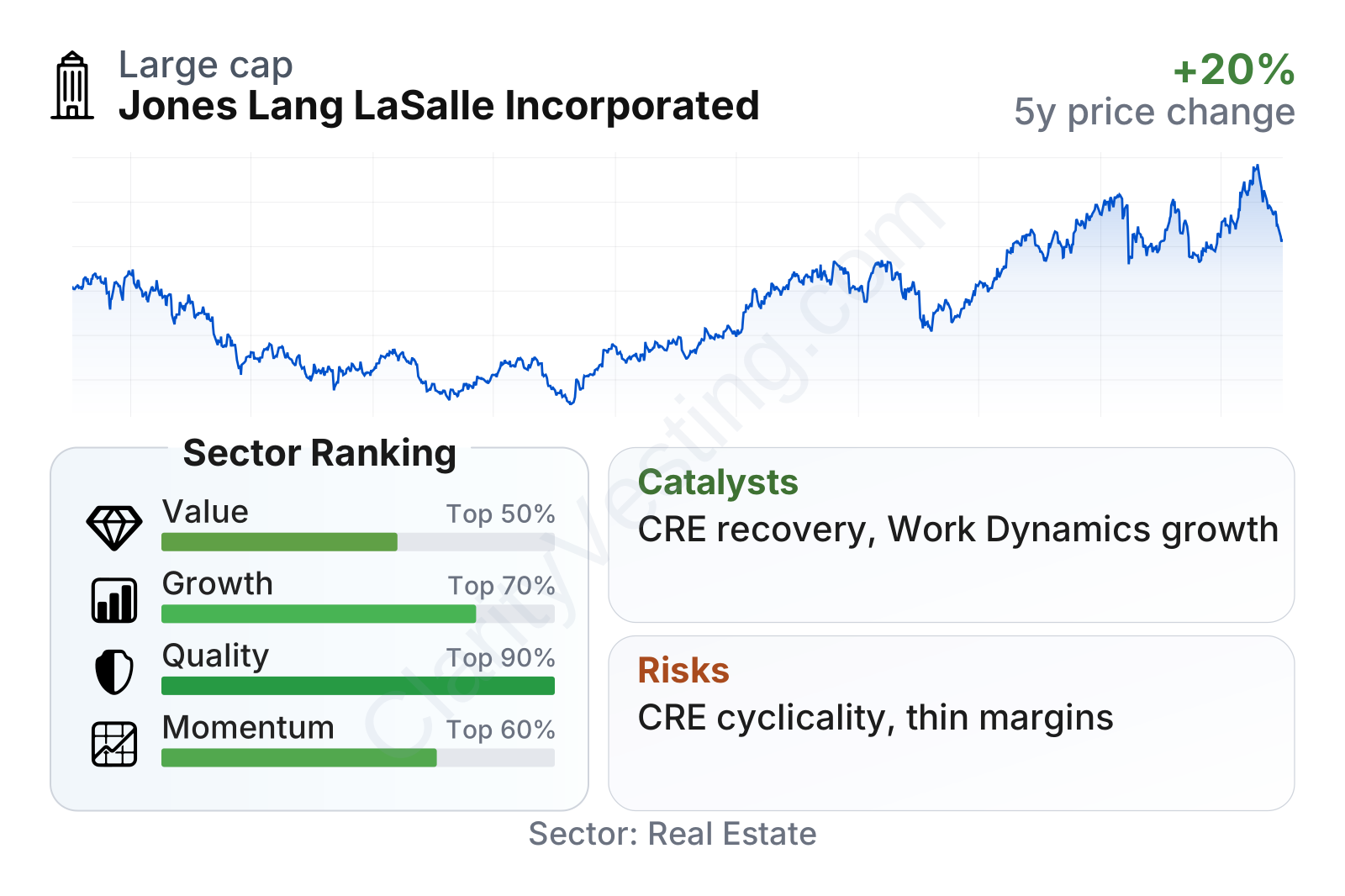
JLL is a large real estate services company with above-average share-price volatility. On valuation, earnings multiples are not stretched relative to the sector, and cash generation compares well with peers. The strongest area is business quality: returns on capital, returns on equity, asset efficiency, interest coverage, and leverage all look materially better than sector medians. Growth is more mixed. Revenue has outpaced the sector, but earnings over the last five years have been choppy, reflecting the cyclical nature of transaction markets and the company’s modest margins.
Growth
JLL operates in a sector that should remain structurally important for a long time, even if it is cyclical. Large companies still need offices, industrial facilities, data-related infrastructure, project management, energy upgrades, lease administration, and property operations. On top of that, real estate owners increasingly outsource complex functions to specialist firms with global reach. That trend supports JLL’s larger outsourcing and workplace services platform.
Its strategy also makes sense for future growth because it is not relying on just one real estate theme. Management has been building a more balanced company across occupier services, investor services, capital markets, and investment management. That reduces reliance on pure dealmaking. The company has also continued to invest in technology, workplace solutions, and project management, which are areas that can benefit from corporate cost control, office redesign, sustainability work, and portfolio optimization.
Revenue per share has moved steadily higher over the last five years, which is a useful sign for long-term business expansion. That trend suggests JLL has been growing not only through market recovery but also through a broader service footprint.
Dividend history is not a central part of the JLL case. The company suspended and later resumed a small payout, so the financial profile is better understood through earnings power, cash flow, and balance-sheet discipline rather than income distribution.
A meaningful catalyst is any sustained recovery in commercial real estate transaction activity. When investment sales, leasing, and financing markets improve, JLL’s higher-margin advisory businesses can rebound quickly. Another catalyst is the continued growth of outsourcing through Work Dynamics, where large enterprises hand over more real estate functions to external specialists. A third support comes from private capital and institutional asset management through LaSalle, especially if fundraising and deployment conditions improve.
Recent company updates have pointed to improving operating conditions in parts of the business, especially where leasing, project management, and capital markets activity have started to recover from a depressed base. JLL has also continued to highlight demand linked to workplace transformation, cost optimization, and capital project execution, which can support growth even when some parts of the office market remain under pressure.
Risks
This article is for informational purposes only and does not constitute financial advice. Some content is AI-generated. See Disclaimer