Stock Analysis · J & J Snack Foods Corp (JJSF)
Overview
J & J Snack Foods Corp is a branded snack and beverage company focused on food sold away from home, plus selected retail channels. Its products are familiar to many consumers even if the company name is less well known than some of its brands. The group sells frozen beverages, soft pretzels, churros, handheld frozen novelties, bakery items, and other snack foods to schools, convenience stores, movie theaters, amusement venues, stadiums, restaurants, warehouse clubs, supermarkets, and mass retailers.
The business is organized into three main segments. Based on the latest annual filing for fiscal 2025, revenue is roughly split as follows:
- Food Service: about 64% — soft pretzels, churros, frozen juice treats, bakery products, funnel cakes, and other items sold through restaurants, schools, entertainment venues, travel locations, and convenience channels.
- Retail Supermarkets: about 27% — packaged frozen and snack products sold through grocery and mass retail, including items such as SuperPretzel, ICEE at home products, Luigi’s Italian Ice, and related offerings.
- Frozen Beverages: about 9% — beverage syrups, equipment, service, and related sales tied mainly to ICEE and SLUSH PUPPIE machines placed at customer locations.
That mix matters because it gives J & J Snack Foods exposure to both everyday grocery demand and higher-traffic impulse purchases in venues where consumers often pay for convenience and branded treats. It also means the company is not dependent on a single product line, although a meaningful share still comes from a relatively narrow set of snack categories.
The broader profit picture shows a business that expanded strongly through 2024, then saw pressure in 2025 as costs and margins moved the wrong way. Revenue has stayed relatively stable at around the mid-$1.5 billion range in recent years, but net income has been more volatile, which is a key point for long-term analysis.
The operating profile improved materially from 2022 to 2024, with better gross profit and operating income, but fiscal 2025 showed a clear step back in profitability even though sales were still near prior highs. That suggests the main issue recently has been margin pressure rather than a collapse in demand.
Key Figures
| Metric | Value | Sector ⓘ |
|---|---|---|
| Date | Oct 17, 2026 | |
| Context | ||
| Sector | Consumer Defensive | |
| Industry | Packaged Foods | |
| Market Cap ⓘ | $1.50B | |
| Beta ⓘ | 0.41 | |
Value (Cheapness) | ||
| P/E Ratio ⓘ | 30.76 | 17.88 |
| P/B Ratio ⓘ | 1.70 | 1.29 |
| FCF Yield ⓘ | 6.13% | 12.39% |
| Dividend Yield ⓘ | 3.94% | 2.85% |
| EBIT / EV ⓘ | 3.70% | 6.43% |
| PEG ⓘ | 5.12 | |
Growth (Business expansion) | ||
| Revenue Growth ⓘ | -6.20% | 4.10% |
| RPS Growth (5Y CAGR) ⓘ | 7.87% | 6.18% |
| EPS Growth (5Y CAGR) ⓘ | -0.46% | -13.59% |
| BVPS Growth (5Y CAGR) ⓘ | 2.85% | 3.20% |
| Margin Growth (5Y Trend) ⓘ | -0.91% | -0.15% |
| FCF Growth (5Y CAGR) ⓘ | 14.46% | 4.10% |
| DPS Growth (5Y CAGR) ⓘ | 7.34% | 6.79% |
Quality (Business durability) | ||
| ROIC (Latest) ⓘ | 5.39% | 12.34% |
| ROA (Latest) ⓘ | 3.60% | 6.30% |
| ROIC (5Y Median) ⓘ | 6.94% | 10.49% |
| ROA (5Y Median) ⓘ | 4.97% | 5.44% |
| Net Debt / EBIT (Latest) ⓘ | 2.07 | 1.96 |
| Net Debt / EBIT (5Y Median) ⓘ | 0.66 | 2.35 |
| Net Debt / EBITDA (Latest) ⓘ | 0.93 | 1.38 |
| Net Debt / Assets ⓘ | 9.50% | 21.51% |
| EBITDA / Interest ⓘ | 63.79 | 9.46 |
| Operating Margin (Latest) ⓘ | 4.09% | 8.87% |
| Operating Margin (5Y Median) ⓘ | 6.47% | 9.53% |
| Debt to Equity (Latest) ⓘ | 21.51% | 72.35% |
| Profit Margin (Latest) ⓘ | 3.23% | 5.40% |
| Free Cash Flow (Latest) ⓘ | $92.00M | |
Momentum (Price trend) | ||
| 3Y Return ⓘ | -42.60% | +20.92% |
| 12M Return (excl. last month) ⓘ | -16.81% | +2.13% |
| 6M Return ⓘ | +0.20% | +1.26% |
| Price vs. 200-Day MA ⓘ | +0.09% | +1.39% |
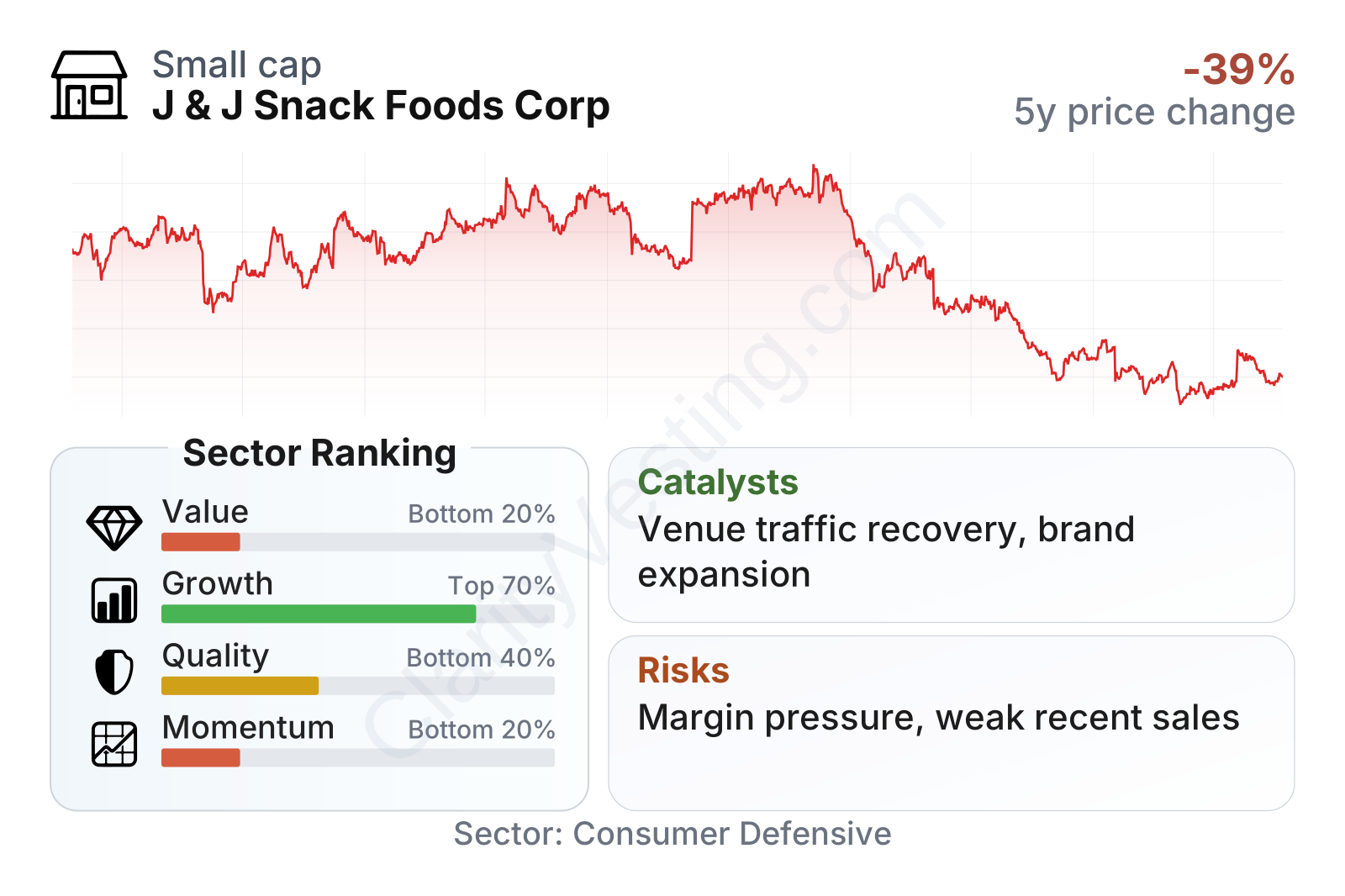
J & J Snack Foods is a small-cap consumer staples company with relatively low share-price volatility, as shown by its beta well below 1. The balance sheet looks conservative, but the broader metrics are mixed. Valuation measures sit on the expensive side versus the sector, while quality scores are held back by below-median returns on capital and weaker profitability. Growth indicators are uneven: the long-term record in revenue per share and free cash flow is decent, but the most recent year-over-year sales trend has turned negative. Market performance has also been weak compared with peers, which reflects the pressure on earnings and sentiment.
Growth
J & J Snack Foods operates in a resilient part of the consumer market. People continue to buy affordable treats and convenience foods even in slower economic periods, and the company’s products are often low-ticket purchases tied to impulse buying. That does not make the business fast-growing by nature, but it does support a steady long-term demand base. The more attractive growth angle comes from channel expansion, product innovation, and further use of its brands across both foodservice and retail shelves.
The company’s strategy is logical for this type of business. It owns recognizable brands, has a broad distribution footprint, and participates in categories where location matters. Products sold in stadiums, movie theaters, schools, convenience stores, and family entertainment venues can benefit when foot traffic improves. Retail also gives it a second route to growth, especially when successful foodservice brands are extended into grocery freezers.
The recent pattern has clearly cooled. After a strong post-pandemic rebound and solid gains through much of 2023, sales growth slowed and then turned negative across several recent quarters. That does not erase the longer-term expansion, but it does show that the company is in a softer phase and needs either stronger volumes, better pricing, or both to reaccelerate.
Cash generation is a more encouraging part of the picture. Free cash flow moved from negative territory in earlier periods to solidly positive levels over the last few years, and the latest trailing figure remains healthy. That matters because cash flow supports dividends, capital spending, and operational flexibility even when earnings are under pressure.
A notable catalyst is the company’s exposure to away-from-home consumption. If traffic trends improve in schools, convenience, travel, and entertainment venues, J & J Snack Foods has a built-in way to benefit. Another support is the frozen beverage platform, where equipment placements and syrup sales create a recurring element to the business. Recent company communications have also emphasized brand support, product launches, and distribution gains, which fit well with the company’s long-standing operating model.
Risks
This article is for informational purposes only and does not constitute financial advice. Some content is AI-generated. See Disclaimer


