Stock Analysis · James Hardie Industries PLC (JHX)
Overview
James Hardie Industries PLC is a building materials company best known for fiber cement siding and backer board products used in residential construction and remodeling. In simple terms, it makes exterior and interior products designed to replace or compete with wood, vinyl, stucco, and other traditional materials. Its products are used mainly on homes, especially in North America, where durability, fire resistance, moisture resistance, and lower maintenance are important selling points.
The company’s business is heavily concentrated in fiber cement and related home-building products rather than in a broad mix of construction categories. Based on its latest annual reporting, revenue is mainly generated from the following segments:
- North America Fiber Cement: approximately 70% to 75% of revenue. This includes siding, trim, soffit, and backer board products sold into new residential construction and repair-and-remodel markets in the U.S. and Canada.
- Asia Pacific Fiber Cement: approximately 15% to 20% of revenue. This business is centered on Australia, New Zealand, and the Philippines, with products used in exterior cladding and interior applications.
- Europe Building Products: approximately 5% to 10% of revenue. This mainly includes fiber gypsum and related interior building solutions through the Fermacell business.
- Other / eliminations: a small remaining share tied to corporate items and intersegment effects.
That mix matters because it shows James Hardie is largely tied to North American housing activity. It also helps explain why the company can grow faster than more diversified building-materials groups when U.S. siding demand is strong, but can also feel pressure when housing slows.
Over the last several years, the business had been able to maintain solid gross profit even when revenue growth became uneven. More recently, revenue moved sharply higher, but operating income and net income came under pressure, suggesting that integration costs, overhead, financing costs, or acquisition-related effects have weighed on the bottom line more than on sales.
The visual breakdown highlights a business that still converts a large portion of sales into gross profit, but with much heavier operating and interest burdens in the latest period than in earlier years. That shift is important because it changes how much of each dollar of revenue is reaching shareholders as profit.
Key Figures
| Metric | Value | Sector ⓘ |
|---|---|---|
| Date | Oct 22, 2026 | |
| Context | ||
| Sector | Basic Materials | |
| Industry | Building Materials | |
| Market Cap ⓘ | $15.27B | |
| Beta ⓘ | 1.06 | |
Value (Cheapness) | ||
| P/E Ratio ⓘ | 105.20 | 16.92 |
| P/B Ratio ⓘ | 2.35 | 1.66 |
| FCF Yield ⓘ | 2.32% | 5.83% |
| Dividend Yield ⓘ | N/A | 2.07% |
| EBIT / EV ⓘ | 2.36% | 6.38% |
| PEG ⓘ | 1.24 | |
Growth (Business expansion) | ||
| Revenue Growth ⓘ | 63.90% | 11.25% |
| RPS Growth (5Y CAGR) ⓘ | 2.26% | 4.49% |
| EPS Growth (5Y CAGR) ⓘ | -31.58% | -15.24% |
| BVPS Growth (5Y CAGR) ⓘ | 40.89% | 5.49% |
| Margin Growth (5Y Trend) ⓘ | -9.83% | -1.54% |
| FCF Growth (5Y CAGR) ⓘ | -19.79% | 0.37% |
| DPS Growth (5Y CAGR) ⓘ | N/A | 5.91% |
Quality (Business durability) | ||
| ROIC (Latest) ⓘ | 2.73% | 9.59% |
| ROA (Latest) ⓘ | 1.06% | 4.92% |
| ROIC (5Y Median) ⓘ | 18.92% | 7.91% |
| ROA (5Y Median) ⓘ | 10.86% | 3.92% |
| Net Debt / EBIT (Latest) ⓘ | 9.05 | 1.36 |
| Net Debt / EBIT (5Y Median) ⓘ | 1.22 | 1.69 |
| Net Debt / EBITDA (Latest) ⓘ | 3.94 | 0.93 |
| Net Debt / Assets ⓘ | 31.36% | 13.69% |
| EBITDA / Interest ⓘ | 4.21 | 12.38 |
| Operating Margin (Latest) ⓘ | 8.64% | 13.24% |
| Operating Margin (5Y Median) ⓘ | 18.88% | 11.82% |
| Debt to Equity (Latest) ⓘ | 69.14% | 40.30% |
| Profit Margin (Latest) ⓘ | 2.69% | 6.38% |
| Free Cash Flow (Latest) ⓘ | $353.48M | |
Momentum (Price trend) | ||
| 3Y Return ⓘ | +6.95% | +73.47% |
| 12M Return (excl. last month) ⓘ | +38.30% | +27.59% |
| 6M Return ⓘ | +19.17% | -4.02% |
| Price vs. 200-Day MA ⓘ | +8.68% | -0.65% |
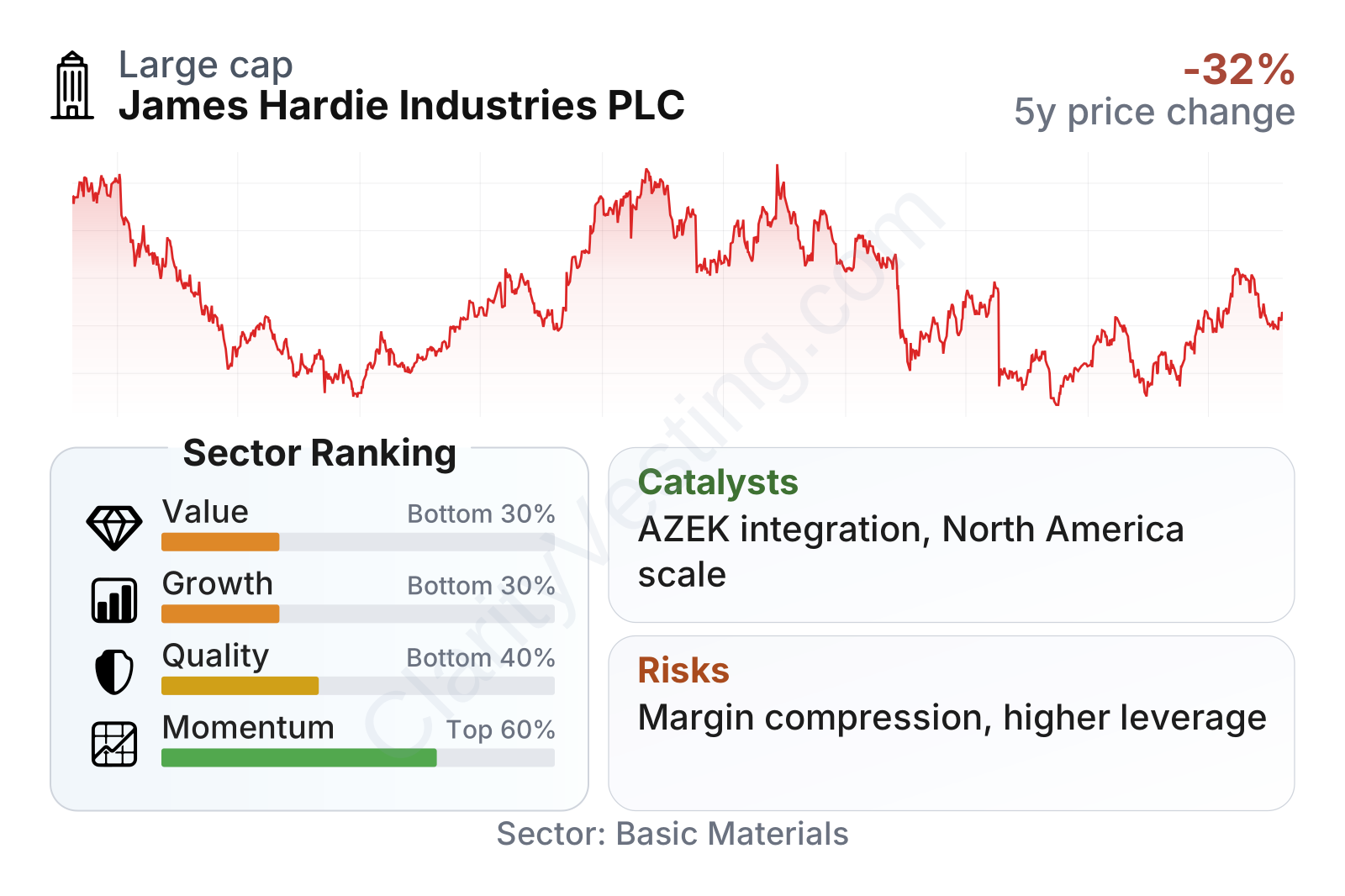
James Hardie is a large building materials company with market behavior close to the broader market, but its current fundamentals look mixed. Recent momentum has improved, yet value, growth, and quality metrics rank below much of the sector. The biggest weak points are the very high earnings multiple, lower free cash flow yield, and weaker current profitability versus sector medians. The longer-term record is better than the latest snapshot in areas like historical returns on capital and operating margins, which suggests the company has been through a meaningful earnings reset rather than a permanently weak business model.
Growth
James Hardie operates in a sector with long-term support from housing construction, remodeling, repair, and the gradual replacement of older exterior materials. Fiber cement has structural appeal because it offers a combination of durability and lower maintenance that fits well with both homeowners and builders. Even in a slower housing market, repair-and-remodel demand can provide some support, although it does not fully remove cyclical risk.
The company’s strategy has generally made sense for growth. It has focused on expanding distribution, increasing penetration with builders and contractors, supporting premium product lines, and broadening its addressable market beyond traditional siding. Management has also emphasized commercial and adjacent product opportunities, while recent corporate actions have aimed to increase scale and category reach. In principle, that can deepen its position with distributors and contractors and make the company more relevant across more parts of the building envelope.
Revenue growth has not been smooth. After a period of declines and low growth, the latest reported periods show a sharp rebound, including growth far above the sector median. That kind of acceleration suggests the company has recently benefited from a major business change rather than just normal housing demand. For long-term analysis, the key question is whether this stronger sales base can translate into healthier margins later on.
Cash generation remains positive, but it has been uneven. Free cash flow recovered strongly after a weak period, then softened again in the latest trailing twelve months. This matters because a company in building materials ultimately needs to turn sales into cash through the cycle. Positive free cash flow is a good sign, but the recent downshift means growth is not currently flowing through as efficiently as sales growth alone might suggest.
A notable recent catalyst is James Hardie’s combination with The AZEK Company, announced in 2025 and reflected in the company’s more recent scale. Strategically, that deal expands James Hardie further into exterior residential products and gives it a broader platform across siding, trim, decking, and outdoor living categories. If integration goes well, this could create cross-selling opportunities, wider contractor relationships, and stronger influence with channel partners. That is likely the clearest company-specific growth opportunity in front of the business today.
Risks
This article is for informational purposes only and does not constitute financial advice. Some content is AI-generated. See Disclaimer


