Stock Analysis · James Hardie Industries plc (JHIUF)
Overview
James Hardie Industries plc is a building materials company best known for fiber cement products used on the outside of homes and buildings. Its main products include siding, backerboard, trim, and other exterior solutions designed to resist moisture, fire, pests, and weather damage. The business is closely tied to residential construction and remodeling, especially in North America, where fiber cement has become a well-established alternative to wood and vinyl.
The company’s revenue base is concentrated in a few operating segments. Based on its latest annual reporting, the mix is approximately as follows:
- North America Fiber Cement: about 80% of revenue. This is the core business and includes siding, trim, soffit, panels, and backerboard sold mainly into new residential construction and repair-and-remodel markets.
- Asia Pacific Fiber Cement: about 10% to 12% of revenue. This includes similar exterior and interior fiber cement products, with Australia and New Zealand as key markets.
- Europe Building Products: about 5% to 7% of revenue. This segment is smaller and includes fiber gypsum and related interior building products.
- Other revenue and adjustments: the remainder, generally a low-single-share portion of total sales, coming from smaller product lines and corporate-level items.
That concentration matters: James Hardie is not a broad industrial conglomerate. It is essentially a focused specialist in a category where scale, brand recognition, contractor relationships, and manufacturing know-how are important.
The business also shows a clear pattern in its cost structure. Revenue has expanded meaningfully over the last several years, gross profit has remained substantial, and operating income has held up better than net income. The sharp drop in net income in the latest fiscal year appears more connected to higher interest expense and acquisition-related financing effects than to a collapse in the underlying operating business.
Key Figures
| Metric | Value | Sector ⓘ |
|---|---|---|
| Date | Oct 17, 2026 | |
| Context | ||
| Sector | Basic Materials | |
| Industry | Building Materials | |
| Market Cap ⓘ | $16.19B | |
| Beta ⓘ | 1.06 | |
Value (Cheapness) | ||
| P/E Ratio ⓘ | 111.56 | 16.90 |
| P/B Ratio ⓘ | 0.00 | 1.65 |
| FCF Yield ⓘ | 2.19% | 5.76% |
| Dividend Yield ⓘ | N/A | 2.13% |
| EBIT / EV ⓘ | 3.55% | 6.30% |
| PEG ⓘ | 1.23 | |
Growth (Business expansion) | ||
| Revenue Growth ⓘ | 63.90% | 11.10% |
| RPS Growth (5Y CAGR) ⓘ | 2.26% | 4.49% |
| EPS Growth (5Y CAGR) ⓘ | 11.70% | -13.47% |
| BVPS Growth (5Y CAGR) ⓘ | 40.89% | 5.51% |
| Margin Growth (5Y Trend) ⓘ | -3.58% | -1.54% |
| FCF Growth (5Y CAGR) ⓘ | -19.79% | 0.37% |
| DPS Growth (5Y CAGR) ⓘ | N/A | 6.08% |
Quality (Business durability) | ||
| ROIC (Latest) ⓘ | 4.07% | 9.26% |
| ROA (Latest) ⓘ | 1.06% | 4.91% |
| ROIC (5Y Median) ⓘ | 18.73% | 7.70% |
| ROA (5Y Median) ⓘ | 10.86% | 3.86% |
| Net Debt / EBIT (Latest) ⓘ | 6.02 | 1.40 |
| Net Debt / EBIT (5Y Median) ⓘ | 1.20 | 1.70 |
| Net Debt / EBITDA (Latest) ⓘ | 3.23 | 0.95 |
| Net Debt / Assets ⓘ | 31.36% | 13.69% |
| EBITDA / Interest ⓘ | 5.10 | 12.34 |
| Operating Margin (Latest) ⓘ | 12.99% | 13.20% |
| Operating Margin (5Y Median) ⓘ | 19.15% | 11.80% |
| Debt to Equity (Latest) ⓘ | 69.14% | 40.56% |
| Profit Margin (Latest) ⓘ | 2.69% | 6.43% |
| Free Cash Flow (Latest) ⓘ | $354.19M | |
Momentum (Price trend) | ||
| 3Y Return ⓘ | +11.34% | +68.89% |
| 12M Return (excl. last month) ⓘ | +31.43% | +30.21% |
| 6M Return ⓘ | +36.72% | -4.16% |
| Price vs. 200-Day MA ⓘ | +16.06% | -1.27% |
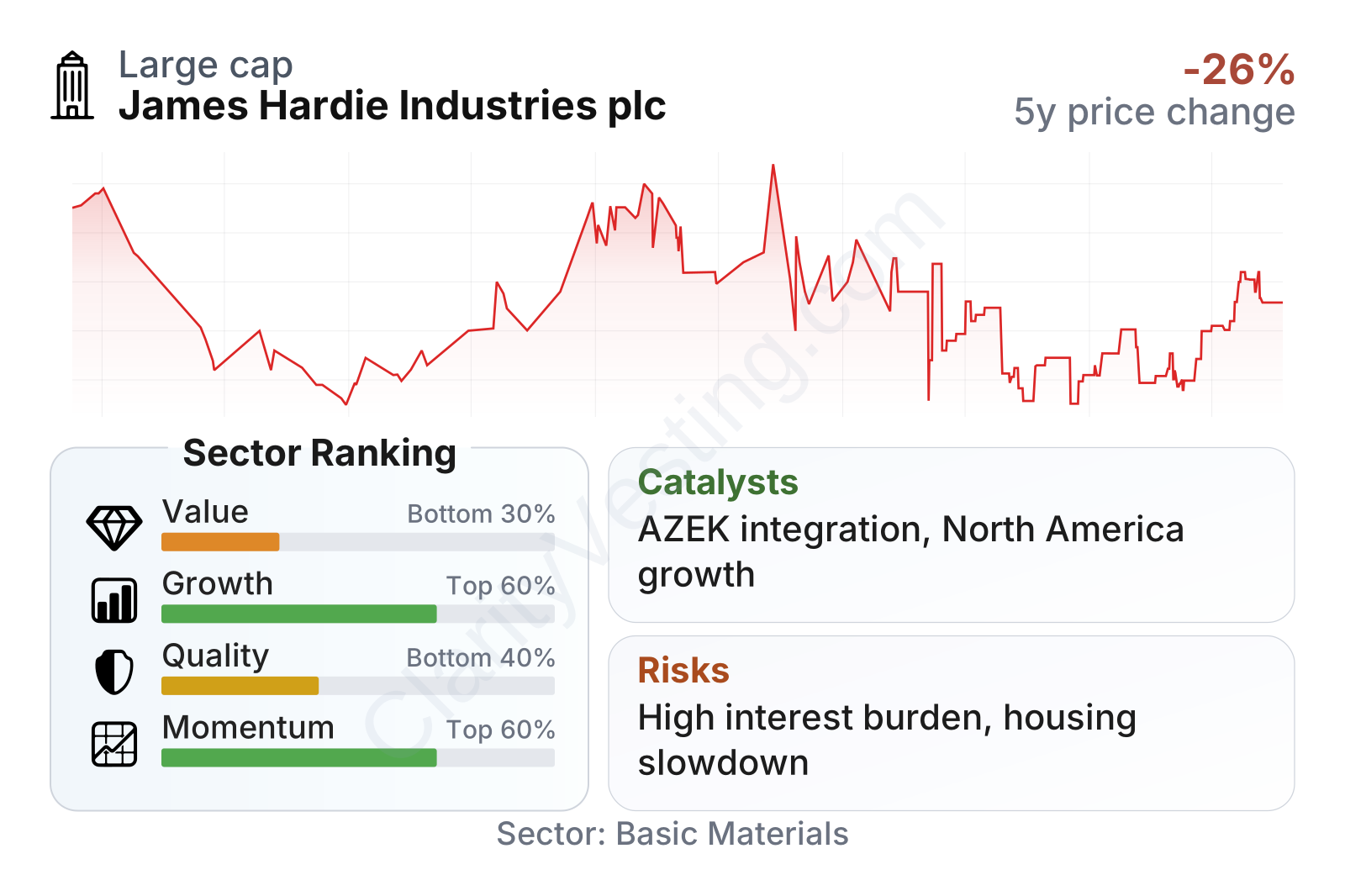
James Hardie is a large building materials company with share-price volatility close to the broader market. The factor breakdown paints a mixed picture. Growth and recent momentum look better than much of the sector, but value and current quality measures look weaker. The market is assigning a rich earnings multiple, while free cash flow yield and EBIT relative to enterprise value sit below sector norms. At the same time, longer-term profitability history has been stronger than the latest trailing figures suggest, which points to a business that may be in a temporary transition period rather than a structurally weak one.
The stock-price history also reflects that uneven profile. After several years without major sustained appreciation, the shares experienced a steep decline and then a sharp rebound. That kind of movement usually signals that the market is reassessing the company’s future earnings power, financing profile, or integration outlook rather than simply reacting to normal quarterly noise.
Growth
James Hardie operates in a sector with long-duration demand drivers. Residential construction, home renovation, aging housing stock, storm repair, and a gradual shift toward more durable exterior materials all support demand over time. Fiber cement products can benefit when builders and homeowners prioritize lower maintenance, fire resistance, and durability. These are not short-lived trends, and they give the company exposure to both new construction and replacement spending.
The company’s strategy also has a clear industrial logic. Its core approach has been to deepen penetration of fiber cement in North America, expand its product system around the exterior of the home, and use scale to support manufacturing, distribution, and contractor adoption. This strategy makes sense because building products often become stronger businesses when they are embedded in installer habits and local distribution networks rather than sold as easily interchangeable commodities.
A more recent growth lever is portfolio expansion through acquisition. The combination with AZEK materially increases James Hardie’s exposure to premium exterior living products such as decking, railing, and related categories. If integration is successful, that can broaden the company beyond siding and create cross-selling opportunities across builders, dealers, and homeowners. It also gives James Hardie a larger role in the full exterior envelope and outdoor living space, where consumer spending can be attractive during healthy housing cycles.
Near-term growth looks stronger than the company’s longer five-year revenue-per-share trend. That suggests recent expansion has accelerated, but it also means observers should separate temporary boosts from durable organic gains. Earnings per share growth over five years has been solid, and book value per share has risen strongly, indicating that the company has historically created value even if revenue growth has not always been smooth.
Cash generation is an area to watch closely. Free cash flow remains positive, but the longer-run pattern has been less impressive than the company’s accounting profit history. For a building products manufacturer, strong cash conversion is important because the business needs to fund plants, logistics, and working capital through housing cycles. A recovery in cash generation would strengthen the growth case, especially after a period of major strategic expansion.
One notable recent development is the scale of revenue in the latest fiscal year, which moved materially higher. That indicates a significant step-up in the business footprint. If that larger revenue base can be matched with stable margins and better financing efficiency over time, James Hardie’s earnings power could look meaningfully different from the latest net income figure alone.
Risks
This article is for informational purposes only and does not constitute financial advice. Some content is AI-generated. See Disclaimer