Stock Analysis · Crown Holdings Inc (CCK)
Overview
Crown Holdings is a global packaging company best known for making metal cans and closures used for beverages, food, household products, and personal care items. In practical terms, it manufactures the containers that large consumer brands rely on to move products through stores, restaurants, and distribution networks. Its business is tied less to fashion or fast-changing technology and more to steady everyday consumption, especially drinks and packaged food.
The company’s revenue is mainly generated by selling packaging products across a few large operating groups. Based on recent annual reporting, the mix is approximately as follows:
- Americas Beverage — about 39% of revenue. This includes aluminum beverage cans, ends, and related packaging sold mainly in North and South America.
- European Beverage — about 19% of revenue. This segment serves beverage producers across Europe with metal cans and ends.
- Transit Packaging — about 16% of revenue. This business includes protective packaging and related machinery used to secure goods in transit, largely through the Signode platform.
- Asia Pacific — about 14% of revenue. This includes beverage cans as well as food and specialty packaging in Asian markets.
- Other — about 12% of revenue. This bucket includes food cans, aerosol cans, closures, and tooling, along with smaller corporate and non-reportable activities.
This mix matters because beverage cans are the center of Crown’s earnings profile. That gives the company exposure to a product category with recurring demand, while the transit packaging business adds some diversification beyond consumer packaging.
The long-term business model is straightforward: Crown invests heavily in manufacturing plants, signs supply relationships with large customers, and aims to earn attractive returns through scale, efficiency, and high production volumes. The latest financial flow also shows a business with very large input costs relative to sales, which is typical in packaging, but operating profit has improved materially since 2021 even though net income has remained more affected by interest expense.
Key Figures
| Metric | Value | Sector ⓘ |
|---|---|---|
| Date | Sep 12, 2026 | |
| Context | ||
| Sector | Consumer Cyclical | |
| Industry | Packaging & Containers | |
| Market Cap ⓘ | $12.25B | |
| Beta ⓘ | 0.57 | |
Value (Cheapness) | ||
| P/E Ratio ⓘ | 16.23 | 17.10 |
| FCF Yield ⓘ | 9.63% | 8.53% |
| EBIT / EV ⓘ | 9.14% | 6.46% |
| PEG ⓘ | 0.66 | |
Growth (Business expansion) | ||
| Revenue Growth ⓘ | 16.50% | 5.75% |
| RPS Growth (5Y CAGR) ⓘ | 5.15% | 9.14% |
| EPS Growth (5Y CAGR) ⓘ | -11.77% | -18.21% |
| Margin Growth (5Y Trend) ⓘ | 14.11% | -0.23% |
| FCF Growth (5Y CAGR) ⓘ | 87.41% | 4.91% |
Quality (Business durability) | ||
| ROIC (Latest) ⓘ | 13.35% | 12.61% |
| ROIC (5Y Median) ⓘ | 11.60% | 10.72% |
| Net Debt / EBIT (Latest) ⓘ | 3.43 | 2.10 |
| Net Debt / EBIT (5Y Median) ⓘ | 4.25 | 2.32 |
| Operating Margin (Latest) ⓘ | 12.33% | 9.25% |
| Operating Margin (5Y Median) ⓘ | 11.00% | 9.64% |
| Debt to Equity (Latest) ⓘ | 218.77% | 75.78% |
| Profit Margin (Latest) ⓘ | 5.91% | 5.33% |
| Free Cash Flow (Latest) ⓘ | $1.18B | |
Momentum (Price trend) | ||
| 3Y Return ⓘ | +30.52% | +14.53% |
| 12M Return (excl. last month) ⓘ | +20.28% | +3.08% |
| 6M Return ⓘ | +9.22% | +0.55% |
| Price vs. 200-Day MA ⓘ | +6.31% | -0.54% |
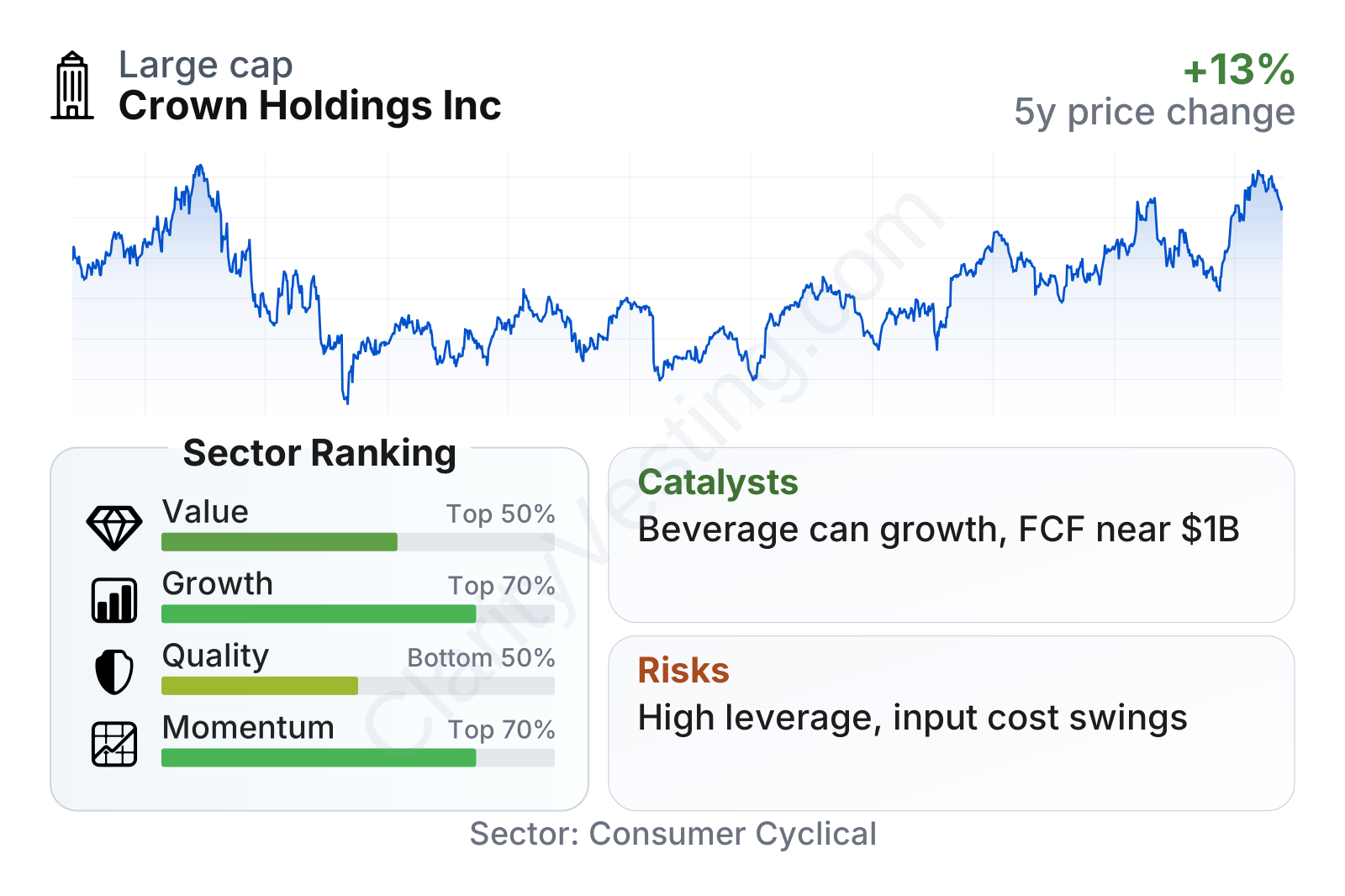
Crown sits in the large-cap range and its share price volatility has been relatively muted, with a beta well below 1. In the latest factor snapshot, the company looks strongest in growth and reasonably solid in value and momentum, while quality is held back by leverage. Operating profitability stands above the sector median, return on invested capital is slightly better than average, and free cash flow generation is meaningful. The main weakness is the balance sheet, where debt remains high compared with many peers even after improvement over the last few years.
Growth
Crown operates in a sector that is not usually thought of as fast-growing, but it can still produce durable expansion because packaging demand rises with population, urbanization, convenience consumption, and substitution toward cans in certain beverage categories. Aluminum beverage cans are especially important because they are lightweight, widely recycled, and favored by many drink brands for portability and shelf appeal. That does not guarantee rapid growth every year, but it does support a long runway for steady volume gains in selected markets.
The company’s strategy for future growth is coherent. Management has continued to focus on beverage can capacity, plant efficiency, and disciplined capital allocation, while also using transit packaging as a second engine. This approach makes sense because large customers value reliable supply, technical know-how, and geographic reach. Once a can supplier is embedded in a customer’s production system, switching is possible but not frictionless, which can support recurring business.
Recent revenue trends show a notable rebound after the softer period in 2023 and early 2024. The latest year-over-year growth rate has accelerated into the mid-teens, clearly ahead of the sector median. That does not necessarily mean a straight-line boom ahead, but it does indicate that demand and pricing conditions have improved from the prior slowdown.
Cash generation has strengthened even more dramatically. Free cash flow moved from negative territory in 2023 to roughly $1 billion on a trailing basis and has remained around that level. For a capital-intensive manufacturer, that is an important signal: it suggests the company is converting operating performance into cash that can be used for debt reduction, share repurchases, or reinvestment.
One meaningful catalyst is the continued expansion of canned beverage consumption across categories such as beer, soft drinks, sparkling water, energy drinks, and ready-to-drink products. Another is operational improvement: Crown’s operating margin trend over the last five years has been clearly positive, suggesting it has been getting more efficient even through uneven demand conditions. In addition, when a packaging producer already has global customer relationships and installed plant capacity, incremental volume can lift profitability faster than revenue.
Recent company updates have also pointed to continued investment in beverage packaging capacity and ongoing efforts to optimize the portfolio. For long-term analysis, that is more important than short-lived headline noise: Crown appears to be leaning into categories where scale and customer integration matter most.
Risks
This article is for informational purposes only and does not constitute financial advice. Some content is AI-generated. See Disclaimer


