Stock Analysis · John Wiley & Sons B (WLYB)
Overview
John Wiley & Sons is a long-established publishing and information company focused on academic research, higher education, and professional learning. Its business is much more specialized than a general book publisher. Wiley serves universities, researchers, corporations, and professionals by providing scientific journals, digital courseware, assessment tools, certification prep, and reference content. Over time, the company has been shifting away from lower-growth and less strategic activities and concentrating on digital, recurring, and knowledge-based products.
Based on Wiley’s latest fiscal year reporting for 2026, revenue is mainly generated from two operating segments, with a smaller contribution from held-for-sale or transitional activities. The mix is roughly as follows:
- Research: about 63% of revenue. This includes scholarly journals, open access publishing, content licensing, and data-driven services for the global academic and research market.
- Learning: about 35% of revenue. This includes academic course materials, digital education products, professional publishing, certification, and corporate learning-related solutions.
- Other / transitional activities: about 2% of revenue. This reflects smaller non-core operations and portfolio changes.
The business model has some attractive features for long-term analysis. Research revenue is usually subscription-based, contract-driven, and deeply embedded in university and institutional workflows. Learning is more exposed to enrollment patterns and product cycles, but Wiley has been trying to improve resilience by emphasizing digital products, inclusive access models, and career-oriented content. The business flow over recent years shows a clear pattern: total revenue has trended down, but operating expenses have been reduced even faster, helping margins recover strongly in fiscal 2026.
That cost structure shift is important. Since fiscal 2022, revenue has moved from just above $2.0 billion to about $1.68 billion, but operating expenses have fallen more sharply, and operating income rebounded from a loss in fiscal 2024 to a solid profit in fiscal 2026. This suggests the recent improvement has come less from top-line expansion and more from portfolio simplification, cost discipline, and better profitability in the remaining core business.
Key Figures
| Metric | Value | Sector ⓘ |
|---|---|---|
| Date | Sep 12, 2026 | |
| Context | ||
| Sector | Communication Services | |
| Industry | Publishing | |
| Market Cap ⓘ | $2.45B | |
| Beta ⓘ | 0.77 | |
Value (Cheapness) | ||
| P/E Ratio ⓘ | 13.04 | 18.61 |
| FCF Yield ⓘ | 8.63% | 13.68% |
| EBIT / EV ⓘ | 7.41% | 4.54% |
| PEG ⓘ | 13.40 | |
Growth (Business expansion) | ||
| Revenue Growth ⓘ | -2.60% | 5.40% |
| RPS Growth (5Y CAGR) ⓘ | -3.83% | 4.62% |
| EPS Growth (5Y CAGR) ⓘ | -48.71% | -18.01% |
| Margin Growth (5Y Trend) ⓘ | 4.63% | 1.10% |
| FCF Growth (5Y CAGR) ⓘ | -5.05% | 5.88% |
Quality (Business durability) | ||
| ROIC (Latest) ⓘ | 16.11% | 8.38% |
| ROIC (5Y Median) ⓘ | 7.51% | 8.32% |
| Net Debt / EBIT (Latest) ⓘ | 4.62 | 1.99 |
| Net Debt / EBIT (5Y Median) ⓘ | 3.94 | 2.94 |
| Operating Margin (Latest) ⓘ | 16.48% | 14.89% |
| Operating Margin (5Y Median) ⓘ | 10.81% | 12.96% |
| Debt to Equity (Latest) ⓘ | 172.50% | 59.59% |
| Profit Margin (Latest) ⓘ | 11.90% | 8.77% |
| Free Cash Flow (Latest) ⓘ | $211.52M | |
Momentum (Price trend) | ||
| 3Y Return ⓘ | +48.40% | +46.64% |
| 12M Return (excl. last month) ⓘ | +39.16% | +2.16% |
| 6M Return ⓘ | +33.32% | +5.05% |
| Price vs. 200-Day MA ⓘ | +18.91% | +2.88% |
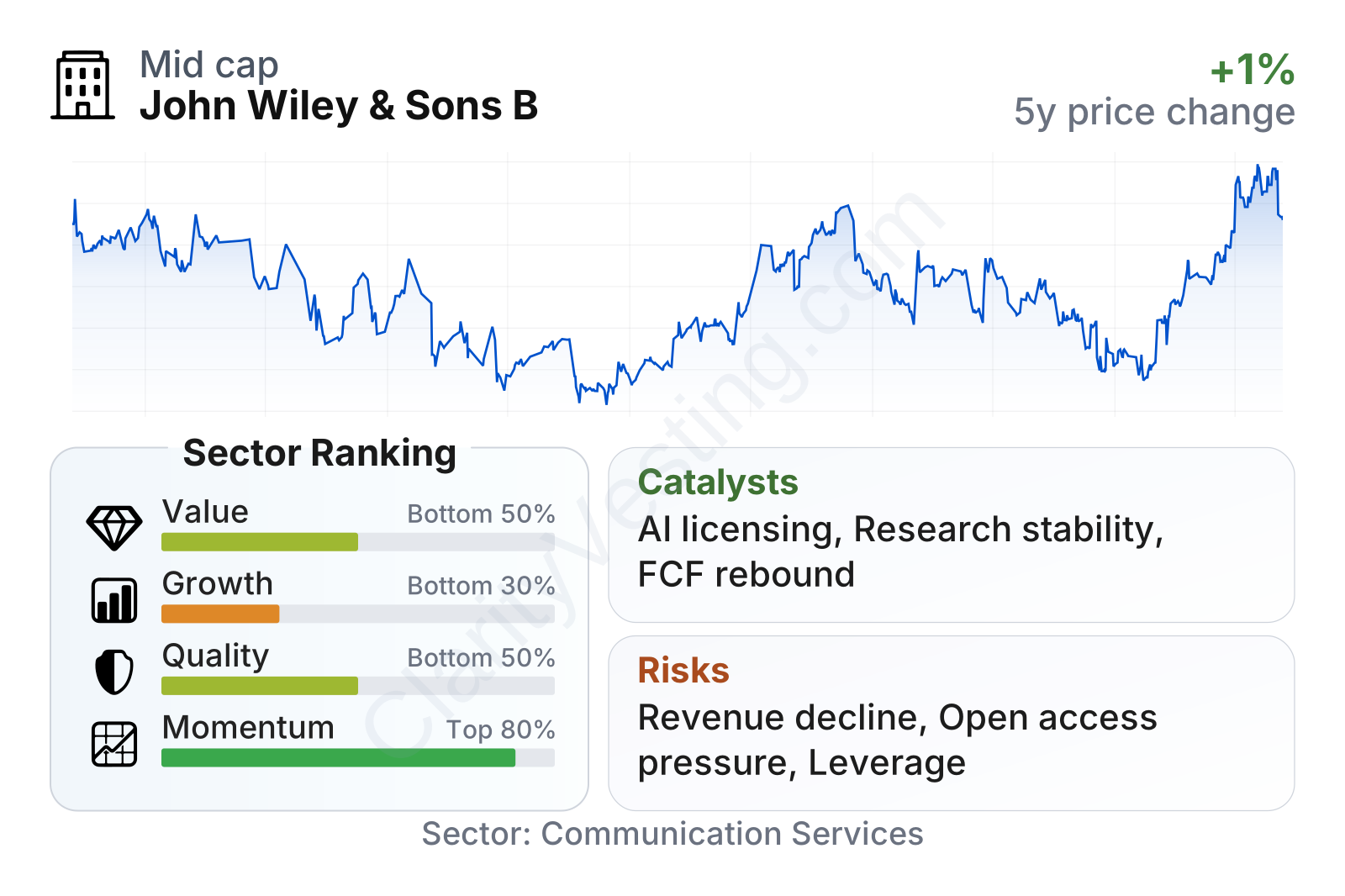
Wiley is a mid-sized company with a market value around $2.5 billion and a stock that has historically moved less than the broader market, as reflected by a beta below 1. The current profile is mixed. Profitability and return on invested capital look solid versus much of the sector, while growth ranks poorly. Momentum has been strong, with the shares rebounding sharply over the last year, but the valuation picture is not uniformly cheap across all measures because earnings have improved faster than revenue.
Growth
Wiley operates in parts of publishing that still have structural relevance, even though the broader publishing industry is mature. Academic research publishing remains supported by global research output, grant funding, international collaboration, and the need for peer-reviewed publication. Professional learning also benefits from workforce upskilling, test preparation, and continuing education. That said, these are not naturally fast-growing markets across the board. The more realistic growth case depends on Wiley taking share in attractive niches, increasing digital usage, and improving monetization of its existing content and customer relationships.
The company’s strategy appears coherent for that environment. Management has been focusing on higher-quality revenue streams, divesting non-core assets, expanding recurring digital offerings, and using artificial intelligence tools to improve discovery, workflow, and content utility. In research, the core asset is not just journal content but the trusted network around authors, editors, institutions, and archives. In learning, the objective is to make content more integrated into digital course delivery and career development rather than relying only on traditional textbook demand.
Recent revenue trends still show the main challenge. Year-over-year growth was negative for an extended period, briefly turned slightly positive, and then slipped back to a low single-digit decline most recently. Compared with the sector median, that is weak. This means the growth argument is currently more about stabilization and quality improvement than about broad-based expansion.
Cash generation is more encouraging. Free cash flow has recovered from the post-2022 drop and has been rebuilding steadily, reaching roughly $212 million on a trailing basis in the latest metrics. That matters because it gives Wiley flexibility to reduce debt, invest in product development, support dividends, and absorb industry transitions without depending heavily on outside capital.
A notable catalyst is the increasing role of AI in scientific and educational workflows. Wiley has announced partnerships and product initiatives tied to AI-enabled discovery, licensing, and research tools. Because the company owns specialized and curated content, it may be in a stronger position than general-interest publishers to benefit from demand for trusted data sources in AI applications. Another positive driver is the continued shift toward open access and research analytics services, where publishers with scale, brand recognition, and institutional relationships can build adjacent revenue streams.
Risks
This article is for informational purposes only and does not constitute financial advice. Some content is AI-generated. See Disclaimer