Stock Analysis · Liberty Latin America Ltd (LILA)
Overview
Liberty Latin America Ltd is a telecommunications and connectivity company focused on Latin America and the Caribbean. It sells mobile phone services, broadband internet, pay TV, fixed-line voice, enterprise connectivity, and related IT services. Its networks reach consumers, businesses, and government customers across a wide set of markets, with major operations including Puerto Rico, Panama, Jamaica, Costa Rica, the Bahamas, Barbados, and several other Caribbean countries.
For long-term analysis, the important point is that this is mainly an infrastructure-based communications business. Customers often rely on its networks for essential daily services such as mobile data, home internet, TV bundles, and business connectivity. That creates recurring revenue, but it also requires large and ongoing spending on spectrum, networks, and upgrades.
Based on company reporting structure and recent filings, Liberty Latin America’s revenue mix is broadly organized as follows:
- Consumer mobile services and handset-related revenue: approximately 35% to 40% of total revenue. This includes mobile subscriptions, prepaid and postpaid plans, roaming, device sales, and other wireless services.
- Residential fixed services: approximately 30% to 35%. This includes broadband internet, video/pay TV, and fixed voice sold to households, often in bundled packages.
- B2B and wholesale services: approximately 20% to 25%. This covers enterprise data, cloud and IT solutions, connectivity for businesses, subsea and wholesale capacity, and government contracts.
- Other revenue: approximately 5% to 10%. This usually includes installation, interconnection, infrastructure-related items, and other ancillary services.
The broad pattern is useful: mobile and broadband are the core earnings engine, while enterprise and wholesale add diversification. Over time, that mix matters because broadband, mobile data, and business connectivity are generally more durable than legacy voice and traditional TV.
The company’s cost structure also shows the main challenge. Revenue has stayed around the mid-$4 billion range in recent years, and gross profit has remained sizable, but interest expense has consumed a large share of operating earnings. That means the business still generates meaningful cash from operations, yet debt costs have heavily limited bottom-line profit.
The flow of revenue into cash generation is still visible, but the biggest pressure point is clear: operating performance has been far more stable than net income because financing costs absorb a large portion of what the business earns.
Key Figures
| Metric | Value | Sector ⓘ |
|---|---|---|
| Date | Sep 12, 2026 | |
| Context | ||
| Sector | Communication Services | |
| Industry | Telecom Services | |
| Market Cap ⓘ | $1.70B | |
| Beta ⓘ | 0.74 | |
Value (Cheapness) | ||
| P/E Ratio ⓘ | N/A | 18.61 |
| FCF Yield ⓘ | 21.00% | 13.68% |
| EBIT / EV ⓘ | 4.27% | 4.54% |
| PEG ⓘ | 3.61 | |
Growth (Business expansion) | ||
| Revenue Growth ⓘ | 1.50% | 5.40% |
| RPS Growth (5Y CAGR) ⓘ | 1.81% | 4.62% |
| EPS Growth (5Y CAGR) ⓘ | -28.07% | -18.01% |
| Margin Growth (5Y Trend) ⓘ | -4.27% | 1.10% |
| FCF Growth (5Y CAGR) ⓘ | 2.25% | 5.88% |
Quality (Business durability) | ||
| ROIC (Latest) ⓘ | 1.80% | 8.38% |
| ROIC (5Y Median) ⓘ | 1.56% | 8.32% |
| Net Debt / EBIT (Latest) ⓘ | 19.26 | 1.99 |
| Net Debt / EBIT (5Y Median) ⓘ | 24.25 | 2.94 |
| Operating Margin (Latest) ⓘ | 9.12% | 14.89% |
| Operating Margin (5Y Median) ⓘ | 4.35% | 12.96% |
| Debt to Equity (Latest) ⓘ | 1617.97% | 59.59% |
| Profit Margin (Latest) ⓘ | -2.20% | 8.77% |
| Free Cash Flow (Latest) ⓘ | $357.90M | |
Momentum (Price trend) | ||
| 3Y Return ⓘ | +50.44% | +46.64% |
| 12M Return (excl. last month) ⓘ | +71.60% | +2.16% |
| 6M Return ⓘ | +71.54% | +5.05% |
| Price vs. 200-Day MA ⓘ | +43.50% | +2.88% |
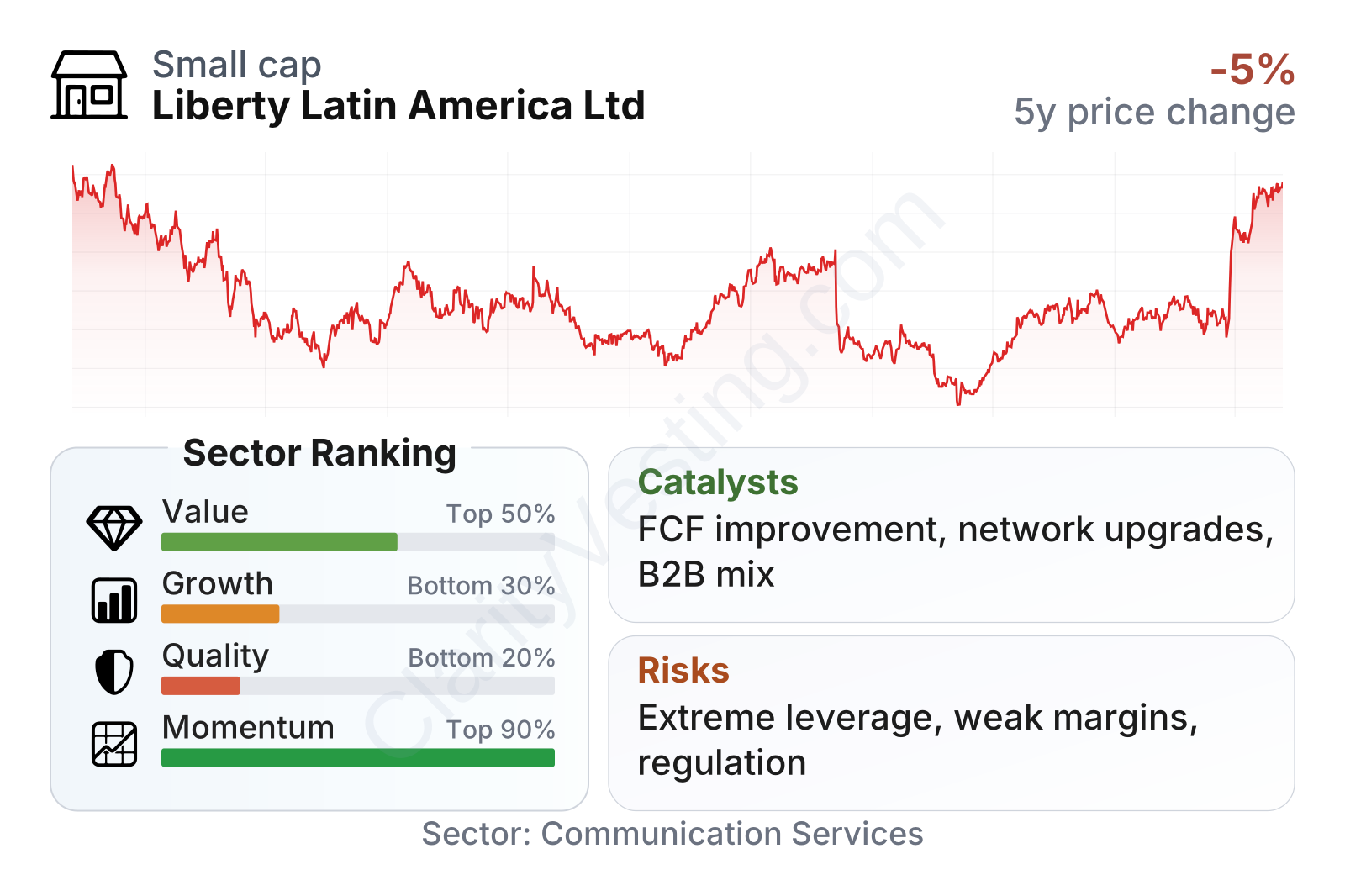
Liberty Latin America is a mid-sized telecom operator with lower share-price volatility than the broader market, as shown by its beta below 1. On valuation and cash generation, the profile looks mixed but interesting: free cash flow yield stands above the sector median, while operating-based valuation is closer to average. The weaker areas are growth and quality. Revenue growth has been modest, returns on invested capital are low, and leverage is far above normal sector levels. Price momentum has been very strong recently, which helps explain why the market has become more constructive even though the operating profile remains uneven.
Growth
Telecom services in Latin America and the Caribbean are part of a sector with long-term demand support. Mobile data usage continues to rise, households still need faster broadband, and businesses increasingly require secure connectivity and IT solutions. That does not automatically create fast revenue growth, but it gives network owners a durable market to operate in. For Liberty Latin America, the more attractive parts of the industry are mobile data, fiber broadband, enterprise connectivity, and infrastructure sharing, while legacy fixed voice and traditional video remain mature or declining.
The company’s strategy broadly makes sense for that environment. Management has focused on network investment, convergence between mobile and fixed services, B2B expansion, and selective asset transactions to unlock value or simplify the portfolio. In telecom, scale within a market and the ability to bundle services matter a lot. A provider that can sell mobile, broadband, and enterprise solutions together often has lower churn and stronger customer economics than a single-product competitor.
Recent revenue growth has been modest, generally hovering around flat to low-single-digit levels after a weaker stretch in 2023 and 2024. That is not unusual for a regional telecom operator, but it does mean the equity case depends less on rapid sales expansion and more on execution, efficiency, pricing discipline, and cash conversion.
Free cash flow is one of the more encouraging operating signals. It has improved meaningfully from 2022 levels and has recovered well from the softer period in 2025. That matters because telecom businesses can remain attractive over long periods even with limited revenue growth if they consistently turn earnings into cash and use that cash to strengthen the balance sheet, refinance debt, or invest in higher-return network opportunities.
A notable catalyst in recent years has been the company’s ongoing portfolio shaping and infrastructure focus, including efforts around network modernization, digital customer experience, and business services. If those efforts continue to lift operating efficiency while demand for broadband and mobile data remains firm, even slow revenue growth could translate into steadier cash generation. Another potential opportunity is further consolidation or partnership activity in fragmented regional telecom markets, where infrastructure owners can sometimes improve returns through combinations, carve-outs, or tower-related transactions.
Risks
This article is for informational purposes only and does not constitute financial advice. Some content is AI-generated. See Disclaimer


