Stock Analysis · Jungfraubahn Holding AG (JFBHF)
Overview
Jungfraubahn Holding AG is a Swiss mountain transport and tourism company centered on one of the best-known alpine destinations in Europe. Its railways, cableways, and connected visitor facilities bring travelers to high-altitude attractions in the Bernese Oberland, especially Jungfraujoch, which is marketed as the “Top of Europe.” In simple terms, the company earns money by moving visitors up the mountains and then capturing additional spending once they arrive.
The business is not a standard freight railroad or commuter rail operator. It is much closer to a tourism infrastructure company with transportation assets at its core. That matters because results depend more on leisure travel demand, international tourism flows, weather conditions, and destination appeal than on industrial shipping volumes or daily commuting patterns.
Based on the company’s recent annual reporting structure, revenue is mainly generated from the following activities:
- Traffic income from mountain excursions and transport services: approximately 70% to 80% of revenue. This includes tickets for the Jungfrau Railway and other mountain transport routes, which are the economic backbone of the group.
- Experience, retail, and hospitality income: approximately 10% to 20% of revenue. This includes restaurants, shops, and visitor-related spending at mountain destinations.
- Winter sports and other leisure activities: approximately 5% to 10% of revenue. This covers ski-related operations and other tourism offerings in the region.
- Real estate and other ancillary income: a small share of revenue. This includes support activities and smaller business lines around the core tourism platform.
The broad pattern is clear even if category definitions can shift slightly from one report to another: transport revenue is the main engine, and the rest of the group is built to increase spending per visitor.
The company’s financial profile also shows how strongly it recovered after the pandemic period. Revenue rose from about CHF 114 million in 2021 to about CHF 272 million in 2025, while net income moved from a small loss to more than CHF 78 million. That is a sharp improvement, but it also means the current business is being measured against a much healthier base than a few years ago.
The long-term trend visible in the business mix is encouraging: sales have expanded meaningfully since 2021, operating profit has rebounded strongly, and interest expense has stayed low. That combination suggests a business with solid pricing power and high operating leverage once visitor volumes recover.
Key Figures
| Metric | Value | Sector ⓘ |
|---|---|---|
| Date | Oct 17, 2026 | |
| Context | ||
| Sector | Industrials | |
| Industry | Railroads | |
| Market Cap ⓘ | $1.83B | |
| Beta ⓘ | 0.59 | |
Value (Cheapness) | ||
| P/E Ratio ⓘ | 20.59 | 22.10 |
| P/B Ratio ⓘ | 2.41 | 1.97 |
| FCF Yield ⓘ | N/A | 6.38% |
| Dividend Yield ⓘ | 2.72% | 1.94% |
| EBIT / EV ⓘ | N/A | 4.79% |
| PEG ⓘ | N/A | |
Growth (Business expansion) | ||
| Revenue Growth ⓘ | -8.60% | 9.30% |
| RPS Growth (5Y CAGR) ⓘ | 24.21% | 7.81% |
| EPS Growth (5Y CAGR) ⓘ | N/A | -13.06% |
| BVPS Growth (5Y CAGR) ⓘ | 6.81% | 6.14% |
| Margin Growth (5Y Trend) ⓘ | 46.03% | 0.88% |
| FCF Growth (5Y CAGR) ⓘ | N/A | 11.01% |
| DPS Growth (5Y CAGR) ⓘ | 15.27% | 9.48% |
Quality (Business durability) | ||
| ROIC (Latest) ⓘ | N/A | 10.84% |
| ROA (Latest) ⓘ | N/A | 5.41% |
| ROIC (5Y Median) ⓘ | 9.17% | 9.38% |
| ROA (5Y Median) ⓘ | 8.05% | 4.95% |
| Net Debt / EBIT (Latest) ⓘ | N/A | 2.08 |
| Net Debt / EBIT (5Y Median) ⓘ | 0.56 | 2.27 |
| Net Debt / EBITDA (Latest) ⓘ | N/A | 1.39 |
| Net Debt / Assets ⓘ | N/A | 19.28% |
| EBITDA / Interest ⓘ | N/A | 9.58 |
| Operating Margin (Latest) ⓘ | N/A | 10.50% |
| Operating Margin (5Y Median) ⓘ | 36.52% | 10.29% |
| Debt to Equity (Latest) ⓘ | N/A | 65.48% |
| Profit Margin (Latest) ⓘ | 23.93% | 6.67% |
| Free Cash Flow (Latest) ⓘ | N/A | |
Momentum (Price trend) | ||
| 3Y Return ⓘ | +225.33% | +61.68% |
| 12M Return (excl. last month) ⓘ | +24.08% | +12.58% |
| 6M Return ⓘ | +1.49% | 0.00% |
| Price vs. 200-Day MA ⓘ | N/A | +0.02% |
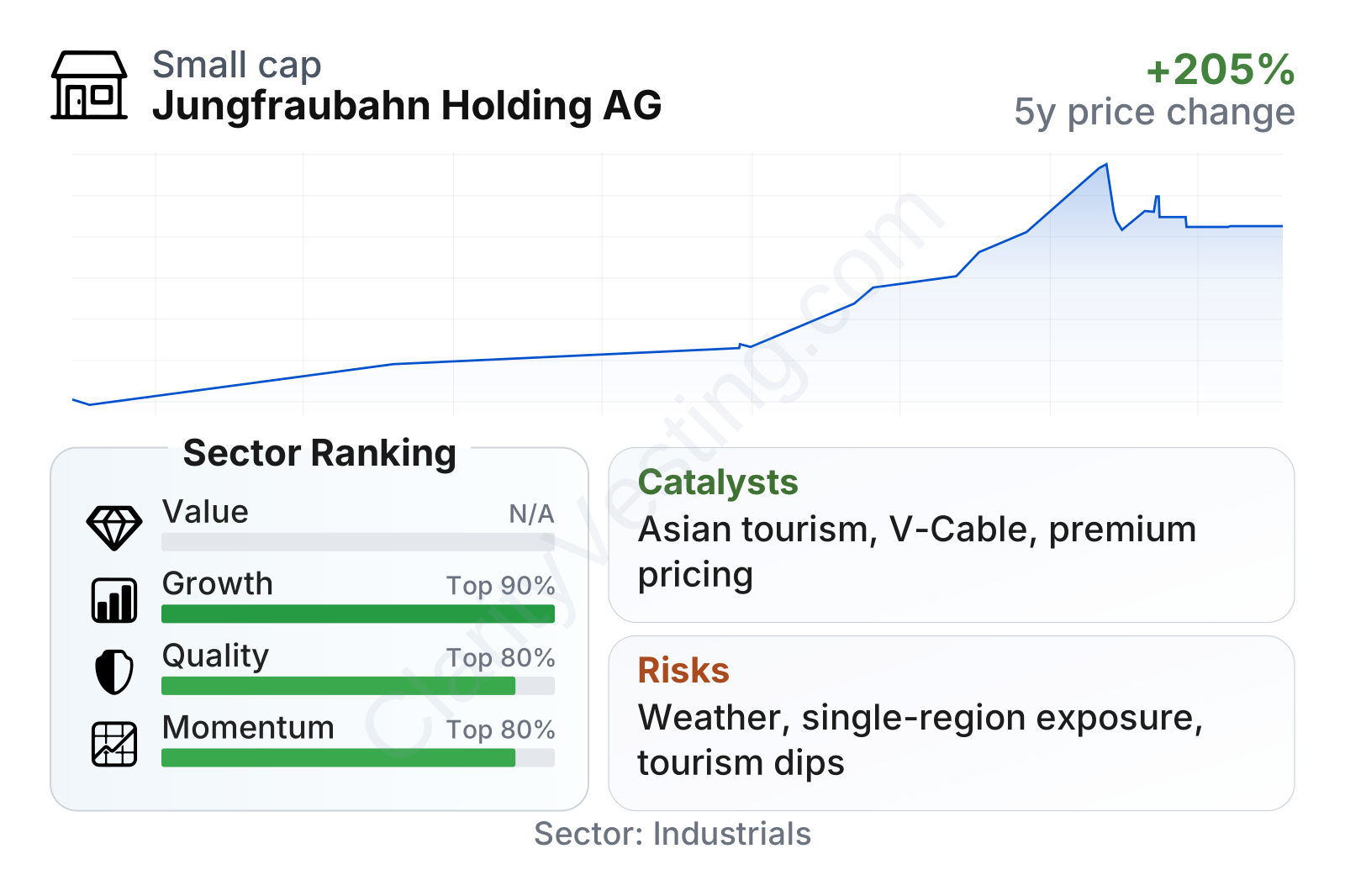
Jungfraubahn is a mid-sized listed company with a relatively low share-price sensitivity to the broader market, as shown by a beta below 1. On valuation, the earnings multiple is close to the sector median, while the price-to-book ratio sits somewhat above it. The dividend yield is also above the sector median, which adds some support to the overall profile.
On business quality, the picture is stronger. Profit margin is well above the sector median, five-year operating margins are exceptionally high for an industrial company, and leverage appears conservative. Net debt compared with earnings has been low over time, which is important for a tourism business exposed to demand swings and weather volatility.
Growth metrics are mixed in the short term but strong over a longer period. Recent year-over-year revenue growth was negative, so the latest period does not show uninterrupted expansion. However, five-year revenue per share growth has been far ahead of the sector median, and dividend growth has also been strong. Share-price performance over three years has been much stronger than the sector median, although the shorter six-month trend looks more modest.
Growth
Jungfraubahn operates in a niche that still has room to grow: premium alpine tourism. Global travel demand has recovered, and Switzerland remains one of the strongest destination brands in Europe for high-income international visitors. Within that setting, the company benefits from owning access to iconic mountain sites that are difficult to replicate. This gives it exposure to structural tourism growth rather than only local transport demand.
The strategy also makes sense for future expansion. Management has spent years developing the destination as more than a rail trip. The model is to attract visitors, move them efficiently through the mountain network, and then monetize the experience through food, retail, and related attractions. That can support both higher ticket volumes and higher spending per guest, which is usually more powerful than relying on volume alone.
A major long-term catalyst has been the V-Cable project and the upgraded transport chain into the region, which improved capacity, travel times, and the overall visitor experience. Infrastructure upgrades like this are particularly valuable in mountain tourism because they can lift throughput without needing a completely new destination. Better access also helps the company handle peak demand more effectively.
Another support factor is the resilience of the brand. Jungfraujoch is one of the most recognizable mountain attractions in Switzerland, and destination businesses with global visibility often recover faster after travel disruptions. This can be especially important for attracting visitors from Asia, North America, and other long-haul markets, where demand can be more sensitive to destination prestige.
Recent operating performance points to a company that has already captured much of the post-pandemic tourism recovery. Revenue and profitability in 2024 and 2025 remained near record levels, which suggests demand has not only returned but stayed strong enough to support healthy margins. That does not guarantee rapid near-term growth, but it does indicate that the core asset base is performing well.
Risks
This article is for informational purposes only and does not constitute financial advice. Some content is AI-generated. See Disclaimer


