Stock Analysis · Jardine Cycle & Carriage Ltd (JCYGY)
Overview
Jardine Cycle & Carriage Ltd is a Singapore-listed holding company within the wider Jardine Matheson group. It is best understood as a regional conglomerate with major exposure to Southeast Asia, especially Indonesia and Vietnam. Rather than relying on one single product, the company owns stakes in several businesses across automotive distribution, financial services, heavy equipment, mining, agribusiness, infrastructure, and Vietnam-focused investments.
The company’s economic engine is dominated by its controlling interest in Astra International, one of Indonesia’s largest diversified groups. Through Astra, Jardine Cycle & Carriage gains exposure to car and motorcycle distribution, auto-related financial services, used cars, parts, heavy equipment, coal mining, gold, nickel-related activities, plantations, logistics, toll roads, and digital initiatives. It also owns direct interests outside Astra, including Truong Hai Group Corporation in Vietnam and other strategic investments in Southeast Asia.
Based on the latest annual disclosures, the revenue mix is heavily concentrated in Astra, with other businesses contributing a much smaller share at the parent level. A simple way to view the business is:
- Astra International: approximately 85% to 95% of underlying business exposure. This includes Indonesian automotive distribution, financial services, heavy equipment, mining, infrastructure, logistics, and agribusiness.
- Direct motor interests and regional investments outside Astra: approximately 5% to 15% of group exposure. This mainly includes Vietnam auto-related operations and other strategic holdings.
Within Astra itself, the largest operating areas are typically automotive, financial services, and heavy equipment/mining, while infrastructure, agribusiness, and newer digital activities are smaller but still meaningful. Because Jardine Cycle & Carriage is a holding company, long-term performance depends less on one brand and more on the quality of its portfolio, capital allocation, and the health of Indonesia’s consumer and industrial economy.
The business flow also shows a company with a very large revenue base, solid gross profit generation, and historically strong operating income, although net income has been more volatile because financing costs, taxes, commodity swings, and minority interests can all affect what ultimately reaches shareholders.
Over the last several years, revenue expanded strongly from 2021 through 2024 before softening in 2025, while operating profit and net income have been more uneven. That pattern fits a diversified cyclical group: size and cash generation remain significant, but earnings can move around as vehicle demand, commodity prices, and financing conditions change.
Key Figures
| Metric | Value | Sector ⓘ |
|---|---|---|
| Date | Oct 24, 2026 | |
| Context | ||
| Sector | Industrials | |
| Industry | Conglomerates | |
| Market Cap ⓘ | $6.86B | |
| Beta ⓘ | -0.09 | |
Value (Cheapness) | ||
| P/E Ratio ⓘ | 6.95 | 22.29 |
| P/B Ratio ⓘ | 0.99 | 1.98 |
| FCF Yield ⓘ | 48.63% | 6.26% |
| Dividend Yield ⓘ | 6.51% | 1.92% |
| EBIT / EV ⓘ | 35.51% | 4.83% |
| PEG ⓘ | N/A | |
Growth (Business expansion) | ||
| Revenue Growth ⓘ | -7.50% | 9.30% |
| RPS Growth (5Y CAGR) ⓘ | 4.85% | 7.76% |
| EPS Growth (5Y CAGR) ⓘ | -6.97% | -13.17% |
| BVPS Growth (5Y CAGR) ⓘ | 3.93% | 6.13% |
| Margin Growth (5Y Trend) ⓘ | 0.59% | 0.74% |
| FCF Growth (5Y CAGR) ⓘ | -4.14% | 10.79% |
| DPS Growth (5Y CAGR) ⓘ | 20.87% | 9.41% |
Quality (Business durability) | ||
| ROIC (Latest) ⓘ | 22.83% | 10.75% |
| ROA (Latest) ⓘ | 5.71% | 5.41% |
| ROIC (5Y Median) ⓘ | 15.94% | 9.37% |
| ROA (5Y Median) ⓘ | 2.92% | 4.95% |
| Net Debt / EBIT (Latest) ⓘ | 1.02 | 2.04 |
| Net Debt / EBIT (5Y Median) ⓘ | 1.19 | 2.27 |
| Net Debt / EBITDA (Latest) ⓘ | 0.67 | 1.39 |
| Net Debt / Assets ⓘ | 14.49% | 19.27% |
| EBITDA / Interest ⓘ | 12.48 | 9.58 |
| Operating Margin (Latest) ⓘ | 10.46% | 10.49% |
| Operating Margin (5Y Median) ⓘ | 12.99% | 10.30% |
| Debt to Equity (Latest) ⓘ | 87.30% | 64.82% |
| Profit Margin (Latest) ⓘ | 4.82% | 6.67% |
| Free Cash Flow (Latest) ⓘ | $3.34B | |
Momentum (Price trend) | ||
| 3Y Return ⓘ | +1.79% | +67.77% |
| 12M Return (excl. last month) ⓘ | -2.17% | +12.05% |
| 6M Return ⓘ | -27.61% | 0.00% |
| Price vs. 200-Day MA ⓘ | -21.44% | +0.67% |
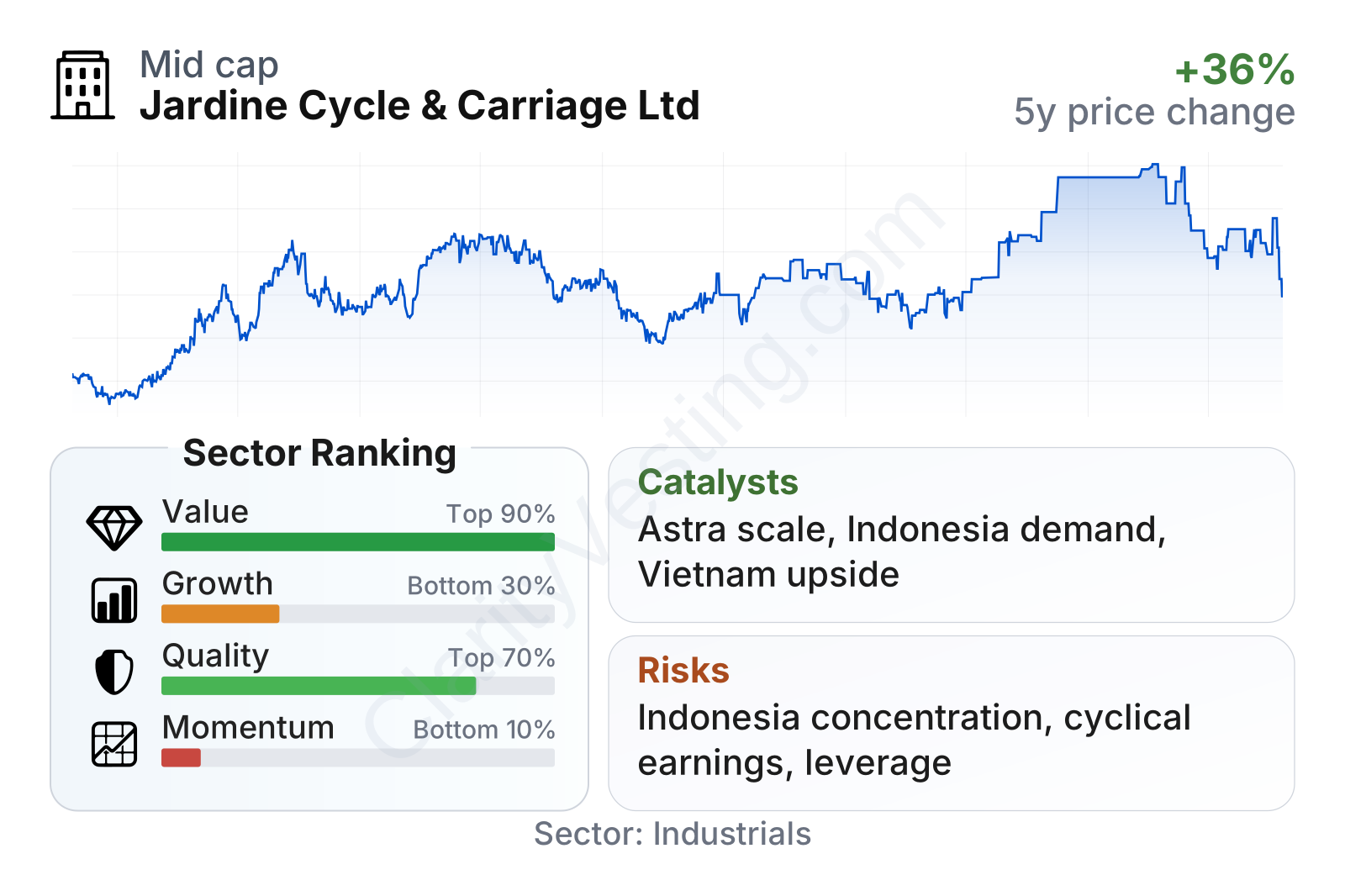
On the surface, Jardine Cycle & Carriage looks inexpensive relative to most industrial peers. Its earnings multiple is far below the sector median, book value is around sector norms, and its trailing dividend yield is noticeably higher than the typical industrial stock. Cash generation also stands out, with free cash flow yield and EBIT relative to enterprise value well above sector medians.
Quality is stronger than the share price performance might suggest. Returns on invested capital are comfortably ahead of the sector median, leverage measured against earnings is moderate, and interest coverage appears healthy. The weaker areas are growth and market momentum: recent revenue growth is negative, free cash flow growth over five years has been soft, and the stock’s multi-year price performance has lagged the broader industrial universe.
That combination paints a clear picture: this is a large regional holding company with solid profitability and cash generation, but with limited recent top-line momentum and a stock market rating that remains cautious.
Growth
Jardine Cycle & Carriage operates in sectors that are mature in some areas and still expanding in others. Traditional automotive distribution is not a high-growth market every year, but Southeast Asia continues to benefit from rising income, urbanization, low vehicle ownership in some markets, infrastructure investment, and demand for financing. On top of that, the company also has exposure to heavy equipment, logistics, mining, plantations, and selected digital platforms, which broadens its growth paths beyond passenger vehicles alone.
The long-term logic of the group’s strategy is coherent. By owning leading businesses in Indonesia and other Southeast Asian markets, the company gains access to consumer demand, industrial development, and natural resource activity in economies that still have room to grow over time. Its portfolio structure also reduces reliance on any one single cycle. When auto sales soften, mining, financial services, or infrastructure can partly offset the weakness, although not always fully.
Near-term growth has clearly cooled. Recent year-over-year revenue has declined, which places the company below the sector median on growth measures. That softness likely reflects a mix of normalization after stronger post-pandemic years, weaker commodity-linked contributions, and a less supportive demand environment in parts of its portfolio. So the current picture is not one of rapid expansion, but rather of a large business going through a slower phase.
Free cash flow remains one of the more encouraging features. Even though the five-year growth rate of free cash flow has been negative, the current absolute level remains substantial for a company of this size. That matters because holding companies create long-term value not only through revenue growth, but also through disciplined reinvestment, dividends, debt management, and selective acquisitions.
A meaningful catalyst is continued development in Indonesia’s industrial and transport ecosystem through Astra’s heavy equipment, mining, logistics, and infrastructure operations. Another is Vietnam, where rising motorization and industrialization could support the value of the group’s direct investments over time. Electrification in transport may also create opportunities, although it introduces competitive disruption as well. In broad terms, the company is not in a fast-growing pure-play niche, but it does sit in parts of Southeast Asia that still offer structural expansion over a long horizon.
Risks
This article is for informational purposes only and does not constitute financial advice. Some content is AI-generated. See Disclaimer