Stock Analysis · Johnson Controls International PLC (JCI)
Overview
Johnson Controls International is a large building technology and equipment company focused on making commercial and institutional buildings safer, more energy efficient, and easier to operate. Its products and services are used in offices, hospitals, schools, data centers, factories, airports, and other large facilities. The company combines heating, ventilation, air conditioning, fire detection, fire suppression, security systems, digital building controls, and ongoing service contracts.
Its business model is built around both equipment sales and recurring service activity. That matters because buildings need maintenance, upgrades, inspections, and software support long after the initial installation. In practice, Johnson Controls is not just selling hardware; it is also tied to the day-to-day operation of important building systems.
Based on recent company reporting, revenue is mainly generated from the following sources:
- Building Solutions North America: approximately 40% of revenue. This includes HVAC and controls equipment, fire and security solutions, installation work, and service for customers in the United States and Canada.
- Building Solutions EMEA/Latin America: approximately 24% of revenue. This covers similar offerings across Europe, the Middle East, Africa, and Latin America.
- Building Solutions Asia Pacific: approximately 17% of revenue. This includes building systems and services across key Asian and Pacific markets.
- Global Products: approximately 19% of revenue. This segment mainly includes applied HVAC systems, ducted systems, residential and light commercial HVAC products, and related equipment sold through global channels.
The broad pattern is that most of Johnson Controls’ revenue comes from integrated building solutions and services, with the remainder from product manufacturing. Over the last several years, revenue has recovered and expanded after a weaker 2022, while operating income has improved more noticeably than sales. That suggests management has been pushing not only for growth, but also for a better mix and tighter cost control.
One useful takeaway from the operating flow is that profit conversion has improved faster than revenue. Sales are higher than a few years ago, but net income has risen much more sharply, helped by stronger operating performance and lower interest expense.
Key Figures
| Metric | Value | Sector ⓘ |
|---|---|---|
| Date | Oct 03, 2026 | |
| Context | ||
| Sector | Industrials | |
| Industry | Building Products & Equipment | |
| Market Cap ⓘ | $90.51B | |
| Beta ⓘ | 1.30 | |
Value (Cheapness) | ||
| P/E Ratio ⓘ | 41.97 | 22.45 |
| P/B Ratio ⓘ | 6.78 | 1.98 |
| FCF Yield ⓘ | 2.21% | 6.31% |
| Dividend Yield ⓘ | 1.07% | 1.96% |
| EBIT / EV ⓘ | 3.05% | 4.81% |
| PEG ⓘ | 1.67 | |
Growth (Business expansion) | ||
| Revenue Growth ⓘ | 9.30% | 9.10% |
| RPS Growth (5Y CAGR) ⓘ | 2.39% | 7.75% |
| EPS Growth (5Y CAGR) ⓘ | 3.84% | -13.59% |
| BVPS Growth (5Y CAGR) ⓘ | -3.46% | 6.22% |
| Margin Growth (5Y Trend) ⓘ | -3.11% | 0.72% |
| FCF Growth (5Y CAGR) ⓘ | -15.96% | 10.98% |
| DPS Growth (5Y CAGR) ⓘ | 9.01% | 9.48% |
Quality (Business durability) | ||
| ROIC (Latest) ⓘ | 10.45% | 10.92% |
| ROA (Latest) ⓘ | 9.33% | 5.41% |
| ROIC (5Y Median) ⓘ | 7.62% | 9.21% |
| ROA (5Y Median) ⓘ | 4.01% | 4.94% |
| Net Debt / EBIT (Latest) ⓘ | 2.97 | 2.07 |
| Net Debt / EBIT (5Y Median) ⓘ | 4.73 | 2.28 |
| Net Debt / EBITDA (Latest) ⓘ | 2.45 | 1.43 |
| Net Debt / Assets ⓘ | 22.79% | 19.27% |
| EBITDA / Interest ⓘ | 17.32 | 9.53 |
| Operating Margin (Latest) ⓘ | 11.91% | 10.50% |
| Operating Margin (5Y Median) ⓘ | 8.64% | 10.27% |
| Debt to Equity (Latest) ⓘ | 70.28% | 65.48% |
| Profit Margin (Latest) ⓘ | 14.32% | 6.62% |
| Free Cash Flow (Latest) ⓘ | $2.00B | |
Momentum (Price trend) | ||
| 3Y Return ⓘ | +194.08% | +58.56% |
| 12M Return (excl. last month) ⓘ | +31.01% | +15.63% |
| 6M Return ⓘ | +14.15% | +4.19% |
| Price vs. 200-Day MA ⓘ | +8.88% | +0.93% |
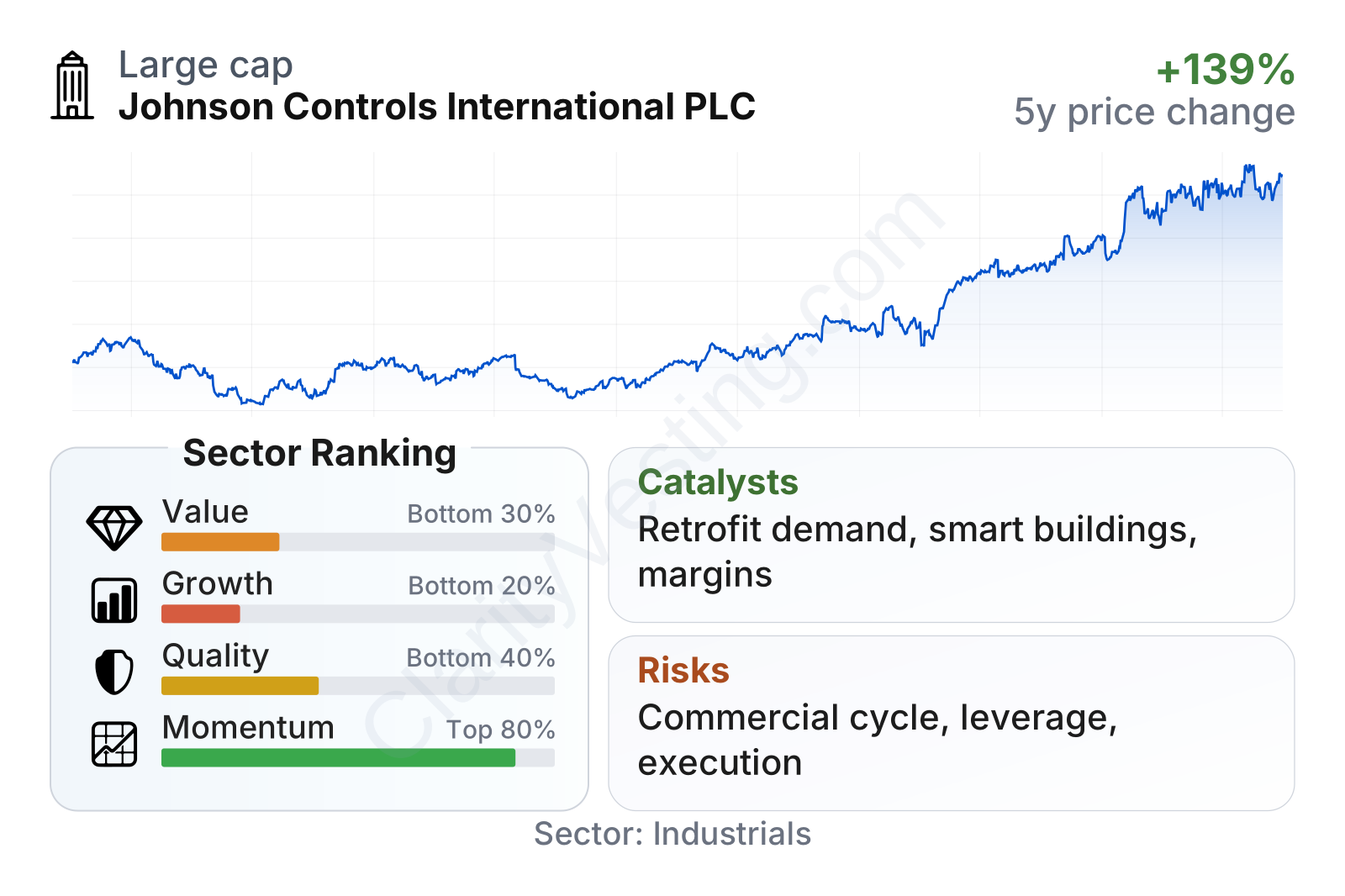
Johnson Controls is a very large industrial company, and its share price has been strong over the last three years. Momentum stands above much of the sector, but the valuation profile looks demanding. The company ranks in the lower part of the sector on value metrics, with a P/E ratio well above the sector median, a high price-to-book ratio, and a free cash flow yield that is clearly lower than typical peers.
The picture is more mixed on business fundamentals. Profitability has recently improved, with return on assets above the sector median and profit margin now well ahead of many peers. However, longer-term growth metrics are less impressive, especially revenue per share, free cash flow growth over five years, and book value per share. In short, the market appears to be paying up for a cleaner, more profitable Johnson Controls today, even though its long-run growth record is not especially strong.
Growth
Johnson Controls operates in a sector with durable long-term tailwinds. Building owners are under pressure to reduce energy use, modernize aging facilities, improve indoor air quality, strengthen fire and security systems, and connect equipment through digital controls. Those needs are structural rather than temporary. They come from regulation, energy costs, labor shortages, and the increasing importance of efficient building operations.
The company’s strategy fits that environment reasonably well. Johnson Controls has been concentrating on higher-value building systems, software-enabled controls, and service relationships instead of being only an equipment supplier. That approach can deepen customer relationships and make revenue less dependent on one-time construction cycles. Its installed base also creates follow-on work: once a building uses Johnson Controls equipment and controls, maintenance, retrofits, and upgrades can become easier to win.
Recent revenue growth has been uneven, with a period of contraction followed by a return to positive growth. More recently, growth has accelerated back toward high single digits year over year, which is healthier than the soft patch seen earlier. Even so, the longer view is still moderate rather than exceptional, which helps explain why the market focus has shifted toward margin improvement and execution quality.
Cash generation is another important part of the growth case. Free cash flow has been positive and meaningful, although not consistently rising. There was a sharp jump followed by a pullback, showing that cash conversion can move around from year to year. Even after that decline, the company is still producing substantial cash, which supports dividends, debt management, internal investment, and bolt-on acquisitions.
A notable catalyst is the continued push for energy-efficient retrofits in existing buildings. New construction matters, but much of the opportunity comes from upgrading what is already built. Johnson Controls is well positioned here because many customers need bundled offerings: equipment, controls, fire and security systems, and ongoing support. Another growth support is demand from more complex facilities such as hospitals, campuses, industrial sites, and data centers, where system reliability and energy management are especially important.
Recent company updates have also pointed to ongoing portfolio sharpening and operational simplification. That is significant because a more focused company can often improve margins and allocate capital more efficiently, even without dramatic top-line growth.
Risks
This article is for informational purposes only and does not constitute financial advice. Some content is AI-generated. See Disclaimer