Stock Analysis · JCDecaux SA (JCDXY)
Overview
JCDecaux is a French outdoor advertising company best known for ads placed in public spaces rather than on television, websites, or newspapers. Its business revolves around street furniture, transport advertising, and large-format billboards. In practice, that means the company installs and manages assets such as bus shelters, digital screens in airports and metro systems, urban information panels, and roadside displays, then sells advertising space on those assets to brands and agencies.
The company operates through long-term contracts with cities, airports, transit authorities, and private site owners. This model matters because it combines advertising sales with infrastructure access: once JCDecaux secures a concession, it can benefit from recurring exposure in high-traffic locations. The trade-off is that the business requires continuous investment, maintenance, and contract renewals.
Based on recent annual reporting, revenue is mainly split across three operating segments:
- Street Furniture: about 49% of revenue. This includes bus shelters, city information panels, kiosks, and other urban installations, with an increasing share of digital screens.
- Transport: about 36% of revenue. This covers advertising in airports, metros, rail stations, buses, and other transit locations.
- Billboard: about 15% of revenue. This segment includes traditional roadside posters and large-format displays, including some digital formats.
Geographically, JCDecaux is highly international, with Europe remaining the largest base, while Asia-Pacific and other regions provide additional growth exposure. That broad footprint reduces dependence on any one city or advertiser category, but it also exposes the company to local economic cycles, regulation, and contract timing.
Over the last several years, the business has largely completed its post-pandemic recovery. Revenue increased from roughly €2.5 billion in 2021 to about €3.7 billion in 2025, while operating income and net income also recovered meaningfully. Margins improved sharply from the depressed 2021 base and have remained far stronger since then, which suggests the business has regained scale efficiencies as audience mobility normalized.
The profitability trend is encouraging: sales have risen steadily since 2021, operating income has expanded much faster than revenue, and interest expense eased in 2025 after a rise in 2023. That points to a business that has regained pricing and utilization, even if recent growth has become more moderate than the rebound years immediately after the pandemic.
Key Figures
| Metric | Value | Sector ⓘ |
|---|---|---|
| Date | Oct 31, 2026 | |
| Context | ||
| Sector | Communication Services | |
| Industry | Advertising Agencies | |
| Market Cap ⓘ | $5.74B | |
| Beta ⓘ | 1.00 | |
Value (Cheapness) | ||
| P/E Ratio ⓘ | 15.17 | 18.47 |
| FCF Yield ⓘ | N/A | 14.23% |
| Dividend Yield ⓘ | 2.78% | 2.78% |
| EBIT / EV ⓘ | 0.62% | 4.73% |
| PEG ⓘ | N/A | |
Growth (Business expansion) | ||
| Revenue Growth ⓘ | 3.80% | 6.10% |
| RPS Growth (5Y CAGR) ⓘ | 9.82% | 4.57% |
| EPS Growth (5Y CAGR) ⓘ | N/A | -17.96% |
| Margin Growth (5Y Trend) ⓘ | 11.13% | 1.32% |
| FCF Growth (5Y CAGR) ⓘ | 1.34% | 5.75% |
| DPS Growth (5Y CAGR) ⓘ | 95.91% | 5.19% |
Quality (Business durability) | ||
| ROIC (Latest) ⓘ | N/A | 9.19% |
| ROIC (5Y Median) ⓘ | N/A | 8.24% |
| Net Debt / EBIT (Latest) ⓘ | N/A | 1.92 |
| Net Debt / EBIT (5Y Median) ⓘ | 2.33 | 2.88 |
| Net Debt / EBITDA (Latest) ⓘ | N/A | 1.22 |
| Net Debt / Assets ⓘ | 7.81% | 18.63% |
| EBITDA / Interest ⓘ | N/A | 8.36 |
| Operating Margin (Latest) ⓘ | N/A | 15.68% |
| Operating Margin (5Y Median) ⓘ | 12.61% | 13.39% |
| Debt to Equity (Latest) ⓘ | N/A | 59.65% |
| Profit Margin (Latest) ⓘ | 8.74% | 8.74% |
| Free Cash Flow (Latest) ⓘ | N/A | |
Momentum (Price trend) | ||
| 3Y Return ⓘ | +9.60% | +46.16% |
| 12M Return (excl. last month) ⓘ | +57.19% | +1.26% |
| 6M Return ⓘ | +51.22% | 0.00% |
| Price vs. 200-Day MA ⓘ | +30.50% | +0.87% |
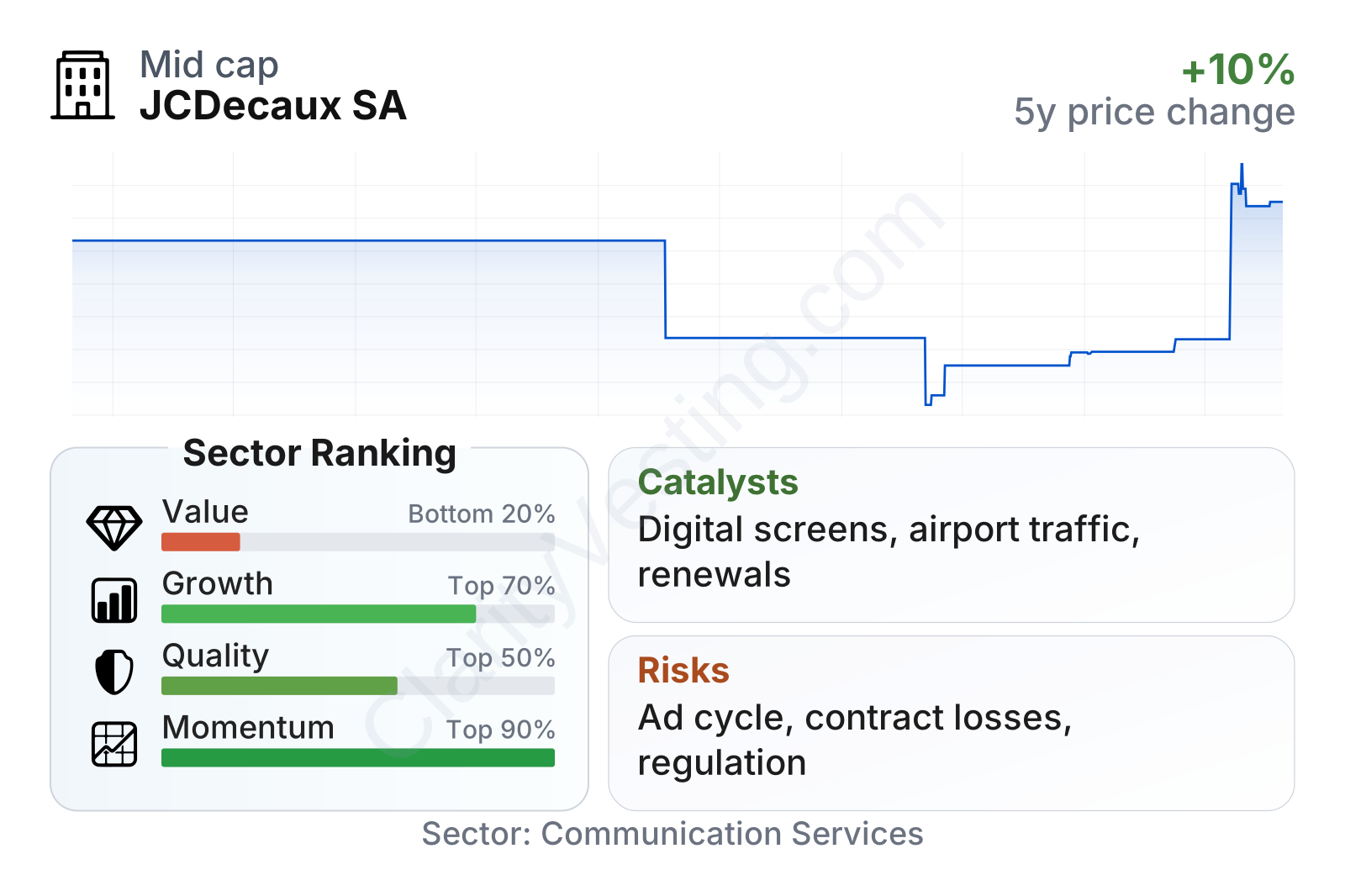
JCDecaux sits in the mid-cap range and shows a market sensitivity close to the broader market. On valuation, the earnings multiple is below the sector median, but the broader value profile is not especially strong because operating earnings relative to enterprise value remain well below many peers. In other words, the stock does not look aggressively priced on earnings alone, yet it also does not screen as deeply cheap when debt and operating profitability are considered together.
Quality is more balanced. Profit margin is roughly in line with the sector median, and leverage looks controlled, with net debt as a share of assets clearly below the sector median. That is a useful feature in a concession-based business that must keep investing in screens, furniture, and contract execution. Operating margins, however, still appear a bit below the typical level seen across the wider sector.
Growth metrics show a mixed but generally constructive picture. Recent year-over-year revenue growth has been positive but not exceptional, while five-year revenue per share growth and margin improvement stand out as stronger than sector medians. Free cash flow growth has been more modest, which suggests that capital needs and working capital can still absorb part of the operating progress.
Price momentum has been particularly strong over the last 6 to 12 months, with the stock outperforming much of the sector and trading well above its longer-term average trend. At the same time, the three-year share price gain remains modest, reflecting how long the outdoor advertising industry needed to recover from the disruption in urban mobility.
Growth
JCDecaux operates in a part of advertising that benefits from urbanization, travel activity, digital screens, and data-driven campaign planning. Outdoor advertising is still a relatively small share of total ad budgets compared with online channels, but it occupies a specific niche: it reaches large audiences in public spaces, cannot be skipped, and increasingly offers flexible digital inventory. That gives the sector room to expand as advertisers look for omnichannel campaigns that combine online and physical presence.
The company’s strategy appears coherent for long-term expansion. A central theme is digitization. Digital displays allow multiple ads to rotate on a single screen, improve pricing flexibility, and make campaigns easier to adapt by time, audience flow, or event. For JCDecaux, this can lift revenue per location without needing to win entirely new sites. Another strategic advantage is the company’s large installed base in premium urban and transport locations, where barriers to entry are high because access depends on concession agreements and public tenders.
Transport is a particularly important growth lever. Airport and transit advertising can benefit from rising passenger traffic, premium brand demand, and a global advertiser base. Street furniture also remains attractive because cities continue to favor modern public infrastructure tied to services such as shelters, information panels, and, in some markets, smart-city features.
Recent corporate updates have also pointed to continued digital rollouts, contract wins and renewals, and ongoing commercial normalization in major cities and travel hubs. These developments matter because they reinforce both capacity and visibility: renewed contracts help protect existing revenue, while digital conversion improves monetization potential over time.
A further catalyst is operating leverage. The company’s cost base includes fixed elements tied to networks and concessions, so incremental revenue can support profit expansion when occupancy and pricing improve. The recovery in operating income from 2021 through 2025 shows this effect already at work.
Risks
This article is for informational purposes only and does not constitute financial advice. Some content is AI-generated. See Disclaimer


