Stock Analysis · JBTMarel Corp (JBTM)
Overview
JBTMarel Corp is a food-processing and food-service equipment company created from the combination of JBT and Marel. In simple terms, it sells machines, systems, software, and services that help food producers prepare, process, portion, cook, freeze, package, and move food at industrial scale. Its customers include meat, poultry, seafood, dairy, pet food, beverage, and prepared-food companies, as well as some food-service operators.
The business is now much more global and broader than the legacy JBT organization. The enlarged company is centered on automation in food production, where customers often want higher throughput, more consistent quality, lower labor needs, better traceability, and compliance with stricter hygiene and safety standards.
Based on the combined structure described by the company, revenue mainly comes from equipment and recurring aftermarket activity. Exact 2026 segment percentages are not clearly disclosed in the material available here, but the business mix can be described in a practical way as follows:
- Primary food-processing equipment: the largest revenue source. This includes production lines and specialized machinery for protein, seafood, dairy, prepared foods, and other food categories.
- Aftermarket parts and services: a major recurring source of revenue. This includes spare parts, maintenance, upgrades, software support, and service contracts tied to the installed base.
- Food-service and liquid foods equipment: smaller than the broad food-processing platform, but still meaningful in areas such as beverage systems, freezing, portioning, and other niche applications.
- Software and digital solutions: still a smaller share than physical equipment and service, but strategically important because it supports plant automation, monitoring, yield management, and process control.
One visible financial shift is that the company became much larger in 2025, with revenue rising from about $1.7 billion in 2024 to about $3.8 billion in 2025, reflecting the impact of the Marel combination. At the same time, the cost structure also expanded sharply, and profitability did not keep pace.
The business scale-up is clear, but so is the challenge: revenue and gross profit moved much higher after the combination, while operating expenses and interest expense also increased substantially. That helps explain why a much larger company can still show weaker bottom-line performance during the integration period.
Key Figures
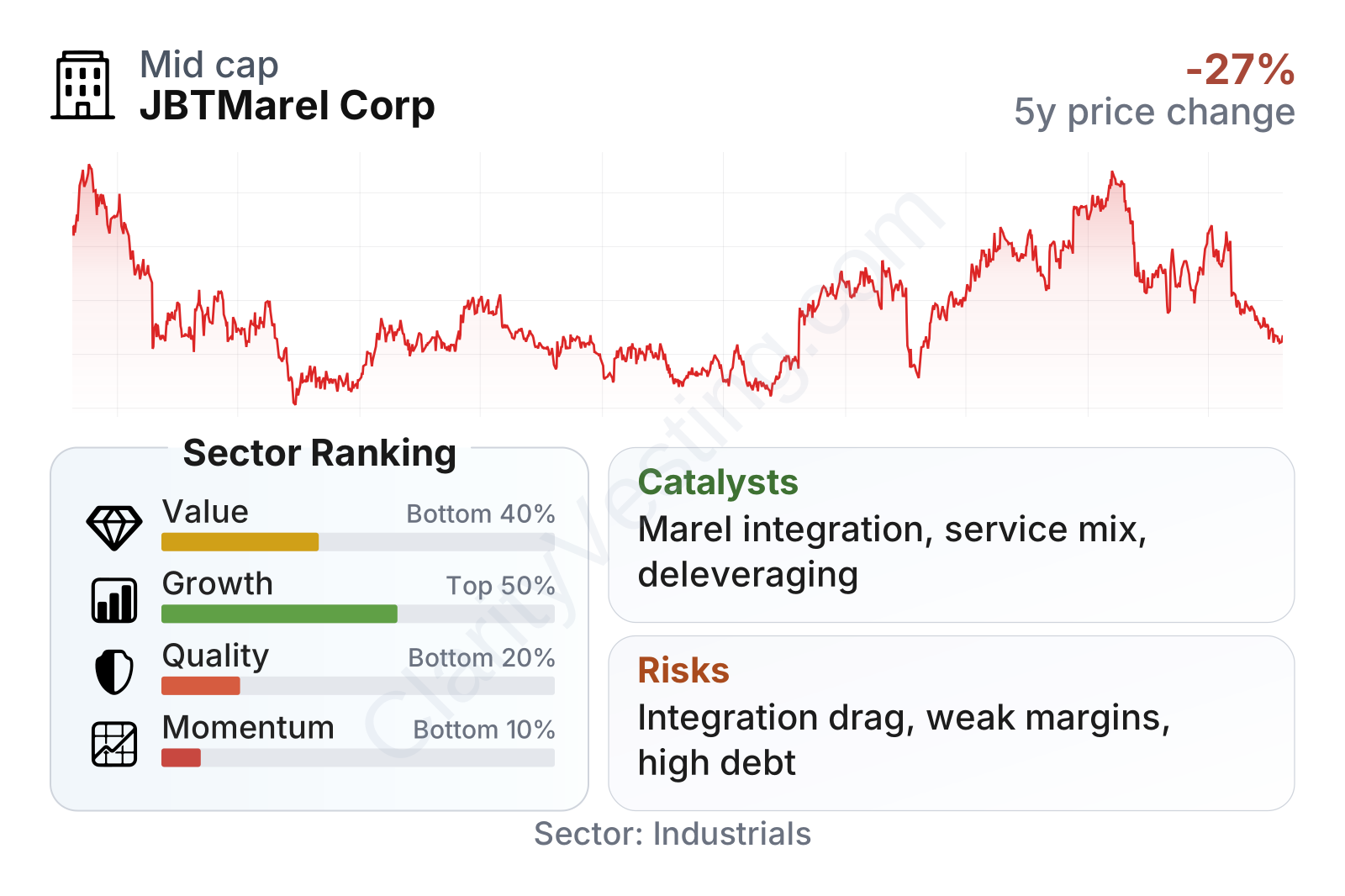
The share price has been volatile over the last several years, falling sharply in 2022, recovering unevenly, and still showing noticeable swings in 2025 and 2026. That pattern fits a company going through a major business transformation rather than a steady, mature industrial profile.
| Metric | Value | Sector ⓘ |
|---|---|---|
| Date | Oct 24, 2026 | |
| Context | ||
| Sector | Industrials | |
| Industry | Specialty Industrial Machinery | |
| Market Cap ⓘ | $5.47B | |
| Beta ⓘ | 0.94 | |
Value (Cheapness) | ||
| P/E Ratio ⓘ | 29.13 | 22.29 |
| P/B Ratio ⓘ | 1.25 | 1.98 |
| FCF Yield ⓘ | 5.67% | 6.26% |
| Dividend Yield ⓘ | 0.38% | 1.92% |
| EBIT / EV ⓘ | 3.94% | 4.83% |
| PEG ⓘ | 1.22 | |
Growth (Business expansion) | ||
| Revenue Growth ⓘ | 4.90% | 9.30% |
| RPS Growth (5Y CAGR) ⓘ | 13.58% | 7.76% |
| EPS Growth (5Y CAGR) ⓘ | -7.67% | -13.17% |
| BVPS Growth (5Y CAGR) ⓘ | 38.24% | 6.13% |
| Margin Growth (5Y Trend) ⓘ | -8.21% | 0.74% |
| FCF Growth (5Y CAGR) ⓘ | 8.45% | 10.79% |
| DPS Growth (5Y CAGR) ⓘ | 0.05% | 9.41% |
Quality (Business durability) | ||
| ROIC (Latest) ⓘ | N/A | 10.75% |
| ROA (Latest) ⓘ | 2.37% | 5.41% |
| ROIC (5Y Median) ⓘ | N/A | 9.37% |
| ROA (5Y Median) ⓘ | 5.75% | 4.95% |
| Net Debt / EBIT (Latest) ⓘ | 5.33 | 2.04 |
| Net Debt / EBIT (5Y Median) ⓘ | 4.56 | 2.27 |
| Net Debt / EBITDA (Latest) ⓘ | 2.84 | 1.39 |
| Net Debt / Assets ⓘ | 19.57% | 19.27% |
| EBITDA / Interest ⓘ | 9.79 | 9.58 |
| Operating Margin (Latest) ⓘ | 7.49% | 10.49% |
| Operating Margin (5Y Median) ⓘ | 8.57% | 10.30% |
| Debt to Equity (Latest) ⓘ | 37.54% | 64.82% |
| Profit Margin (Latest) ⓘ | 4.90% | 6.67% |
| Free Cash Flow (Latest) ⓘ | $310.00M | |
Momentum (Price trend) | ||
| 3Y Return ⓘ | +11.38% | +67.77% |
| 12M Return (excl. last month) ⓘ | -17.80% | +12.05% |
| 6M Return ⓘ | -19.12% | 0.00% |
| Price vs. 200-Day MA ⓘ | -19.06% | +0.67% |
JBTMarel looks mixed on the main financial factors. Growth is around the middle of the sector, supported by strong multi-year revenue expansion, but quality ranks weakly because margins and returns remain below many peers and leverage is still elevated on an earnings basis. Value metrics do not stand out as cheap, especially with earnings still in recovery mode, while share-price momentum has lagged much of the industrial machinery group.
Growth
JBTMarel operates in a sector with long-term structural support. Food producers continue to automate because labor is expensive, product traceability matters more, and large processors want better yields and lower waste. These are durable themes rather than short-lived trends. That makes the underlying market attractive for a company with a large installed base and a broad set of processing technologies.
The strategic logic of the JBT-Marel combination is fairly easy to understand. The merged company can offer more equipment categories to the same food manufacturers, deepen relationships through parts and service, and potentially build a stronger software-and-automation layer across plants. For a business selling mission-critical equipment, a bigger installed base can create recurring follow-on revenue for many years.
Recent growth figures need careful interpretation. The very large year-over-year jump during 2025 was mainly acquisition-driven rather than purely organic. By 2026, growth had cooled back to mid-single-digit territory, which gives a more realistic picture of the company’s current pace after the initial combination effect. Over a five-year period, revenue per share growth remains solid and ahead of the sector median, suggesting the company has expanded meaningfully even if the path has been uneven.
Cash generation has improved materially from the weak level seen in 2024. Trailing free cash flow has rebounded to a little above $300 million, which is an important positive sign because it gives the company more flexibility to reduce debt, fund integration work, and invest in product development. For an industrial company in the middle of a large merger, cash flow recovery matters more than short-term accounting noise.
A major catalyst is successful integration. If management can combine procurement, manufacturing, sales channels, and service operations without disrupting customers, the company could gradually convert its much larger revenue base into stronger margins. Another catalyst is the aftermarket business: each additional machine installed in food plants can create years of parts and service demand, which is typically steadier than original equipment orders.
Risks
This article is for informational purposes only and does not constitute financial advice. Some content is AI-generated. See Disclaimer


