Stock Analysis · JetBlue Airways Corp (JBLU)
Overview
JetBlue Airways is a U.S. airline focused on passenger air travel, with a network centered on domestic routes, the Caribbean, and selected Latin American and transatlantic markets. The company built its brand around a customer-friendly product, including more legroom than many low-cost peers, seatback entertainment on many aircraft, and a stronger presence in leisure-heavy destinations. It also owns JetBlue Vacations, which packages flights with hotels and other travel services.
Its revenue is still overwhelmingly tied to flying passengers. Based on recent annual filings, the business can be understood through a few main streams:
- Passenger revenue: about 88% to 91% of total revenue. This is the core business and includes base fares paid by travelers across JetBlue’s route network.
- Other revenue: about 9% to 12%. This includes loyalty-related revenue, baggage and change-related fees, onboard services, vacation packages, and other ancillary items.
- Cargo and smaller activities: a very small share of total revenue, well below the main passenger and ancillary businesses.
Within the business model, an important economic driver is the TrueBlue loyalty ecosystem and the sale of points to partners, especially co-branded credit card relationships. While this is reported inside broader revenue categories rather than as a standalone dominant segment, it matters because it can carry better economics than a standard airline ticket and helps support customer retention.
Over the last several years, JetBlue’s revenue recovered strongly after the pandemic period, but profitability did not follow at the same pace. Operating costs, interest expense, and fleet-related spending remained heavy, which helps explain why a return to stable earnings has been difficult even when traffic demand improved.
The broad pattern is clear: revenue climbed sharply from 2021 into 2023, then leveled off, but costs and interest burden absorbed too much of that recovery. Gross profit improved versus the early recovery period, yet losses remained persistent because the expense base stayed high.
Key Figures
| Metric | Value | Sector ⓘ |
|---|---|---|
| Date | Oct 17, 2026 | |
| Context | ||
| Sector | Industrials | |
| Industry | Airlines | |
| Market Cap ⓘ | $1.26B | |
| Beta ⓘ | 1.77 | |
Value (Cheapness) | ||
| P/E Ratio ⓘ | N/A | 22.10 |
| P/B Ratio ⓘ | 0.70 | 1.97 |
| FCF Yield ⓘ | -89.32% | 6.38% |
| Dividend Yield ⓘ | N/A | 1.94% |
| EBIT / EV ⓘ | -4.82% | 4.79% |
| PEG ⓘ | 0.88 | |
Growth (Business expansion) | ||
| Revenue Growth ⓘ | 14.50% | 9.30% |
| RPS Growth (5Y CAGR) ⓘ | 6.68% | 7.81% |
| EPS Growth (5Y CAGR) ⓘ | N/A | -13.06% |
| BVPS Growth (5Y CAGR) ⓘ | -16.97% | 6.14% |
| Margin Growth (5Y Trend) ⓘ | N/A | 0.88% |
| FCF Growth (5Y CAGR) ⓘ | N/A | 11.01% |
| DPS Growth (5Y CAGR) ⓘ | N/A | 9.48% |
Quality (Business durability) | ||
| ROIC (Latest) ⓘ | -3.26% | 10.84% |
| ROA (Latest) ⓘ | -5.37% | 5.41% |
| ROIC (5Y Median) ⓘ | -1.39% | 9.38% |
| ROA (5Y Median) ⓘ | -2.47% | 4.95% |
| Net Debt / EBIT (Latest) ⓘ | N/A | 2.08 |
| Net Debt / EBIT (5Y Median) ⓘ | N/A | 2.27 |
| Net Debt / EBITDA (Latest) ⓘ | 28.01 | 1.39 |
| Net Debt / Assets ⓘ | 47.22% | 19.28% |
| EBITDA / Interest ⓘ | 0.48 | 9.58 |
| Operating Margin (Latest) ⓘ | -4.58% | 10.50% |
| Operating Margin (5Y Median) ⓘ | -2.02% | 10.29% |
| Debt to Equity (Latest) ⓘ | 591.43% | 65.48% |
| Profit Margin (Latest) ⓘ | -9.32% | 6.67% |
| Free Cash Flow (Latest) ⓘ | -$1.13B | |
Momentum (Price trend) | ||
| 3Y Return ⓘ | -32.81% | +61.68% |
| 12M Return (excl. last month) ⓘ | -13.66% | +12.58% |
| 6M Return ⓘ | -46.25% | 0.00% |
| Price vs. 200-Day MA ⓘ | -40.27% | +0.02% |
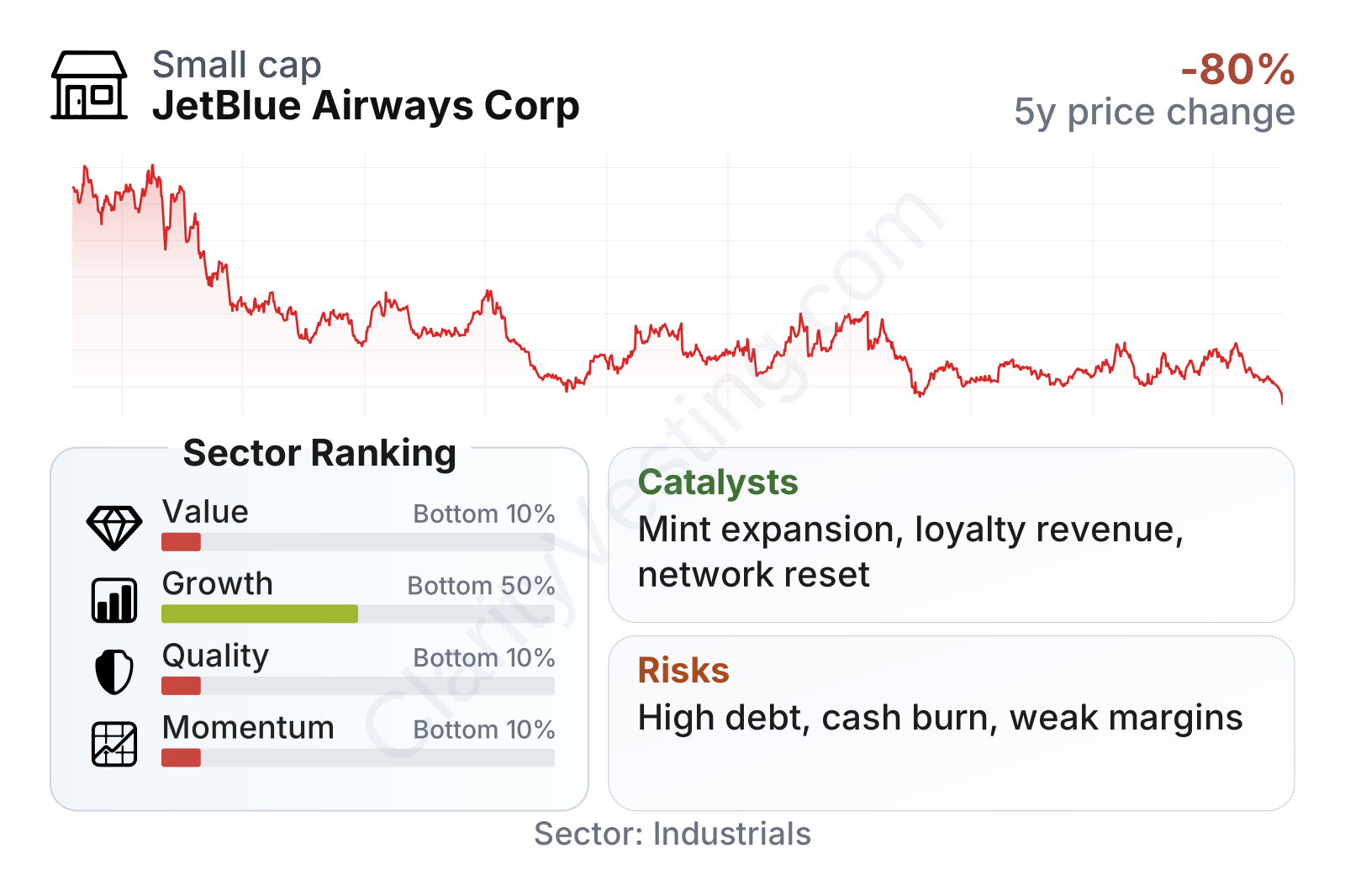
JetBlue is a smaller public airline by market value and its share price has been volatile, which fits the airline industry’s sensitivity to fuel, travel demand, and financing conditions. The table shows a difficult overall profile: value metrics may look optically low in places, but that is largely offset by weak profitability, negative free cash flow, and high leverage. Growth is mixed rather than uniformly weak, with recent revenue growth above the broader sector median, but quality and momentum remain near the bottom of the sector. In practical terms, the market is not treating JetBlue as a stable compounder; it is being priced more like a turnaround case that still needs proof.
Growth
The airline sector is mature, but it can still grow through network shifts, capacity discipline, premium seating, loyalty monetization, and better use of aircraft. JetBlue’s long-term opportunity is less about being in a fast-growing industry and more about improving its position in attractive travel corridors where customer demand remains resilient. Leisure travel to Florida, the Caribbean, and visiting-friends-and-relatives markets has been a durable area of demand, and JetBlue remains well known in those geographies.
Management’s strategy has increasingly emphasized revenue quality over simple expansion. That includes adding more premium seating through its Mint product on selected routes, refining its network, and trying to improve returns rather than just chasing market share. The company has also been adjusting capacity and unprofitable flying after the blocked Spirit merger changed its growth path. That reset can make strategic sense if it leads to a healthier route system and better aircraft utilization, even though it can weigh on near-term scale.
Recent revenue trends show that the sharp post-pandemic rebound faded into a softer period, with declines through much of 2024 and 2025 before a return to positive year-over-year growth in 2026. That rebound is encouraging, especially because it comes after a long stretch of pressure, but it is not yet enough on its own to demonstrate a fully restored earnings engine.
Cash generation remains one of the key issues. Free cash flow has stayed deeply negative for several years, reflecting losses and continued capital needs. For a long-term assessment, this matters as much as revenue growth because airlines need cash to maintain fleets, service debt, and absorb shocks. A recovery in free cash flow would likely be one of the most important signs that the turnaround is becoming more durable.
Recent company updates in 2026 have centered on network optimization, cost actions, and commercial initiatives intended to lift unit revenue. Another notable opportunity remains JetBlue’s loyalty and co-branded card economics, which can grow without adding the same amount of physical capacity as a new route or aircraft. If this higher-margin part of the business expands, it could help smooth some of the cyclicality of ticket sales.
Risks
This article is for informational purposes only and does not constitute financial advice. Some content is AI-generated. See Disclaimer


