Stock Analysis · Julius Bär Gruppe AG (JBARF)
Overview
Julius Bär Gruppe AG is a Swiss private banking group focused on wealth management. In simple terms, it helps wealthy individuals, families, and some institutions manage money, invest assets, borrow against portfolios, plan across generations, and access advisory services. Compared with large universal banks, Julius Bär is much more specialized: its identity is centered on private banking rather than mass-market lending or investment banking.
The business model is mainly driven by client assets. When clients keep more money with the bank, trade more often, or use lending and advisory products, revenue tends to rise. That makes asset levels, market conditions, and client confidence especially important.
Based on the company’s annual reporting structure, Julius Bär’s revenue comes primarily from recurring fee and commission activities, followed by interest-related income, with trading and other ordinary results making up a smaller share. A practical breakdown for recent years is approximately:
- Fee and commission income: about 55% to 65% — portfolio management fees, custody fees, brokerage, fund-related fees, and advisory charges tied to client assets and activity.
- Net interest income: about 25% to 35% — income from loans, deposits, and treasury activities, influenced by interest rates and balance sheet mix.
- Trading income and other ordinary results: about 10% to 15% — foreign exchange, market-making, and other smaller banking-related items.
Geographically, the group serves clients internationally, with Switzerland remaining the core base, while Asia, Europe, and selected emerging markets are important growth regions. This diversified footprint matters because global wealth creation is uneven, and private banks tend to follow the regions where the number of affluent clients rises fastest.
The recent operating profile shows a business that recovered strongly after a difficult 2023. Revenue rebounded in 2024 and expanded further in 2025, while profitability remained sensitive to financing costs and the broader market backdrop. For a wealth manager, that pattern is not unusual: earnings can look very steady in good environments, then move sharply when client activity, asset prices, or credit events change.
The revenue path has been uneven rather than linear. After a sharp drop in 2023, the business recovered in 2024 and revenue moved higher again in 2025. That supports the view that Julius Bär still has meaningful earnings power, but it also shows that results can be affected materially by market conditions and one-off disruptions.
Key Figures
| Metric | Value | Sector ⓘ |
|---|---|---|
| Date | Oct 17, 2026 | |
| Context | ||
| Sector | Financial Services | |
| Industry | Asset Management | |
| Market Cap ⓘ | $17.56B | |
| Beta ⓘ | 0.87 | |
Value (Cheapness) | ||
| P/E Ratio ⓘ | 12.23 | 12.26 |
| P/B Ratio ⓘ | 3.01 | 1.23 |
| FCF Yield ⓘ | 23.85% | 10.40% |
| Dividend Yield ⓘ | 2.98% | 3.02% |
| EBIT / EV ⓘ | N/A | 8.14% |
| PEG ⓘ | 1.00 | |
Growth (Business expansion) | ||
| Revenue Growth ⓘ | 25.70% | 9.35% |
| RPS Growth (5Y CAGR) ⓘ | 5.18% | 12.19% |
| EPS Growth (5Y CAGR) ⓘ | -23.22% | -9.53% |
| BVPS Growth (5Y CAGR) ⓘ | -2.98% | 4.99% |
| Margin Growth (5Y Trend) ⓘ | -15.66% | -3.86% |
| FCF Growth (5Y CAGR) ⓘ | N/A | 4.81% |
| DPS Growth (5Y CAGR) ⓘ | 3.48% | 8.79% |
Quality (Business durability) | ||
| ROIC (Latest) ⓘ | N/A | 9.49% |
| ROE (Latest) ⓘ | 28.29% | 13.90% |
| ROA (Latest) ⓘ | 1.81% | 1.55% |
| ROIC (5Y Median) ⓘ | 5.78% | 7.86% |
| ROE (5Y Median) ⓘ | 14.59% | 12.17% |
| ROA (5Y Median) ⓘ | 0.86% | 1.30% |
| Net Debt / EBIT (Latest) ⓘ | 3.81 | 0.96 |
| Net Debt / EBIT (5Y Median) ⓘ | -13.08 | 0.73 |
| Net Debt / EBITDA (Latest) ⓘ | 2.72 | 0.92 |
| Operating Margin (Latest) ⓘ | 9.86% | 22.30% |
| Operating Margin (5Y Median) ⓘ | 25.19% | 24.63% |
| Debt to Equity (Latest) ⓘ | 151.30% | 58.56% |
| Profit Margin (Latest) ⓘ | 26.99% | 26.57% |
| Free Cash Flow (Latest) ⓘ | $4.19B | |
Momentum (Price trend) | ||
| 3Y Return ⓘ | +62.51% | +88.33% |
| 12M Return (excl. last month) ⓘ | +27.48% | +19.38% |
| 6M Return ⓘ | +7.45% | +4.75% |
| Price vs. 200-Day MA ⓘ | +8.20% | +3.50% |
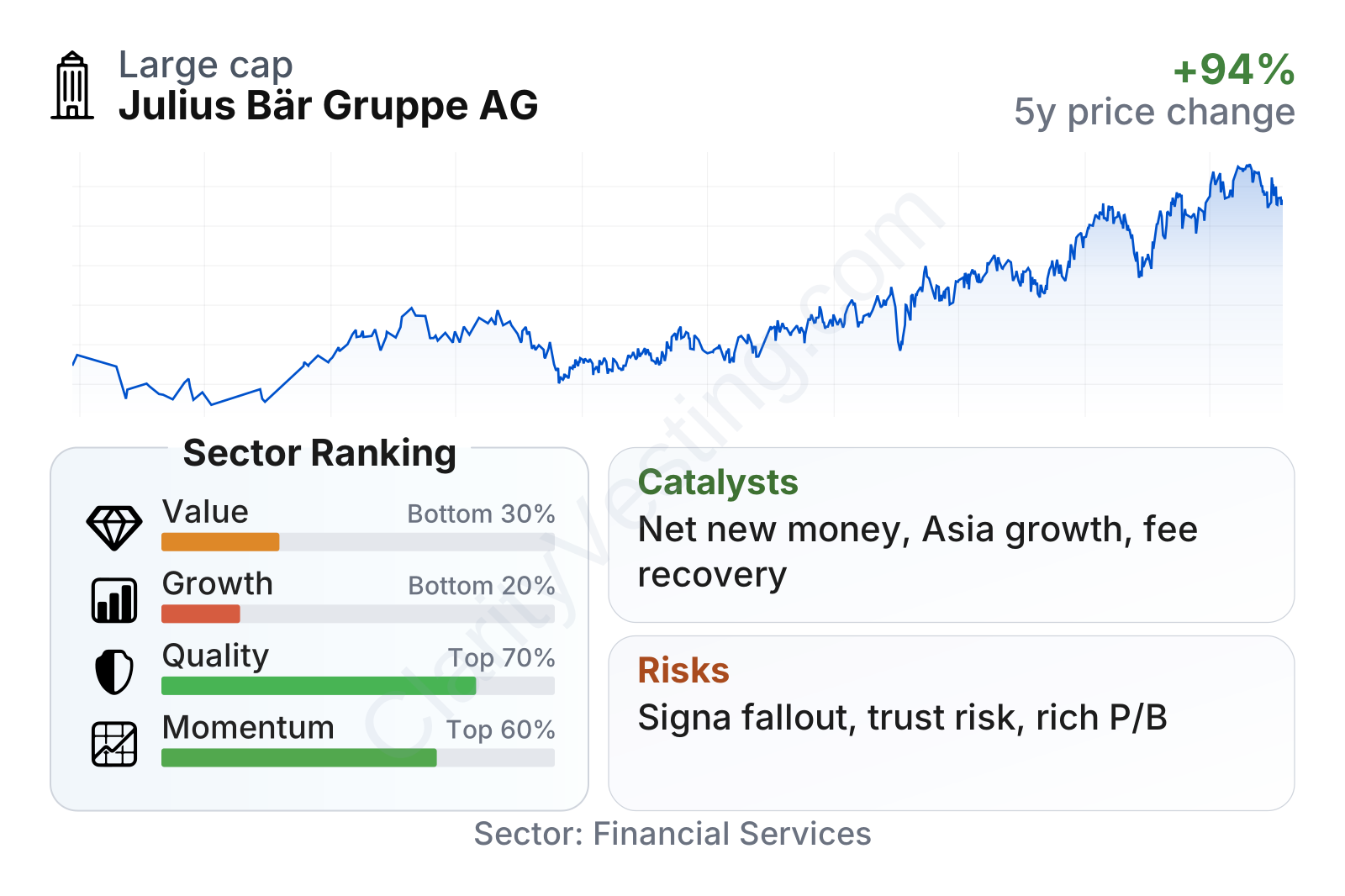
Julius Bär is a large listed wealth manager with a market value in the large-cap range and a share-price volatility slightly below the broader market. On profitability, return on equity is notably above the sector median, and profit margin is roughly in line to slightly better. That indicates a business still capable of producing solid shareholder returns when conditions are normal.
At the same time, the table points to weaker areas beneath the surface. Growth metrics rank near the bottom of the sector despite a strong recent revenue rebound, which suggests that the longer-term record has been uneven. Operating margin is also below the sector median, and leverage-related measures are heavier than many peers. In other words, current profitability looks respectable, but the quality of that profitability is not as clean as the headline return on equity might imply.
Market performance has improved meaningfully over the last year and over six months, and the shares trade well above the 200-day average. That signals stronger sentiment recently. Valuation factors are more mixed: earnings valuation is not far from sector norms, but the price-to-book multiple stands clearly above the median, meaning the market is already recognizing the franchise as more valuable than a typical financial stock.
Growth
Julius Bär operates in a part of financial services that has long-term structural support. Global wealth has tended to grow over time, and the number of high-net-worth individuals has expanded in many regions, especially in Asia and internationally mobile client segments. Private banks that can preserve trust, serve clients across borders, and offer tailored advice can benefit from this trend for many years.
The company’s strategy is logically aligned with that backdrop. Julius Bär remains focused on pure-play wealth management, where scale in relationship management, compliance, investment products, and booking platforms can matter. Its brand is well known in Swiss private banking, and that reputation can be valuable when clients are choosing a custodian for large pools of capital. The group has also emphasized selective hiring of client advisers and growth in regions where private wealth is rising faster than in mature Western European markets.
One important growth driver is net new money, which shows whether the bank is attracting fresh client assets beyond market gains. Another is the interest-rate environment. Higher rates have recently supported many wealth managers through deposit spreads and lending income, although that tailwind can ease if rates normalize. A third driver is normalization after the 2023 disruption tied to credit losses and risk management issues; if the bank stabilizes client confidence and restores cleaner execution, earnings comparisons can look better.
Recent company communications have also pointed to continued efforts to simplify operations, strengthen risk controls, and improve capital efficiency. For a wealth manager, this matters because growth is not only about gathering assets; it is also about converting those assets into durable fee income without taking outsized balance-sheet risk.
Book value per share has not followed a smooth upward path over the last several years. There was a recovery in 2024, but the broader trend is less convincing than what many long-term shareholders usually prefer from a private bank. That makes future growth more dependent on execution and franchise strength than on a steadily compounding balance sheet.
A meaningful recent opportunity is the industry-wide advantage held by independent wealth managers as some ultra-wealthy clients diversify away from very large universal banks. If Julius Bär can present itself as a stable specialist with global reach, that positioning can remain attractive. The strongest catalyst is therefore not a single product launch, but the combination of recurring fee income, international private wealth growth, and the possibility of rebuilding momentum after a difficult period.
Risks
This article is for informational purposes only and does not constitute financial advice. Some content is AI-generated. See Disclaimer


