Stock Analysis · Jazz Pharmaceuticals PLC (JAZZ)
Overview
Jazz Pharmaceuticals PLC is a biopharmaceutical company focused on medicines for serious diseases, mainly in neuroscience, sleep medicine, oncology, and rare diseases. Its business model is straightforward: develop, acquire, and commercialize specialized drugs that address areas where treatment options are limited and where physicians often rely on a smaller number of well-established therapies.
The company’s revenue base is more diversified than a single-product biotech, but it still depends heavily on a few core medicines. Based on its recent annual reporting and product mix, the main sources of revenue are approximately:
- Xywav: about 30% to 35% of revenue. This is Jazz’s leading sleep-disorder medicine, used primarily in narcolepsy and idiopathic hypersomnia.
- Epidiolex/Epidyolex: about 20% to 25%. This cannabis-derived treatment is used for certain severe forms of epilepsy and has become a major growth driver.
- Xyrem: about 10% to 15%. This older narcolepsy treatment remains meaningful, although it is in decline as patients shift to newer products and generic competition increases.
- Rylaze: about 10% to 15%. This oncology product is used in acute lymphoblastic leukemia and lymphoblastic lymphoma.
- Zepzelca: about 8% to 12%. This cancer drug is used in small cell lung cancer and is an important part of Jazz’s oncology platform.
- Vyxeos: about 5% to 8%. This treatment is used in certain high-risk leukemias.
- Other products: roughly 5% to 10%, including smaller neuroscience and oncology medicines and royalties or collaboration-related revenue where applicable.
What stands out is the ongoing shift in the revenue mix. Older products such as Xyrem are becoming less central, while Xywav, Epidiolex, and selected oncology assets are taking a larger role. That matters for long-term analysis because it shows Jazz is trying to replace maturing products with newer branded medicines rather than relying on one aging franchise.
The company also benefits from very high gross margins, which is typical for successful specialty pharmaceuticals. Over the last several years, revenue and gross profit have generally trended upward, while interest expense has moderated. However, operating costs have at times risen sharply, especially selling, general, and administrative spending, which means strong product sales do not always flow cleanly into reported earnings.
Key Figures
| Metric | Value | Sector ⓘ |
|---|---|---|
| Date | Oct 17, 2026 | |
| Context | ||
| Sector | Healthcare | |
| Industry | Biotechnology | |
| Market Cap ⓘ | $13.61B | |
| Beta ⓘ | 0.37 | |
Value (Cheapness) | ||
| P/E Ratio ⓘ | 14.42 | 24.79 |
| P/B Ratio ⓘ | 3.10 | 3.08 |
| FCF Yield ⓘ | 11.33% | 3.15% |
| Dividend Yield ⓘ | N/A | 1.94% |
| EBIT / EV ⓘ | 5.28% | 0.57% |
| PEG ⓘ | 0.96 | |
Growth (Business expansion) | ||
| Revenue Growth ⓘ | 15.50% | 7.45% |
| RPS Growth (5Y CAGR) ⓘ | 7.79% | 8.61% |
| EPS Growth (5Y CAGR) ⓘ | -4.08% | -17.81% |
| BVPS Growth (5Y CAGR) ⓘ | 1.61% | 3.72% |
| Margin Growth (5Y Trend) ⓘ | -25.52% | -0.62% |
| FCF Growth (5Y CAGR) ⓘ | 11.82% | 1.04% |
| DPS Growth (5Y CAGR) ⓘ | N/A | 6.77% |
Quality (Business durability) | ||
| ROIC (Latest) ⓘ | 25.59% | 3.24% |
| ROA (Latest) ⓘ | 8.39% | 3.01% |
| ROIC (5Y Median) ⓘ | 6.95% | 4.60% |
| ROA (5Y Median) ⓘ | -1.94% | 1.89% |
| Net Debt / EBIT (Latest) ⓘ | 3.03 | 1.34 |
| Net Debt / EBIT (5Y Median) ⓘ | 5.58 | 1.84 |
| Net Debt / EBITDA (Latest) ⓘ | 1.70 | 1.00 |
| Net Debt / Assets ⓘ | 25.17% | 5.45% |
| EBITDA / Interest ⓘ | 8.44 | 9.64 |
| Operating Margin (Latest) ⓘ | 20.04% | 9.27% |
| Operating Margin (5Y Median) ⓘ | 21.14% | 7.38% |
| Debt to Equity (Latest) ⓘ | 91.83% | 28.58% |
| Profit Margin (Latest) ⓘ | 20.45% | 3.59% |
| Free Cash Flow (Latest) ⓘ | $1.54B | |
Momentum (Price trend) | ||
| 3Y Return ⓘ | +57.66% | +42.80% |
| 12M Return (excl. last month) ⓘ | +92.33% | +18.50% |
| 6M Return ⓘ | +7.57% | +7.57% |
| Price vs. 200-Day MA ⓘ | +0.07% | +5.12% |
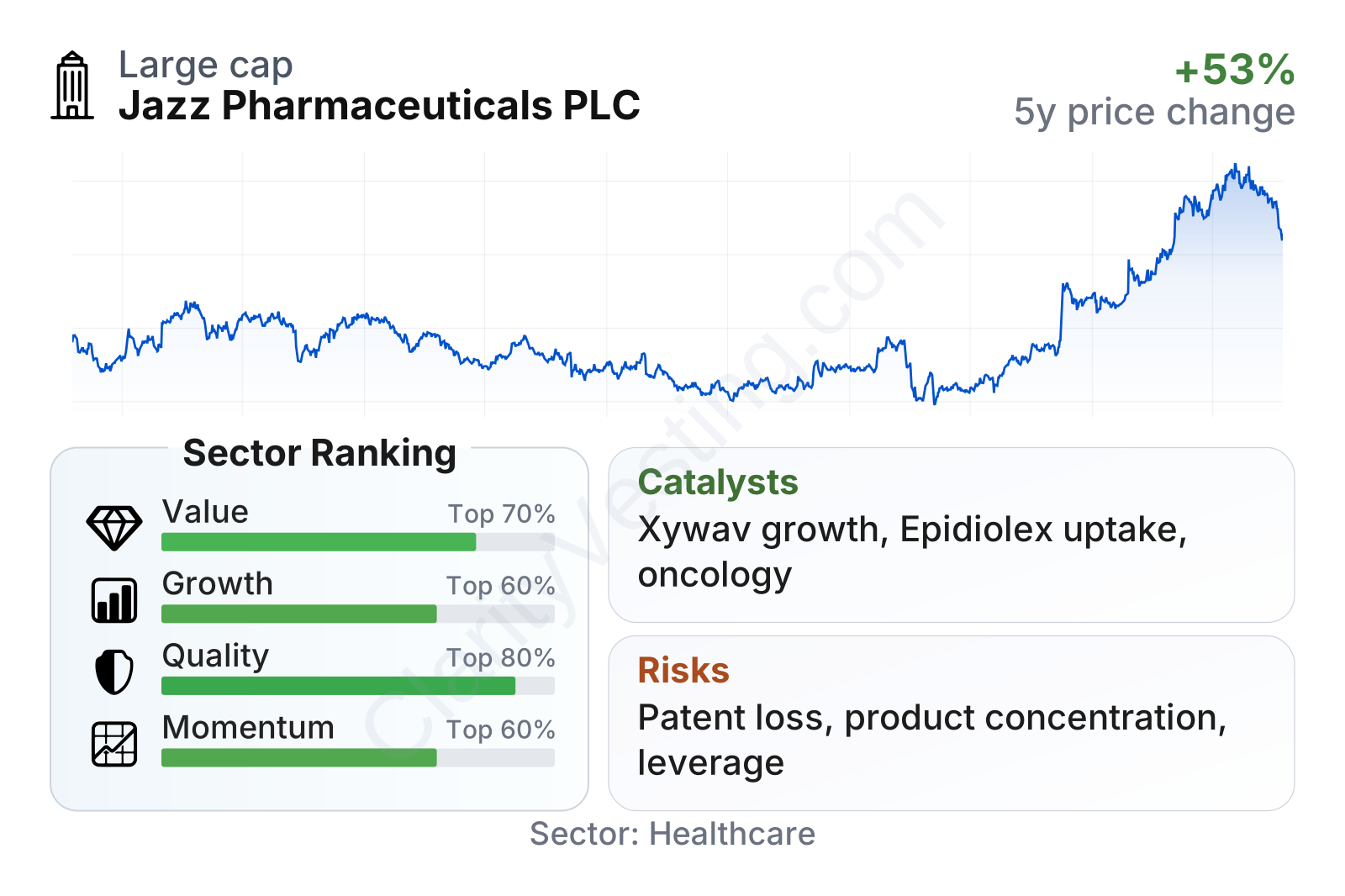
Jazz is a mid-to-large biotechnology company by sector standards, with a relatively low beta of 0.36, which suggests the stock has historically moved less than the broader market. The overall factor profile is solid: quality ranks well within the sector, value metrics look better than many healthcare peers, and growth is above the sector median but not at the very top.
A few figures stand out. Profitability is notably stronger than the industry median, with operating and net margins well above many biotech peers. Free cash flow generation is also unusually strong for the group, which supports debt reduction, acquisitions, and pipeline investment. On valuation measures, the earnings multiple sits below the sector median, while the free cash flow yield is materially stronger than average. That combination gives Jazz a more balanced profile than many biotech companies that trade on future hopes alone.
Growth
Jazz operates in parts of healthcare that still have long-term growth potential. Sleep disorders, epilepsy, and oncology are all areas with durable demand, and rare-disease markets can be especially attractive because successful drugs often have pricing power, focused physician adoption, and longer commercial lives. This does not make growth automatic, but it means the company is active in categories where innovation can translate into meaningful revenue.
The company’s strategy is coherent. It combines internal research with acquisitions and licensing to build a portfolio around specialized medicines. That approach has already reshaped the business: sleep remains a major profit engine, but oncology and epilepsy now provide a broader base than Jazz had several years ago. For a long-term view, that diversification is important because it reduces dependence on one franchise.
Revenue growth has not been perfectly smooth, but the recent trend has improved again, with year-over-year expansion moving back into the mid-teens by 2026. That is comfortably above the sector median. Earlier periods showed slower growth and a brief contraction, so the current acceleration suggests that newer products and commercial execution are offsetting pressure from legacy products more effectively than before.
Cash generation is another encouraging element. Free cash flow has climbed substantially over the last several years, even with some fluctuation in the latest period. At around $1.5 billion on a trailing basis in the latest metrics snapshot, Jazz has meaningful financial flexibility. For a pharmaceutical company, that matters because cash can fund clinical development, business development, and debt reduction without immediate dependence on external financing.
Recent corporate developments also support the growth case. Jazz has continued to emphasize expansion of Xywav, broader uptake of Epidiolex, and development work in oncology, including label expansion efforts and pipeline programs. In practical terms, the strongest catalysts appear to be continued adoption of the newer sleep franchise, oncology execution around Rylaze and Zepzelca, and pipeline readouts that could add new indications or extend product lifecycles.
Risks
This article is for informational purposes only and does not constitute financial advice. Some content is AI-generated. See Disclaimer


