Stock Analysis · Jardine Matheson Holdings Limited (JARLF)
Overview
Jardine Matheson Holdings Limited is a large Asian-focused conglomerate. In simple terms, it is a holding company that owns major stakes in several operating businesses rather than relying on one single activity. Its portfolio spans motor distribution and dealerships, supermarkets and convenience stores, health and beauty retail, home furnishings, restaurants, engineering and construction, financial services, commercial property, hotels, and premium automotive manufacturing. The group’s geographic exposure is centered on Greater China and Southeast Asia, especially Hong Kong, Singapore, Indonesia, Vietnam, and mainland China.
The company’s structure matters because Jardine Matheson does not earn money from one brand alone. A large share of its economic value comes from listed subsidiaries and associates, including Astra, Hongkong Land, Dairy Farm, Mandarin Oriental, and Jardine Cycle & Carriage, as well as wholly owned Jardine Pacific and Jardine Motors. That makes the business more diversified than a typical industrial company, but also more complex to analyze.
Based on the group’s latest annual reporting and the relative size of its major underlying businesses, the main sources of revenue are approximately the following:
- Automotive and mobility-related operations: about 45% to 55% — mainly Astra in Indonesia, Jardine Cycle & Carriage interests, and Jardine Motors. This includes car and motorcycle distribution, dealerships, manufacturing exposure, used vehicles, financing-related activity, and heavy equipment linked to transportation and industrial demand.
- Retail and consumer businesses: about 25% to 35% — mainly Dairy Farm and parts of Astra’s consumer-facing operations. This covers food retail, convenience stores, health and beauty chains, home furnishings, and restaurants.
- Property and hospitality: about 10% to 20% — largely Hongkong Land and Mandarin Oriental. This includes office leasing, mixed-use developments, residential sales, and luxury hotel operations.
- Engineering, construction, and other corporate interests: about 5% to 10% — including Jardine Pacific activities and additional support, infrastructure, and service operations.
Those percentages should be read as broad directional estimates because Jardine Matheson reports through a mix of subsidiaries, associates, and ownership layers, so consolidated revenue does not perfectly capture the full economic contribution of every business in the same way.
The group’s earnings profile is also different from revenue alone. Property, premium assets, and associates can have a much larger impact on profit than on reported sales, while consumer retail can produce high revenue but thinner margins.
Over the last five years, revenue stayed broadly in the mid-$30 billion range, but profit moved much more sharply. Operating income weakened in 2024 and then recovered in 2025, while net income swung from strong profitability in 2021-2022 to a loss in 2024 before returning to positive territory in 2025. That pattern highlights the group’s diversification, but also shows how exposed reported earnings are to property cycles, financing costs, and valuation-related pressure in major subsidiaries.
Key Figures
| Metric | Value | Sector ⓘ |
|---|---|---|
| Date | Oct 03, 2026 | |
| Context | ||
| Sector | Industrials | |
| Industry | Conglomerates | |
| Market Cap ⓘ | $16.98B | |
| Beta ⓘ | 0.43 | |
Value (Cheapness) | ||
| P/E Ratio ⓘ | 15.30 | 22.45 |
| P/B Ratio ⓘ | 0.60 | 1.98 |
| FCF Yield ⓘ | 41.38% | 6.31% |
| Dividend Yield ⓘ | 4.14% | 1.96% |
| EBIT / EV ⓘ | N/A | 4.81% |
| PEG ⓘ | N/A | |
Growth (Business expansion) | ||
| Revenue Growth ⓘ | -6.80% | 9.10% |
| RPS Growth (5Y CAGR) ⓘ | 0.39% | 7.75% |
| EPS Growth (5Y CAGR) ⓘ | N/A | -13.59% |
| BVPS Growth (5Y CAGR) ⓘ | -40.87% | 6.22% |
| Margin Growth (5Y Trend) ⓘ | -0.10% | 0.72% |
| FCF Growth (5Y CAGR) ⓘ | -0.93% | 10.98% |
| DPS Growth (5Y CAGR) ⓘ | 8.59% | 9.48% |
Quality (Business durability) | ||
| ROIC (Latest) ⓘ | N/A | 10.92% |
| ROA (Latest) ⓘ | 1.44% | 5.41% |
| ROIC (5Y Median) ⓘ | 5.36% | 9.21% |
| ROA (5Y Median) ⓘ | 1.28% | 4.94% |
| Net Debt / EBIT (Latest) ⓘ | N/A | 2.07 |
| Net Debt / EBIT (5Y Median) ⓘ | 4.08 | 2.28 |
| Net Debt / EBITDA (Latest) ⓘ | 1.52 | 1.43 |
| Net Debt / Assets ⓘ | 12.22% | 19.27% |
| EBITDA / Interest ⓘ | 4.79 | 9.53 |
| Operating Margin (Latest) ⓘ | N/A | 10.50% |
| Operating Margin (5Y Median) ⓘ | 8.93% | 10.27% |
| Debt to Equity (Latest) ⓘ | 61.84% | 65.48% |
| Profit Margin (Latest) ⓘ | 3.40% | 6.62% |
| Free Cash Flow (Latest) ⓘ | $7.03B | |
Momentum (Price trend) | ||
| 3Y Return ⓘ | +44.31% | +58.56% |
| 12M Return (excl. last month) ⓘ | +2.65% | +15.63% |
| 6M Return ⓘ | -19.00% | +4.19% |
| Price vs. 200-Day MA ⓘ | +11.36% | +0.93% |
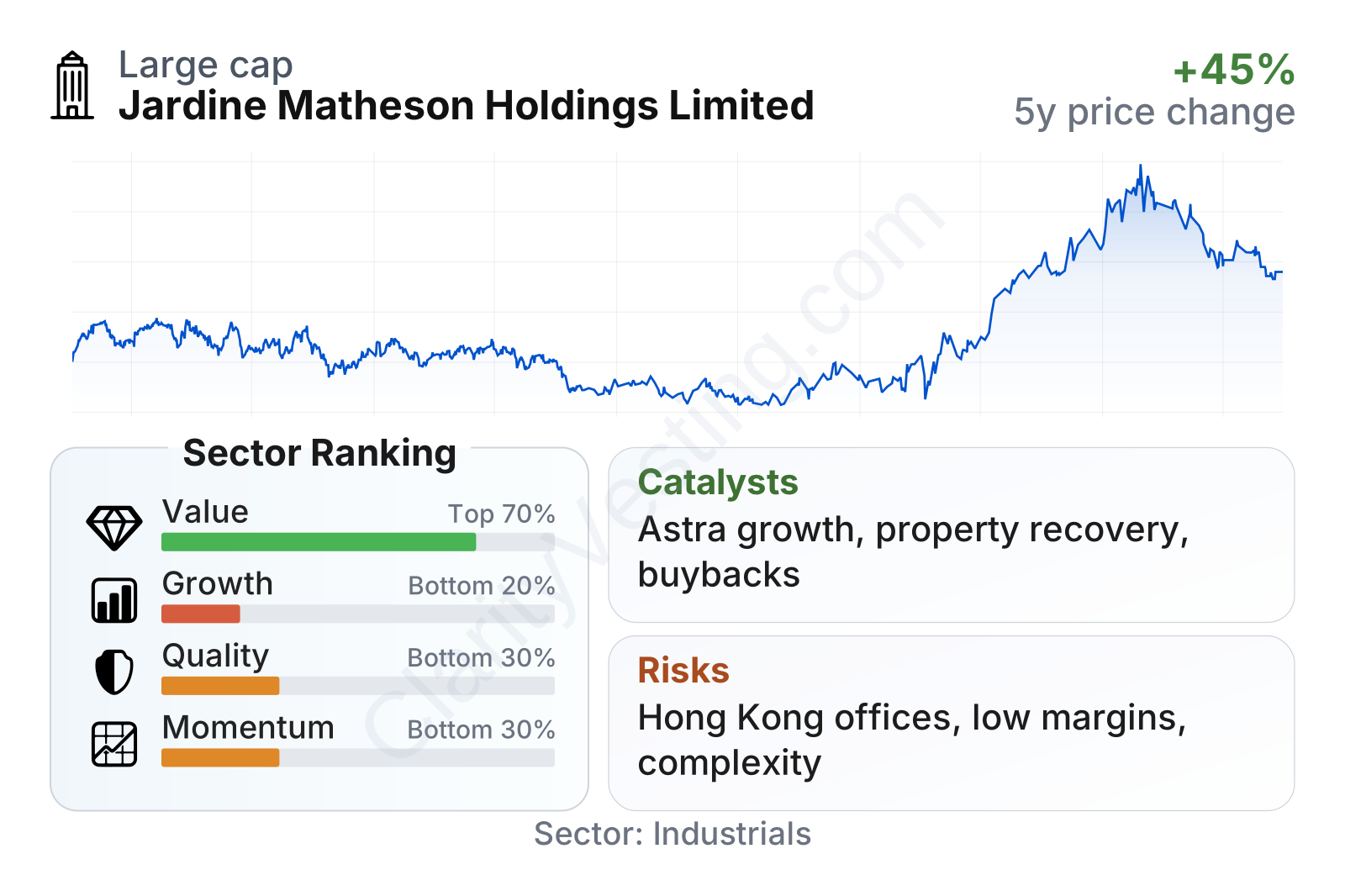
Jardine Matheson is a large-cap company with relatively low share-price volatility, reflected by a beta well below 1. On valuation, several measures look inexpensive versus the broader industrial sector: the earnings multiple is below the sector median, the price-to-book ratio is far lower, free cash flow yield is unusually high, and the trailing dividend yield is above the sector norm.
At the same time, the table also shows why the market may be cautious. Growth ranks in the bottom part of the sector, profitability is modest, and returns on assets and capital trail sector medians. In other words, the shares look optically cheap, but that discount sits next to slow growth and uneven earnings quality rather than clear operational momentum.
Growth
Jardine Matheson operates in sectors that should remain relevant for many years, but not all of them are fast-growing. Consumer retail, mobility, healthcare retail, premium property, and infrastructure-linked services all benefit from long-term urbanization and rising household income in Asia. Indonesia, Vietnam, and parts of Southeast Asia remain attractive markets because vehicle ownership, modern retail penetration, and financial product usage still have room to expand over time.
The group’s strategy broadly makes sense for long-term expansion because it is built around strong regional positions, local scale, and diversified cash flow streams. Astra gives it exposure to Indonesia’s economy, one of the most important growth engines in Southeast Asia. Dairy Farm offers a direct link to everyday consumer spending. Hongkong Land provides access to premium commercial and mixed-use real estate. This combination gives Jardine Matheson several ways to participate in economic growth without depending on a single market or product.
The near-term picture is less impressive than the long-term theme. Recent revenue growth has been negative year over year, and the company’s five-year revenue-per-share trend has been close to flat. That means the growth case currently depends more on recovery and better execution across the portfolio than on visible top-line acceleration.
A meaningful catalyst is the normalization of earnings after the weak 2024 period. The improvement in 2025 operating income and net income suggests some of the pressure was cyclical rather than structural. If Hong Kong commercial property conditions stabilize, if Indonesian mobility and consumer demand remain solid, and if major subsidiaries continue streamlining operations, the group could show stronger earnings conversion than recent headline results suggest.
Another important opportunity is capital allocation. Because Jardine Matheson trades at a large discount to book value, any disciplined asset recycling, subsidiary restructuring, or share repurchase activity can have a bigger effect than at companies already valued close to underlying asset value. In conglomerates, simplified structures and better capital deployment can become major long-term value drivers even when revenue growth is not especially fast.
Recent company communications have also pointed to continued focus on portfolio discipline, operating efficiency, and strengthening businesses with leading positions in their local markets. For a company like Jardine Matheson, steady improvement inside the portfolio can matter more than launching a new high-growth product line.
Risks
This article is for informational purposes only and does not constitute financial advice. Some content is AI-generated. See Disclaimer


