Stock Analysis · Janux Therapeutics Inc (JANX)
Overview
Janux Therapeutics is a clinical-stage biotechnology company focused on cancer treatments. Its work centers on a type of engineered immunotherapy designed to activate the body’s immune system more selectively against tumors. The company’s platform is built around tumor-activated T cell engagers and related immune-oncology approaches that aim to improve anti-cancer activity while reducing unwanted toxicity in healthy tissue.
Because Janux is still in the clinical stage, it does not generate recurring product sales from approved drugs. Its revenue is mainly made up of collaboration and license-related payments tied to research partnerships, along with smaller amounts of other operating revenue when recognized under accounting rules. That makes reported revenue uneven from year to year and much less informative than pipeline progress, cash resources, and trial milestones.
The main revenue sources are currently structured approximately as follows:
- Collaboration and license revenue: nearly 100% — upfront payments, research support, milestone recognition, and similar amounts related to partnership agreements.
- Product revenue: 0% — Janux does not currently have an approved commercial product.
- Other revenue: minimal — generally incidental compared with collaboration-related income.
Operationally, the business is still in investment mode. Research and development is by far the largest expense line, and that spending has risen sharply as programs advance through clinical testing. Revenue has remained modest, while operating losses have widened as the pipeline has expanded.
The financial picture shows a typical early biotech profile: small revenue, heavy research spending, and persistent losses. One notable point is that costs are driven primarily by R&D rather than debt service or manufacturing, which is consistent with a company trying to create future drug assets rather than manage a mature commercial business.
Key Figures
| Metric | Value | Sector ⓘ |
|---|---|---|
| Date | Oct 17, 2026 | |
| Context | ||
| Sector | Healthcare | |
| Industry | Biotechnology | |
| Market Cap ⓘ | $1.05B | |
| Beta ⓘ | 2.39 | |
Value (Cheapness) | ||
| P/E Ratio ⓘ | N/A | 24.79 |
| P/B Ratio ⓘ | 1.17 | 3.08 |
| FCF Yield ⓘ | -4.00% | 3.15% |
| Dividend Yield ⓘ | N/A | 1.94% |
| EBIT / EV ⓘ | -170.83% | 0.57% |
| PEG ⓘ | N/A | |
Growth (Business expansion) | ||
| Revenue Growth ⓘ | 2177.90% | 7.45% |
| RPS Growth (5Y CAGR) ⓘ | 16.31% | 8.61% |
| EPS Growth (5Y CAGR) ⓘ | -17.47% | -17.81% |
| BVPS Growth (5Y CAGR) ⓘ | 14.83% | 3.72% |
| Margin Growth (5Y Trend) ⓘ | N/A | -0.62% |
| FCF Growth (5Y CAGR) ⓘ | N/A | 1.04% |
| DPS Growth (5Y CAGR) ⓘ | N/A | 6.77% |
Quality (Business durability) | ||
| ROIC (Latest) ⓘ | -8.42% | 3.24% |
| ROA (Latest) ⓘ | -10.10% | 3.01% |
| ROIC (5Y Median) ⓘ | -13.67% | 4.60% |
| ROA (5Y Median) ⓘ | -14.56% | 1.89% |
| Net Debt / EBIT (Latest) ⓘ | N/A | 1.34 |
| Net Debt / EBIT (5Y Median) ⓘ | N/A | 1.84 |
| Net Debt / EBITDA (Latest) ⓘ | N/A | 1.00 |
| Net Debt / Assets ⓘ | -0.67% | 5.45% |
| EBITDA / Interest ⓘ | N/A | 9.64 |
| Operating Margin (Latest) ⓘ | -321.81% | 9.27% |
| Operating Margin (5Y Median) ⓘ | -779.04% | 7.38% |
| Debt to Equity (Latest) ⓘ | 2.26% | 28.58% |
| Profit Margin (Latest) ⓘ | N/A | 3.59% |
| Free Cash Flow (Latest) ⓘ | -$41.92M | |
Momentum (Price trend) | ||
| 3Y Return ⓘ | +101.40% | +42.80% |
| 12M Return (excl. last month) ⓘ | -30.22% | +18.50% |
| 6M Return ⓘ | +15.16% | +7.57% |
| Price vs. 200-Day MA ⓘ | +14.34% | +5.12% |
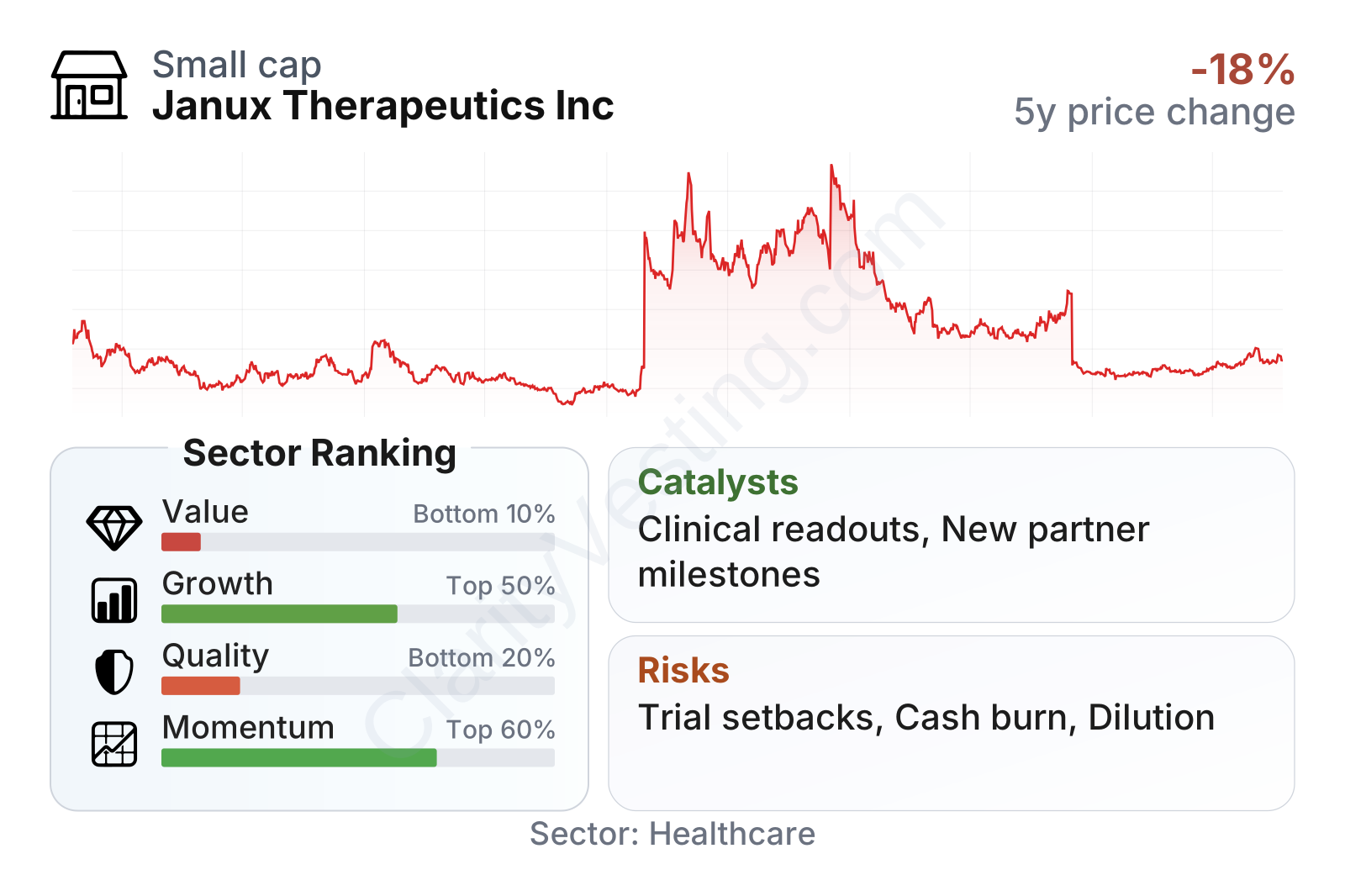
Janux is a small-cap biotech company with unusually high share-price volatility, reflected in a beta above 2. Its growth profile ranks around the middle of the healthcare sector, but that headline masks the reality that revenue is partnership-driven and can swing sharply from one period to another. On valuation screens, the stock looks weak on traditional earnings-based measures because the company is not profitable, although its price-to-book ratio sits below the sector median. Quality metrics are low because returns on capital and assets are negative, which is normal for a development-stage drugmaker but still important for long-term risk assessment.
The stock history also highlights how event-driven the name is. Shares were relatively subdued through 2022 and 2023, surged dramatically in 2024, then gave back a large part of those gains in 2025 and into 2026. That pattern fits a biotechnology company whose valuation is tied more to trial data and pipeline sentiment than to steady business fundamentals.
Growth
Janux operates in one of the more promising areas of biotechnology: cancer immunotherapy. The broad sector remains attractive because successful oncology drugs can generate very large sales, and larger pharmaceutical companies continue to seek external innovation through licensing and acquisitions. Within that market, T cell engagers and next-generation immune therapies are receiving strong industry attention, especially approaches that may improve the balance between effectiveness and safety.
Janux’s growth strategy is logically built around proving that its tumor-activated design can work better than earlier generations of similar therapies. If that approach produces encouraging efficacy with a cleaner safety profile, the company could strengthen its negotiating position for partnerships, increase the perceived value of its pipeline, and potentially move multiple programs forward. In biotech, that is often the key path to long-term value creation before any product launch.
Revenue growth has been extremely volatile. Some periods show very large increases, while others show steep declines. That does not reflect a stable expansion in customer demand; it mainly reflects the timing of collaboration revenue recognition. For that reason, reported sales growth matters less here than clinical execution and the ability to secure meaningful development partnerships.
Cash generation remains negative, and recent free cash flow has moved deeper into the red. That is not unusual for a company running expensive clinical programs, but it does mean growth depends on careful capital management. The encouraging counterbalance is that Janux has kept debt very low, so the main funding question is dilution risk and cash runway rather than balance-sheet stress from borrowing.
A meaningful catalyst came from the company’s clinical progress updates and continued advancement of lead programs targeting prostate cancer and other tumor types. The biggest opportunities usually come from trial readouts that suggest better efficacy, better tolerability, or both. In addition, any expansion of existing partnerships or new licensing deals with larger pharmaceutical companies would likely be viewed as an external validation of the platform.
Risks
This article is for informational purposes only and does not constitute financial advice. Some content is AI-generated. See Disclaimer


