Stock Analysis · Janus Living Inc (JAN)
Overview
Janus Living Inc is a residential real estate company in the REIT category. In simple terms, it owns and operates housing assets and earns income from those properties. The business sits in the residential real estate segment, where performance is usually driven by occupancy, rental rates, operating costs, and the company’s ability to add properties or improve the income produced by existing ones.
The available public financial breakdown suggests that revenue is highly concentrated in its core property operations rather than spread across many business lines. Based on the latest annual figures, the company appears to have a fairly straightforward model:
- Property-related revenue: about 100% of total revenue. This mainly reflects income generated by the residential portfolio, such as rent and other property-level charges tied to occupancy and resident services.
- Other revenue: not material based on available disclosures. No large secondary revenue stream stands out in the latest financial profile.
That concentration can be a strength because the business is easy to understand, but it also means results depend heavily on the health of one market: residential real estate operations.
The latest annual flow of income also shows a notable pattern: revenue increased strongly from 2024 to 2025, but expenses rose even faster, leaving the company with operating and net losses despite the larger top line. That is an important theme for long-term analysis because growth alone is not enough if property expenses, overhead, or integration costs keep profitability under pressure.
The income flow highlights a mixed picture: sales expanded sharply year over year, but total operating expenses climbed even more quickly, which pushed operating results further into the red. Interest expense remained low, so the main pressure did not come from heavy borrowing costs; it came from the cost structure and the gap between revenue growth and operating efficiency.
Key Figures
| Metric | Value | Sector ⓘ |
|---|---|---|
| Date | Oct 24, 2026 | |
| Context | ||
| Sector | Real Estate | |
| Industry | REIT - Residential | |
| Market Cap ⓘ | $8.81B | |
| Beta ⓘ | N/A | |
Value (Cheapness) | ||
| P/E Ratio ⓘ | N/A | 17.85 |
| P/B Ratio ⓘ | 4.38 | 0.87 |
| FCF Yield ⓘ | 0.19% | 7.30% |
| Dividend Yield ⓘ | 0.55% | 4.83% |
| EBIT / EV ⓘ | 0.60% | 3.78% |
| PEG ⓘ | N/A | |
Growth (Business expansion) | ||
| Revenue Growth ⓘ | 45.40% | 5.35% |
| RPS Growth (5Y CAGR) ⓘ | N/A | 6.02% |
| EPS Growth (5Y CAGR) ⓘ | N/A | -10.65% |
| BVPS Growth (5Y CAGR) ⓘ | N/A | 0.43% |
| Margin Growth (5Y Trend) ⓘ | N/A | -0.69% |
| FCF Growth (5Y CAGR) ⓘ | N/A | 5.40% |
| DPS Growth (5Y CAGR) ⓘ | N/A | 5.07% |
Quality (Business durability) | ||
| ROIC (Latest) ⓘ | N/A | 5.69% |
| ROE (Latest) ⓘ | 2.43% | 7.37% |
| ROA (Latest) ⓘ | N/A | 2.85% |
| ROIC (5Y Median) ⓘ | N/A | 4.26% |
| ROE (5Y Median) ⓘ | N/A | 6.04% |
| ROA (5Y Median) ⓘ | N/A | 2.45% |
| Net Debt / EBIT (Latest) ⓘ | -36.86 | 7.55 |
| Net Debt / EBIT (5Y Median) ⓘ | N/A | 8.26 |
| Net Debt / EBITDA (Latest) ⓘ | -7.27 | 5.26 |
| Net Debt / Assets ⓘ | -33.07% | 37.45% |
| EBITDA / Interest ⓘ | 82.41 | 4.11 |
| Operating Margin (Latest) ⓘ | 5.91% | 33.86% |
| Operating Margin (5Y Median) ⓘ | N/A | 37.49% |
| Debt to Equity (Latest) ⓘ | N/A | 88.76% |
| Profit Margin (Latest) ⓘ | 1.83% | 18.94% |
| Free Cash Flow (Latest) ⓘ | $16.45M | |
Momentum (Price trend) | ||
| 3Y Return ⓘ | N/A | +36.33% |
| 12M Return (excl. last month) ⓘ | N/A | +4.32% |
| 6M Return ⓘ | +20.10% | -1.74% |
| Price vs. 200-Day MA ⓘ | N/A | -1.42% |
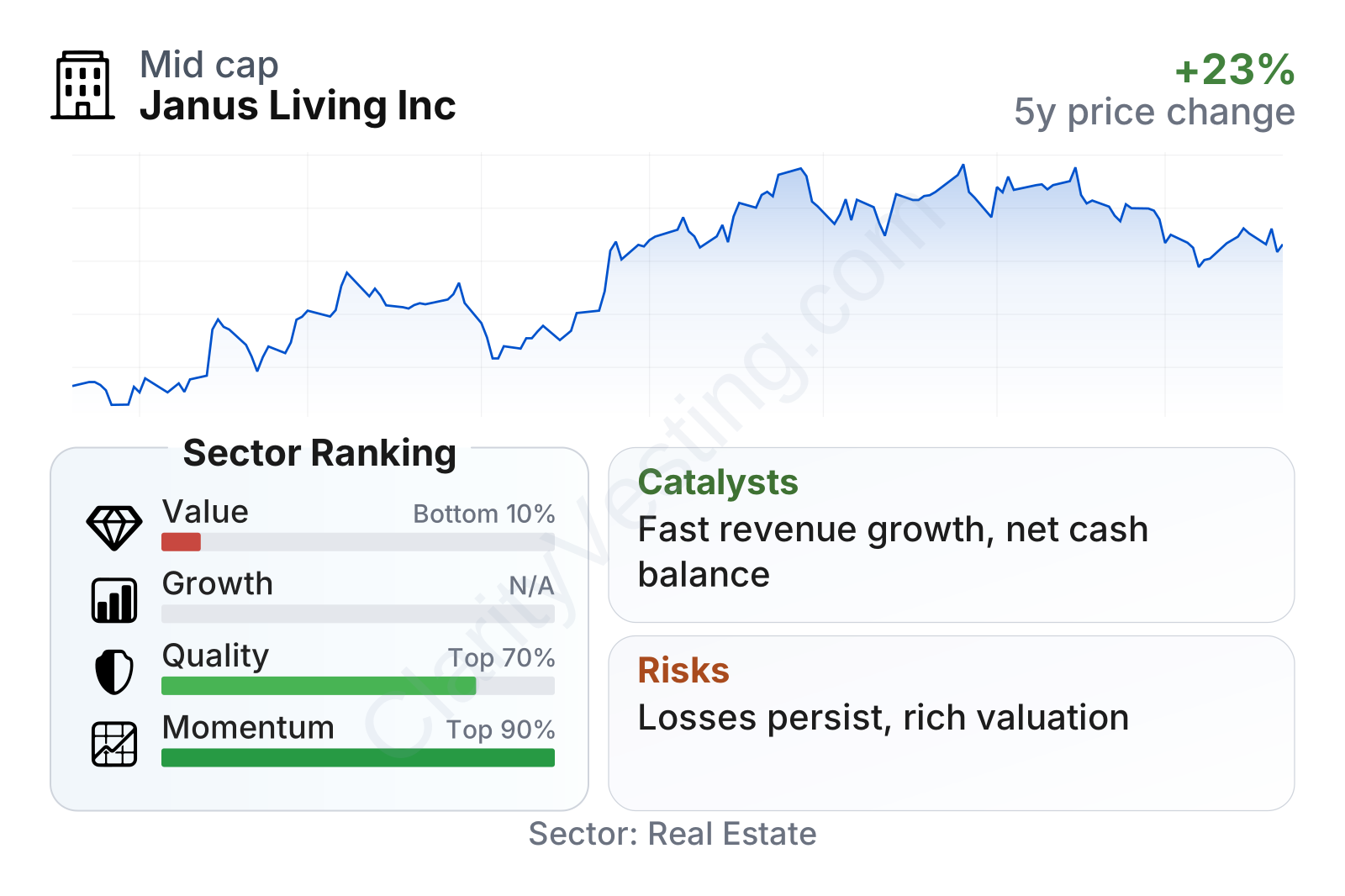
Janus Living is a mid-sized listed real estate company with a market value around the large single-digit billions of dollars. Recent share performance has been strong, with the stock rising meaningfully over the past six months and continuing higher through 2026. That momentum stands out against the broader real estate group.
The broader financial profile is less straightforward. Growth has been strong, with revenue up about 45% year over year, far above the sector median. Balance sheet measures also look unusually strong for a REIT: the company carries net cash rather than net debt, and interest coverage is very high. Those are uncommon positives in a sector that often relies heavily on leverage.
At the same time, profitability and valuation metrics are more demanding. Operating margin is only around 6% versus a much higher sector median, profit margin is also thin, free cash flow yield is very low, and the price-to-book ratio is far above the sector norm. In short, the market is valuing Janus Living more like a growth-oriented property platform than a typical income-focused residential REIT.
Growth
Residential real estate remains a structurally important sector because housing demand is persistent over long periods. In favorable local markets, companies can grow through rent increases, higher occupancy, redevelopment, and acquisitions. That makes the sector attractive when management can expand without damaging returns.
Janus Living’s recent numbers indicate that the company is capturing growth at the revenue level. Revenue per share moved up clearly from 2024 to 2025, which is more meaningful than total revenue alone because it shows that the business expanded on a per-share basis rather than relying only on issuing more stock.
The strategic logic appears sensible if the company is building scale in residential assets and using a relatively conservative balance sheet to support expansion. The combination of strong top-line growth and low leverage gives Janus Living more flexibility than many peers to pursue acquisitions, reposition assets, or fund improvements internally. In a sector where debt can become a major constraint, that flexibility is a real advantage.
One recent opportunity sign is the sharp improvement in stock market momentum during 2026. While share-price strength is not a business result by itself, it can help a real estate company in practical ways by improving access to capital and increasing strategic room for portfolio growth. The company’s latest metrics also suggest that the market is responding to expansion potential more than current profitability.
The dividend picture is less supportive of the growth case. Dividend per share fell significantly from 2024 to 2025, which suggests management is preserving cash rather than emphasizing immediate shareholder payouts.
That lower payout can still fit a long-term growth strategy if retained cash is being used productively. For a residential REIT, a reduced dividend is easier to accept when it helps fund property upgrades, acquisitions, or operational improvements that can lift future cash generation. The key question is whether Janus Living can turn today’s rapid revenue expansion into stronger margins and more dependable cash flow over time.
Risks
This article is for informational purposes only and does not constitute financial advice. Some content is AI-generated. See Disclaimer


