Stock Analysis · Invesco Plc (IVZ)
Overview
Invesco Plc is a global asset manager. In simple terms, it runs investment products and manages money on behalf of individuals, financial advisers, institutions, retirement plans, and sovereign clients. Its offerings include exchange-traded funds, mutual funds, separately managed accounts, alternatives, and retirement-related strategies across equities, fixed income, multi-asset, and private markets.
The company’s business model is mostly based on fees charged on assets under management. When client assets rise because of market gains or net inflows, revenue usually improves; when markets fall or clients withdraw money, revenue can come under pressure. That makes Invesco closely tied to both financial market levels and its ability to gather and retain client assets.
Based on company reporting, Invesco’s revenue mix is primarily organized by client and product channels rather than by a single product line. The broad sources of revenue can be summarized as follows:
- Investment management fees: about 85% to 90% of total revenue. This is the core business and includes recurring fees from ETFs, active funds, retirement products, institutional mandates, and advisory accounts.
- Performance fees: about 1% to 3%. These are less predictable and depend on selected strategies outperforming agreed benchmarks or return hurdles.
- Service and distribution-related revenue plus other income: about 8% to 12%. This can include administrative, transfer agency, and other client servicing items, alongside smaller miscellaneous revenue lines.
At the product level, ETFs are especially important because Invesco is one of the largest ETF providers globally through the Invesco QQQ franchise and a broad range of index and thematic products. Active strategies remain a large part of the franchise as well, including fixed income, international equities, and private market capabilities. Geographically, the company has a meaningful presence in North America, Europe, and Asia-Pacific, which gives it broader distribution than many mid-sized asset managers.
The business flow over recent years shows a cyclical profile: revenue has stayed in the multibillion-dollar range, but profitability has been uneven, with periods of strong earnings followed by years affected by market weakness, margin pressure, and charges. That pattern matters because asset management can look highly cash generative in good periods while reported earnings become volatile when markets, mix, or restructuring costs move against the firm.
The long-term picture is not one of steady margin expansion. Revenue has remained fairly resilient, but profit conversion has been inconsistent, including loss-making periods at the operating and net income level. That suggests the key issue is not scale alone, but how efficiently Invesco turns its large asset base into durable earnings.
Key Figures
| Metric | Value | Sector ⓘ |
|---|---|---|
| Date | Oct 17, 2026 | |
| Context | ||
| Sector | Financial Services | |
| Industry | Asset Management | |
| Market Cap ⓘ | $12.33B | |
| Beta ⓘ | 1.63 | |
Value (Cheapness) | ||
| P/E Ratio ⓘ | N/A | 12.26 |
| P/B Ratio ⓘ | 1.14 | 1.23 |
| FCF Yield ⓘ | 15.94% | 10.40% |
| Dividend Yield ⓘ | 2.94% | 3.02% |
| EBIT / EV ⓘ | -1.67% | 8.14% |
| PEG ⓘ | 0.90 | |
Growth (Business expansion) | ||
| Revenue Growth ⓘ | 20.50% | 9.35% |
| RPS Growth (5Y CAGR) ⓘ | -1.31% | 12.19% |
| EPS Growth (5Y CAGR) ⓘ | -7.00% | -9.53% |
| BVPS Growth (5Y CAGR) ⓘ | -0.52% | 4.99% |
| Margin Growth (5Y Trend) ⓘ | -46.21% | -3.86% |
| FCF Growth (5Y CAGR) ⓘ | 10.42% | 4.81% |
| DPS Growth (5Y CAGR) ⓘ | 2.32% | 8.79% |
Quality (Business durability) | ||
| ROIC (Latest) ⓘ | -1.43% | 9.49% |
| ROE (Latest) ⓘ | -1.90% | 13.90% |
| ROA (Latest) ⓘ | -0.23% | 1.55% |
| ROIC (5Y Median) ⓘ | 4.10% | 7.86% |
| ROE (5Y Median) ⓘ | 4.03% | 12.17% |
| ROA (5Y Median) ⓘ | 2.77% | 1.30% |
| Net Debt / EBIT (Latest) ⓘ | N/A | 0.96 |
| Net Debt / EBIT (5Y Median) ⓘ | 4.98 | 0.73 |
| Net Debt / EBITDA (Latest) ⓘ | 0.48 | 0.92 |
| Operating Margin (Latest) ⓘ | -5.74% | 22.30% |
| Operating Margin (5Y Median) ⓘ | 17.53% | 24.63% |
| Debt to Equity (Latest) ⓘ | 13.02% | 58.56% |
| Profit Margin (Latest) ⓘ | -0.93% | 26.57% |
| Free Cash Flow (Latest) ⓘ | $1.97B | |
Momentum (Price trend) | ||
| 3Y Return ⓘ | +146.15% | +88.33% |
| 12M Return (excl. last month) ⓘ | +42.16% | +19.38% |
| 6M Return ⓘ | +18.25% | +4.75% |
| Price vs. 200-Day MA ⓘ | +4.06% | +3.50% |
Invesco is a large publicly traded asset manager, with a market value in the low tens of billions of dollars. The shares have been volatile, which is not unusual for a company whose earnings power depends heavily on market levels and investor flows. The stock’s beta above 1.5 also points to above-average sensitivity to market swings.
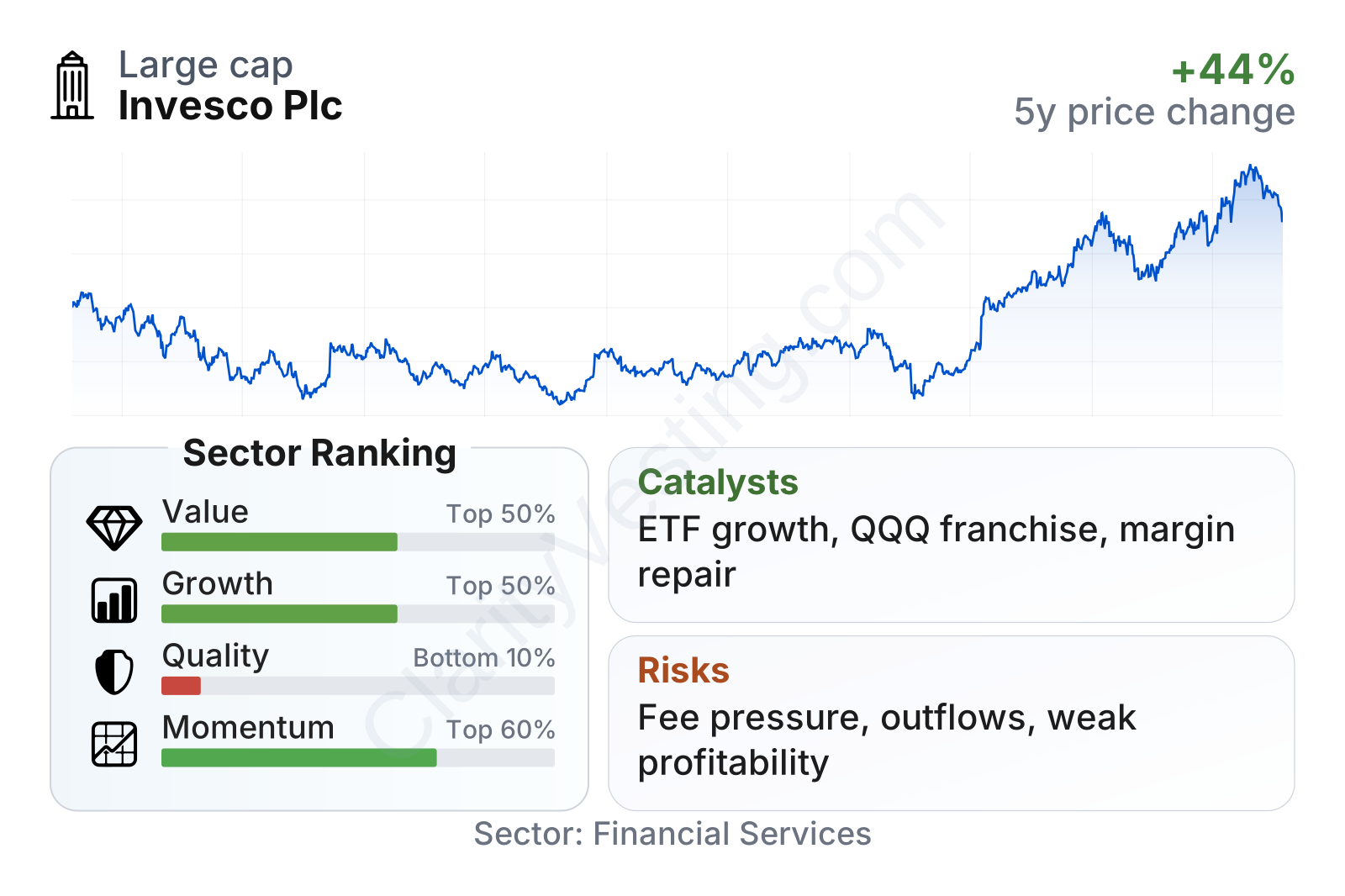
The overall factor profile is mixed. Growth metrics currently rank in the upper half of the sector, helped by strong recent year-over-year revenue growth and solid free cash flow expansion over five years. Momentum is also favorable relative to many financial peers, reflecting a strong multi-year share price recovery. By contrast, quality metrics rank near the bottom of the sector, mainly because recent profitability and returns on capital have been weak or negative. Valuation is not obviously stretched on book value and cash flow measures, but it also does not screen as especially cheap once profitability concerns are considered.
Free cash flow remains a notable support point. Invesco is still producing substantial cash relative to its size, and leverage looks moderate on debt-to-equity and net debt to EBITDA. That helps offset some of the concern created by weaker accounting profitability.
Growth
Invesco operates in a sector that still has structural growth behind it. Over time, global savings pools are expanding, retirement systems continue shifting toward market-based investing, and ETFs keep taking share from traditional products. Those trends support long-run asset management demand even though individual firms can lag if they lose flows or fail to stay relevant in product design and distribution.
Invesco’s strategy broadly fits the parts of the market that continue to grow. Its ETF platform is a major asset, particularly the QQQ franchise, which benefits from strong brand recognition and persistent demand for low-cost, liquid vehicles linked to large-cap growth and technology exposure. The company has also been building private markets and solutions capabilities, areas where fee rates are often higher than in plain-vanilla index products. If that mix improves, growth can become less dependent on purely rising equity markets.
Recent operating momentum looks better than the longer-term record. Revenue growth of about 21% year over year is clearly ahead of the sector median, showing that current conditions are more favorable than the five-year averages imply. However, the five-year trends for revenue per share and book value per share remain soft, which means the turnaround case still needs to prove durability.
Earnings per share have improved from the trough years, but the progression has not been smooth. The path suggests partial recovery rather than a clean upward trend. For a long-term view, the key question is whether better asset levels and product mix can turn that recent improvement into more stable earnings power.
Book value per share had improved through 2024 before retreating in 2025, another sign that Invesco’s progress has been uneven. In asset management, book value is less important than at banks or insurers, but a stable or rising capital base still matters because it reflects balance-sheet resilience and the cumulative effect of profits, buybacks, dividends, and market-related adjustments.
A meaningful catalyst is the continued industry shift toward ETFs and model-based portfolio construction. Invesco already has established distribution in these channels, so it does not need to create a presence from scratch. Another potential catalyst is margin repair through cost discipline and a better product mix, especially if higher-fee capabilities such as active fixed income, international strategies, and alternatives gain traction. If markets remain constructive, operating leverage can be significant because fee revenue tends to rise faster than fixed costs.
Recent company updates have also emphasized strategic execution around private markets, active ETFs, and international expansion partnerships. None of these alone changes the whole investment case, but together they show that management is trying to push the franchise toward areas with stronger demand and potentially better economics than commoditized traditional mutual funds.
Risks
This article is for informational purposes only and does not constitute financial advice. Some content is AI-generated. See Disclaimer


