Stock Analysis · Investec Group (IVTJF)
Overview
Investec Group is an international banking and wealth management company with roots in South Africa and a meaningful presence in the United Kingdom. Its business model is more specialized than that of a large mass-market bank. Rather than focusing on everyday retail banking at scale, Investec centers on private banking, lending, wealth management, advisory work, investment activities, and selected corporate and institutional services.
The group reports through two main operating divisions: Wealth & Investment and Specialist Banking. In practice, that means it earns money from managing client assets and advice on one side, while on the other it generates income from lending, banking services, treasury activities, and related fees. This mix gives it exposure both to recurring fee income and to interest-driven banking income.
Based on recent annual reporting, the main revenue sources can be summarized as follows:
- Net interest income: approximately 45% to 55% of core operating income. This is the spread between what Investec earns on loans and banking assets and what it pays on funding and deposits.
- Wealth and asset management fees: approximately 20% to 30%. This includes recurring fees for managing client portfolios, financial advice, and related wealth services.
- Non-interest banking income: approximately 15% to 25%. This includes lending fees, transactional income, advisory fees, commissions, and treasury or client flow activities.
- Investment and other income: usually below 10%. This can include gains from investments, associates, and smaller supporting revenue lines.
Geographically, the business is still anchored in South Africa and the UK, which are the group’s two most important markets. That matters because earnings are influenced not only by company execution, but also by interest rates, economic activity, regulation, and currency movements in those countries.
The earnings flow also shows a business that has remained profitable, with revenue and operating profit recovering well from earlier periods, although banking costs and interest-related movements can make reported figures look less smooth from year to year than in a typical industrial company.
The overall pattern points to a company where income has improved over the last few years, while net profit has remained solid even as financing and operating costs moved around. For a bank-like business, that combination suggests a resilient earnings base rather than a perfectly linear growth path.
Key Figures
| Metric | Value | Sector ⓘ |
|---|---|---|
| Date | Oct 17, 2026 | |
| Context | ||
| Sector | Financial Services | |
| Industry | Capital Markets | |
| Market Cap ⓘ | $5.55B | |
| Beta ⓘ | 0.44 | |
Value (Cheapness) | ||
| P/E Ratio ⓘ | 8.77 | 12.26 |
| P/B Ratio ⓘ | 1.31 | 1.23 |
| FCF Yield ⓘ | -44.24% | 10.40% |
| Dividend Yield ⓘ | 4.35% | 3.02% |
| EBIT / EV ⓘ | N/A | 8.14% |
| PEG ⓘ | N/A | |
Growth (Business expansion) | ||
| Revenue Growth ⓘ | 9.40% | 9.35% |
| RPS Growth (5Y CAGR) ⓘ | 28.82% | 12.19% |
| EPS Growth (5Y CAGR) ⓘ | -12.51% | -9.53% |
| BVPS Growth (5Y CAGR) ⓘ | 6.82% | 4.99% |
| Margin Growth (5Y Trend) ⓘ | -13.40% | -3.86% |
| FCF Growth (5Y CAGR) ⓘ | N/A | 4.81% |
| DPS Growth (5Y CAGR) ⓘ | 9.56% | 8.79% |
Quality (Business durability) | ||
| ROIC (Latest) ⓘ | N/A | 9.49% |
| ROE (Latest) ⓘ | 23.59% | 13.90% |
| ROA (Latest) ⓘ | 2.27% | 1.55% |
| ROIC (5Y Median) ⓘ | 8.68% | 7.86% |
| ROE (5Y Median) ⓘ | 12.46% | 12.17% |
| ROA (5Y Median) ⓘ | 1.21% | 1.30% |
| Net Debt / EBIT (Latest) ⓘ | N/A | 0.96 |
| Net Debt / EBIT (5Y Median) ⓘ | -4.86 | 0.73 |
| Net Debt / EBITDA (Latest) ⓘ | -0.44 | 0.92 |
| Operating Margin (Latest) ⓘ | N/A | 22.30% |
| Operating Margin (5Y Median) ⓘ | 40.11% | 24.63% |
| Debt to Equity (Latest) ⓘ | 42.00% | 58.56% |
| Profit Margin (Latest) ⓘ | 34.07% | 26.57% |
| Free Cash Flow (Latest) ⓘ | -$2.46B | |
Momentum (Price trend) | ||
| 3Y Return ⓘ | +85.74% | +88.33% |
| 12M Return (excl. last month) ⓘ | +40.33% | +19.38% |
| 6M Return ⓘ | +6.59% | +4.75% |
| Price vs. 200-Day MA ⓘ | +92.23% | +3.50% |
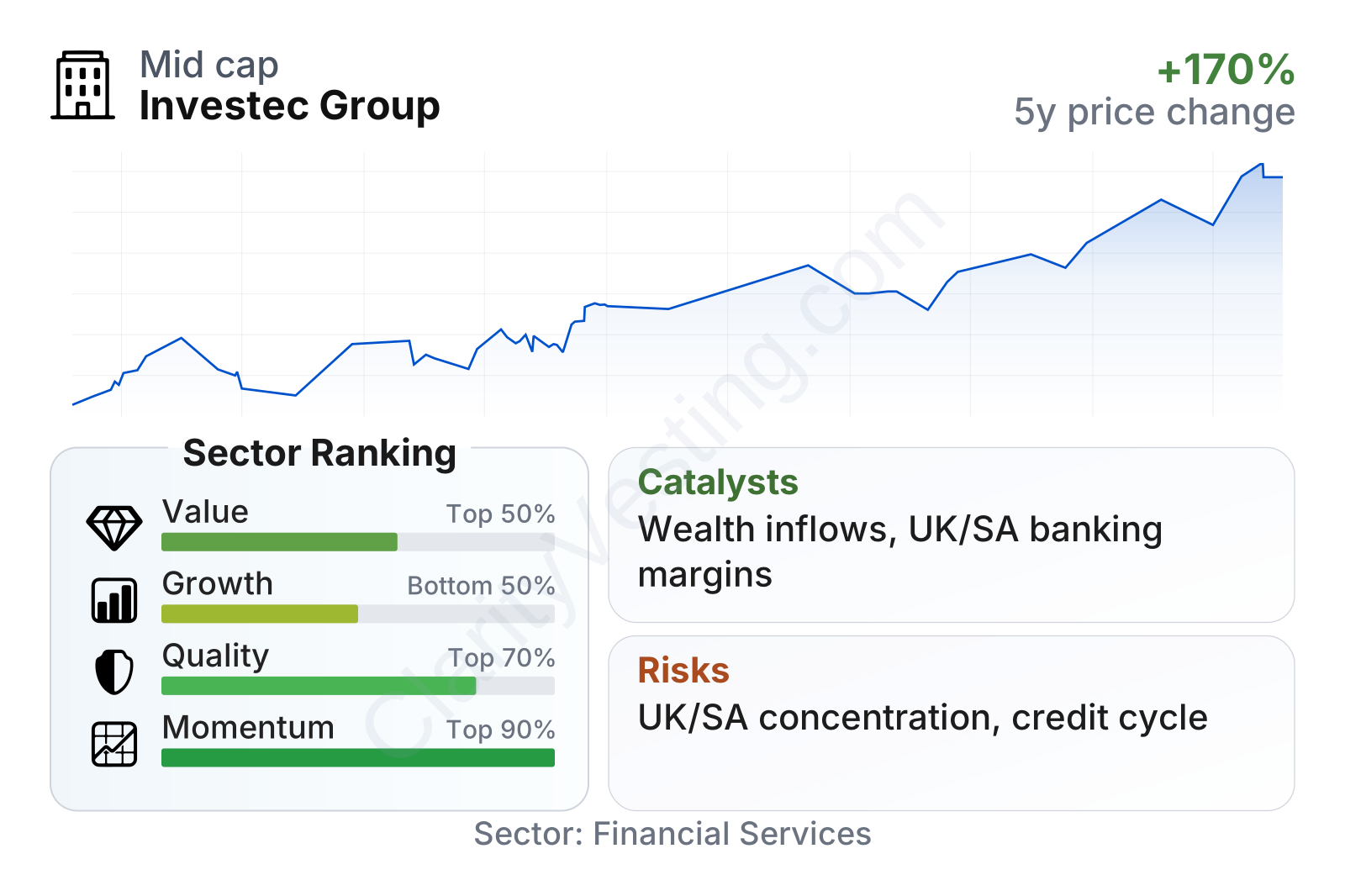
Investec stands out for profitability and balance-sheet discipline more than for rapid, steady earnings expansion. Return on equity is clearly above the sector median, profit margin is also stronger than many peers, and debt relative to equity appears lower than the industry midpoint. That supports the view of a well-run financial group with healthy returns on capital.
On valuation measures, the shares trade on a lower earnings multiple than the sector median, while the price-to-book ratio is slightly above the sector midpoint. That mix often appears when the market recognizes quality and profitability, but still stops short of assigning a premium similar to larger global financial franchises. Dividend yield is also above the sector median, adding to total return potential, although free cash flow is not very useful here in the same way it would be for a non-financial company because banking cash flow can be volatile and accounting-driven.
Price performance has been strong in the last year and over six months, and the shares sit well above the long-term moving average. That signals improving market confidence, even if the stock’s longer three-year return is not dramatically ahead of the broader financial sector.
Growth
Investec operates in parts of financial services that should remain relevant over the long term: private banking for affluent clients, wealth management, corporate lending, and advisory services. These are not hyper-growth markets in the way software or semiconductors can be, but they can still deliver durable expansion when a company has strong client relationships, trusted branding, and disciplined underwriting.
The most convincing part of the growth case is strategic positioning rather than pure industry speed. Wealth management can produce recurring fee income as client assets grow over time. Specialist banking can benefit from higher client activity, selective loan growth, and a deeper product offering for entrepreneurs, professionals, and mid-sized businesses. In South Africa and the UK, established relationships and regulatory know-how can create a useful barrier to entry.
There are also some encouraging longer-term indicators. Revenue per share has grown much faster than the sector median over five years, and book value per share has continued to rise. That matters for a financial company because compounding book value often reflects retained earnings and capital strength building over time, even when annual earnings are uneven.
Earnings per share have not shown the same consistency as revenue per share and book value. Over five years, the earnings trend has been weaker than the sector median, which suggests that margin pressure, credit conditions, or business mix changes have interrupted the conversion of revenue growth into steady bottom-line progress. For long-term analysis, this makes future execution more important than simple top-line growth.
The rise in book value per share supports the idea that the franchise has been adding economic value over time. For a bank and wealth business, that is often a more stable anchor than short-term earnings swings. If management continues to expand client assets, protect credit quality, and maintain attractive returns on equity, book value growth can remain an important driver of long-term value creation.
A meaningful catalyst is the interest-rate backdrop. Investec’s banking operations can benefit from a supportive net interest margin environment, although the exact impact depends on deposit pricing, funding costs, and loan demand. Another catalyst is continued expansion in wealth and investment activities, where recurring fees can soften the cyclicality of banking income. The group has also continued to emphasize capital-light and fee-generating activities, which generally makes strategic sense for a specialized financial institution.
Recent company reporting also points to continued profitability, resilient capital levels, and an ongoing focus on shareholder distributions and operational discipline. None of that guarantees faster growth, but it does indicate that the business is not relying on a single fragile growth engine.
Risks
This article is for informational purposes only and does not constitute financial advice. Some content is AI-generated. See Disclaimer


