Stock Analysis · Inventrust Properties Corp (IVT)
Overview
InvenTrust Properties Corp is a retail real estate investment trust, or REIT. In simple terms, it owns shopping centers and retail properties, then collects rent from the businesses that operate there. The company focuses mainly on open-air neighborhood and community centers in growth-oriented Sun Belt markets, plus selected markets with strong household income and population density. Its properties are generally anchored by grocery stores or other necessity-based retailers, which tends to make tenant demand more stable than in more discretionary retail categories.
Its revenue is overwhelmingly tied to owning and leasing retail real estate. Based on recent annual reporting, the business is largely built around rental income from shopping centers, with smaller additions from reimbursements and other property-related income streams.
- Base rental revenue: approximately 60% to 70% of total revenue. This is the recurring rent tenants pay under lease agreements.
- Recoveries and reimbursements: approximately 20% to 30%. These are amounts tenants repay for common area maintenance, real estate taxes, insurance, and similar property operating costs.
- Percentage rent, short-term leasing, and other property income: approximately 5% to 10%. This includes smaller leasing-related items and ancillary income.
- Disposition and other non-core items: variable and usually not a stable operating source. Property sales can affect reported profit, but they are not the main engine of the business.
Operationally, the company is relatively focused rather than highly diversified. That can be a strength when management knows its niche well, but it also means results depend heavily on the health of U.S. open-air retail real estate and the company’s chosen markets.
The financial flow over the last several years shows a business with steadily rising revenue and gross profit through 2024, while net income has been much more uneven. That pattern is common in real estate, where interest expense, depreciation, and property-related accounting items can make bottom-line profit look volatile even when the underlying properties are performing more steadily.
Key Figures
| Metric | Value | Sector ⓘ |
|---|---|---|
| Date | Oct 17, 2026 | |
| Context | ||
| Sector | Real Estate | |
| Industry | REIT - Retail | |
| Market Cap ⓘ | $2.31B | |
| Beta ⓘ | 0.86 | |
Value (Cheapness) | ||
| P/E Ratio ⓘ | 155.58 | 17.38 |
| P/B Ratio ⓘ | 1.33 | 0.85 |
| FCF Yield ⓘ | 5.22% | 7.38% |
| Dividend Yield ⓘ | 3.28% | 4.85% |
| EBIT / EV ⓘ | 2.59% | 3.78% |
| PEG ⓘ | N/A | |
Growth (Business expansion) | ||
| Revenue Growth ⓘ | 12.60% | 5.30% |
| RPS Growth (5Y CAGR) ⓘ | 6.37% | 6.02% |
| EPS Growth (5Y CAGR) ⓘ | 63.06% | -11.37% |
| BVPS Growth (5Y CAGR) ⓘ | 0.88% | 0.45% |
| Margin Growth (5Y Trend) ⓘ | 43.64% | -0.22% |
| FCF Growth (5Y CAGR) ⓘ | 11.97% | 5.40% |
| DPS Growth (5Y CAGR) ⓘ | 4.43% | 5.02% |
Quality (Business durability) | ||
| ROIC (Latest) ⓘ | 2.55% | 5.69% |
| ROE (Latest) ⓘ | 0.85% | 7.56% |
| ROA (Latest) ⓘ | 0.53% | 2.85% |
| ROIC (5Y Median) ⓘ | 1.63% | 4.22% |
| ROE (5Y Median) ⓘ | 0.82% | 6.03% |
| ROA (5Y Median) ⓘ | 0.53% | 2.44% |
| Net Debt / EBIT (Latest) ⓘ | 11.63 | 7.59 |
| Net Debt / EBIT (5Y Median) ⓘ | 12.79 | 8.40 |
| Net Debt / EBITDA (Latest) ⓘ | 4.52 | 5.27 |
| Net Debt / Assets ⓘ | 33.67% | 37.76% |
| EBITDA / Interest ⓘ | 2.56 | 4.10 |
| Operating Margin (Latest) ⓘ | 27.73% | 35.29% |
| Operating Margin (5Y Median) ⓘ | 18.53% | 37.31% |
| Debt to Equity (Latest) ⓘ | 62.11% | 88.87% |
| Profit Margin (Latest) ⓘ | 4.80% | 19.61% |
| Free Cash Flow (Latest) ⓘ | $120.27M | |
Momentum (Price trend) | ||
| 3Y Return ⓘ | +29.55% | +30.75% |
| 12M Return (excl. last month) ⓘ | +7.56% | +4.36% |
| 6M Return ⓘ | -4.75% | -2.52% |
| Price vs. 200-Day MA ⓘ | -5.31% | -2.34% |
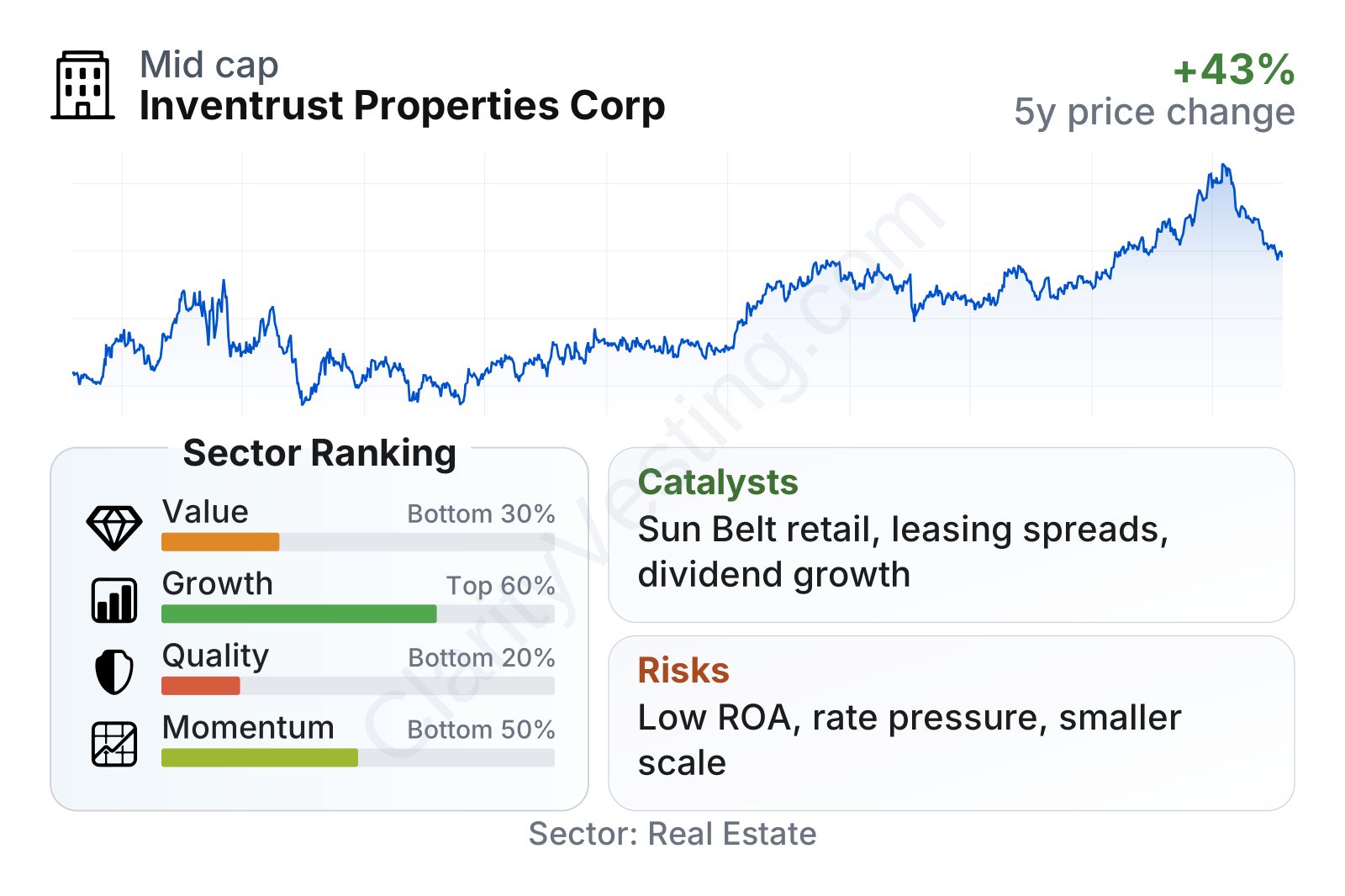
InvenTrust is a mid-sized public REIT in the retail property space. The stock’s longer-term price trend has been positive, with a strong move since 2024, although the pace has not been linear. In the factor breakdown, growth and market performance rank around the middle to upper half of the sector, while value and quality rank weaker. That mix points to a company that has produced decent operating progress, but where profitability and balance-sheet efficiency still lag many peers.
The current valuation metrics also need careful interpretation. The headline P/E ratio looks extremely high, but for REITs that number is often less useful because accounting earnings are distorted by depreciation and property gains or losses. Measures tied to cash generation and property values are usually more informative, and on those measures the stock does not appear especially cheap relative to the retail REIT group.
Growth
InvenTrust operates in a part of real estate that still has a clear role in the U.S. economy. Open-air shopping centers anchored by grocery stores, pharmacies, and essential services have generally held up better than many enclosed malls because they are easier to access and less exposed to fashion-heavy retail disruption. Population migration toward Sun Belt markets also supports demand for neighborhood retail space, since growing suburbs need nearby grocery, service, and convenience-oriented tenants.
The company’s strategy is coherent for that backdrop. It has concentrated the portfolio around necessity-based retail and markets with favorable demographic trends. For a long-term business model, that matters because it can help occupancy, rent spreads, and redevelopment opportunities. A landlord in attractive local trade areas can often raise rents gradually as leases reset, even without making large acquisitions.
Revenue per share has trended upward over the last five years, although the pace has flattened more recently. That suggests the company has already captured part of the benefit from acquisitions, leasing gains, and portfolio improvement, while future growth may depend more on rent increases, redevelopment, and selective capital allocation than on simple expansion alone.
Dividend per share has also moved higher over time. For a REIT, that is an important signal because it suggests the cash-generating base of the portfolio has been improving enough to support a larger payout. The current dividend yield is below the sector median, however, which means the stock’s income appeal relies more on dividend growth and property quality than on offering one of the highest payouts in retail REITs.
Recent company communications have emphasized portfolio quality, leasing activity, and balance-sheet management rather than aggressive empire-building. That is a sensible posture in a higher-rate environment. A notable opportunity for the company is that well-located open-air centers can benefit when retailers prefer physical locations that support convenience shopping and last-mile customer access. If leasing spreads remain healthy and redevelopment projects generate better returns than new acquisitions, growth can remain durable without requiring excessive leverage.
Risks
This article is for informational purposes only and does not constitute financial advice. Some content is AI-generated. See Disclaimer


