Stock Analysis · Invesco Mortgage Capital Inc (IVR-PC)
Overview
Invesco Mortgage Capital Inc. is a mortgage real estate investment trust, or mortgage REIT. Instead of owning office buildings, apartments, or shopping centers, it primarily invests in mortgage-related financial assets. Its business is built around buying pools of home loans and mortgage-backed securities, financing those holdings largely with borrowed money, and trying to earn a spread between the yield on its assets and its funding costs.
For long-term readers, the important point is that IVR-PC is tied much more to interest rates, mortgage markets, financing conditions, and portfolio management than to traditional property rents. The company is externally managed by Invesco Advisers, which gives it access to a large asset-management platform, but it also means management fees are part of the structure.
Based on recent company filings, its portfolio is concentrated in residential mortgage-related assets, especially agency residential mortgage-backed securities, mortgage servicing rights, and residential credit investments. The mix can shift over time as management adjusts to changes in rates and spreads.
The company’s economic engine is mainly made up of the following revenue sources and earnings drivers:
- Interest income on mortgage-backed securities and other mortgage investments — the core recurring source of income. This comes from coupon payments and asset yields on the securities and loans it owns.
- Gains and losses on investments and hedging instruments — often a very large swing factor for annual results. In some years this can materially lift earnings, while in difficult rate environments it can sharply reduce them.
- Income tied to mortgage servicing rights — these assets can gain value when higher rates slow refinancing activity, helping offset pressure elsewhere in the portfolio.
- Other investment-related income — a smaller contribution that can include fees, trading-related items, or income from other structured mortgage exposures.
Because mortgage REIT accounting can be volatile, clean percentage splits by revenue source are not always stable or very meaningful from one year to the next. What is clear is that interest income remains the foundation of the model, while fair-value marks and hedges can have an outsized effect on reported results.
Recent annual figures show a notable rebound from the deep losses recorded during the 2022 rate shock. Revenue turned positive again in 2023 and improved further in 2024 and 2025, while expenses stayed comparatively contained. That recovery reflects both portfolio repositioning and a more supportive backdrop for mortgage spreads than the company faced during the sharp repricing period.
The business has become more profitable after a very difficult 2022, with revenue and net income recovering meaningfully over the last two years. At the same time, this remains a balance-sheet-intensive model where interest expense is a major cost line, so earnings quality depends heavily on how well management handles leverage, hedging, and asset mix.
Key Figures
| Metric | Value | Sector ⓘ |
|---|---|---|
| Date | Oct 17, 2026 | |
| Context | ||
| Sector | Real Estate | |
| Industry | REIT - Mortgage | |
| Market Cap ⓘ | $1.91B | |
| Beta ⓘ | 1.64 | |
Value (Cheapness) | ||
| P/E Ratio ⓘ | N/A | 17.38 |
| P/B Ratio ⓘ | 2.51 | 0.85 |
| FCF Yield ⓘ | 8.70% | 7.38% |
| Dividend Yield ⓘ | 5.87% | 4.85% |
| EBIT / EV ⓘ | N/A | 3.78% |
| PEG ⓘ | N/A | |
Growth (Business expansion) | ||
| Revenue Growth ⓘ | 557.70% | 5.30% |
| RPS Growth (5Y CAGR) ⓘ | 29.36% | 6.02% |
| EPS Growth (5Y CAGR) ⓘ | N/A | -11.37% |
| BVPS Growth (5Y CAGR) ⓘ | -54.92% | 0.45% |
| Margin Growth (5Y Trend) ⓘ | 211.12% | -0.22% |
| FCF Growth (5Y CAGR) ⓘ | 0.78% | 5.40% |
| DPS Growth (5Y CAGR) ⓘ | -24.02% | 5.02% |
Quality (Business durability) | ||
| ROIC (Latest) ⓘ | N/A | 5.69% |
| ROE (Latest) ⓘ | 13.65% | 7.56% |
| ROA (Latest) ⓘ | 1.82% | 2.85% |
| ROIC (5Y Median) ⓘ | -0.93% | 4.22% |
| ROE (5Y Median) ⓘ | -1.65% | 6.03% |
| ROA (5Y Median) ⓘ | -0.31% | 2.44% |
| Net Debt / EBIT (Latest) ⓘ | N/A | 7.59 |
| Net Debt / EBIT (5Y Median) ⓘ | N/A | 8.40 |
| Net Debt / EBITDA (Latest) ⓘ | 21.54 | 5.27 |
| Net Debt / Assets ⓘ | 84.78% | 37.76% |
| EBITDA / Interest ⓘ | 1.30 | 4.10 |
| Operating Margin (Latest) ⓘ | N/A | 35.29% |
| Operating Margin (5Y Median) ⓘ | 92.09% | 37.31% |
| Debt to Equity (Latest) ⓘ | 627.11% | 88.87% |
| Profit Margin (Latest) ⓘ | 86.11% | 19.61% |
| Free Cash Flow (Latest) ⓘ | $166.02M | |
Momentum (Price trend) | ||
| 3Y Return ⓘ | +55.13% | +30.75% |
| 12M Return (excl. last month) ⓘ | +8.84% | +4.36% |
| 6M Return ⓘ | +2.47% | -2.52% |
| Price vs. 200-Day MA ⓘ | +1.78% | -2.34% |
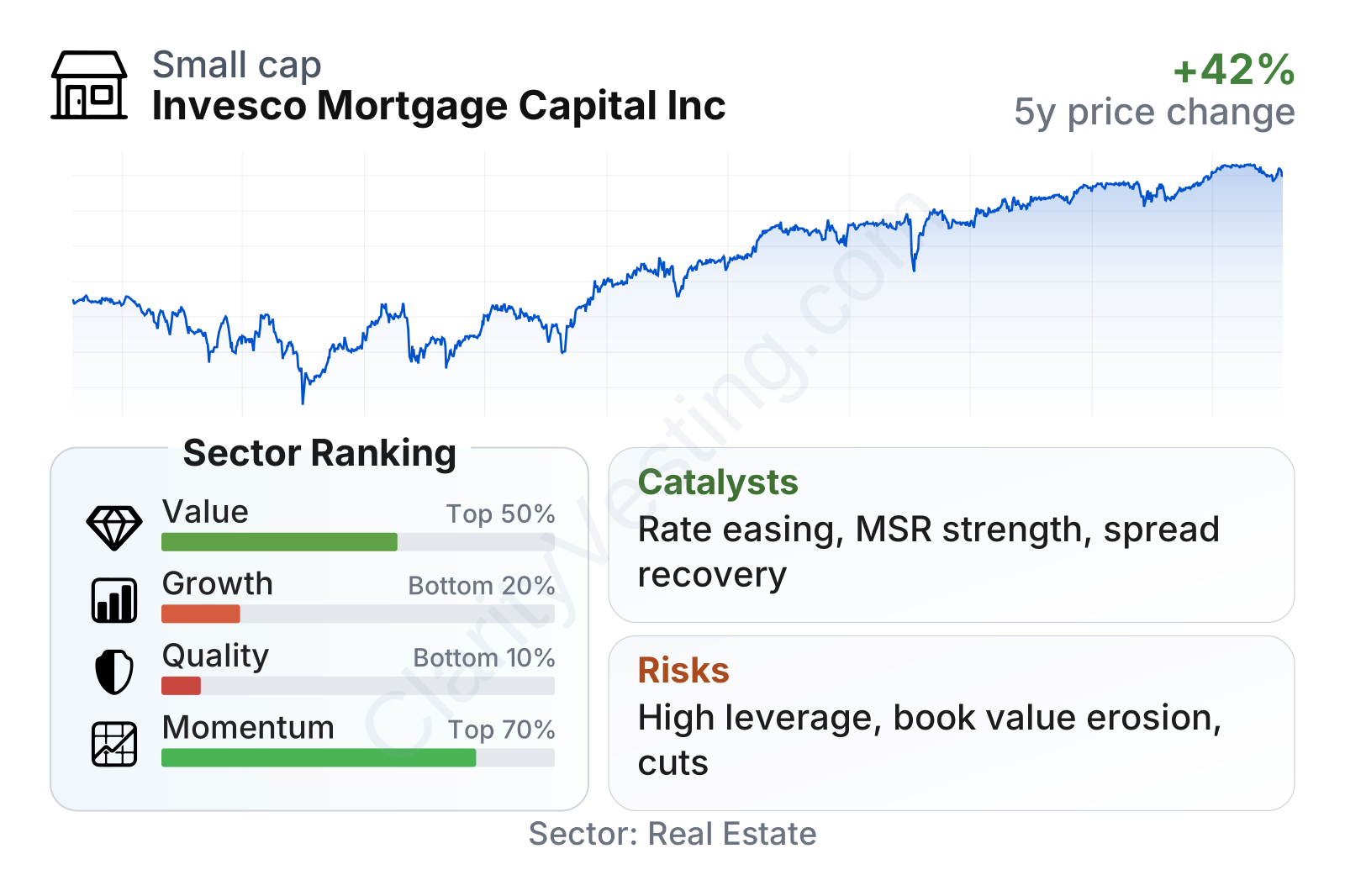
IVR-PC sits in the mid-cap range and its share price behavior has been more volatile than the broader market, which fits the mortgage REIT profile. Recent price momentum has been better than the sector median over 6 months, 12 months, and 3 years, suggesting the market has been recognizing the company’s recovery.
On income metrics, the stock stands out for a dividend yield around 6%, above the sector median, and free cash flow yield modestly above the sector median as well. However, the quality profile is weak relative to peers. Leverage is very high, with debt-to-equity above 600%, net debt compared with assets near 85%, and interest coverage around 1.3x, all of which point to a business that has limited room for error if financing conditions worsen.
Growth metrics look unusual. Revenue growth has been strong recently and the five-year revenue-per-share trend is well above the sector median, but book value per share has contracted heavily over five years and dividend per share has trended down. That combination suggests the recent rebound is real, but it has come after significant balance-sheet damage and payout reductions.
Growth
Mortgage REITs operate in a sector that is not a classic long-term growth industry in the way software or medical technology can be. Their opportunity set depends more on cycles than on steady structural expansion. For Invesco Mortgage Capital, the key growth question is not whether mortgage finance will grow rapidly, but whether the company can generate better returns from spreads, hedges, and capital allocation over a full rate cycle.
The company’s current strategy is sensible for that environment. Management has emphasized a mix of agency residential mortgage-backed securities, residential credit, and mortgage servicing rights. That matters because mortgage servicing rights can help offset some of the pressure that rising rates create for fixed-income securities. In simple terms, the company is trying to avoid relying on a single rate outcome.
Revenue per share has rebounded sharply since the 2022 dislocation and stayed positive in the following years, although it remains uneven. That pattern fits a company recovering from a severe market shock rather than one delivering smooth compounding. It also means long-term performance will depend on whether the recent stabilization can continue without another major hit to book value.
The dividend trend is less encouraging. The payout has moved lower over several years, which reflects how difficult the last rate cycle was for the business. A high current yield is attractive on the surface, but the longer history shows that income generation here has been cyclical rather than steadily rising.
The strongest catalyst is a more normal interest-rate environment. If short-term funding costs ease or stabilize while mortgage asset yields remain attractive, the company’s earnings power can improve. A second catalyst is spread normalization in agency mortgages and related credit assets, which can support book value and improve returns on new investments. A third is continued strength in mortgage servicing rights, which can act as a counterweight when prepayment patterns remain favorable.
Recent operating improvement also matters. After posting significant losses in 2022, the company returned to positive net income in 2024 and improved further in 2025. That does not remove the cyclical nature of the business, but it does show that the portfolio repositioning has had a measurable impact.
Risks
This article is for informational purposes only and does not constitute financial advice. Some content is AI-generated. See Disclaimer


