Stock Analysis · ITV plc (ITVPF)
Overview
ITV plc is a British media company best known for its free-to-air television channels, but its business is broader than traditional broadcasting. The group operates a large advertising-funded TV network in the U.K., runs the ITVX streaming platform, and owns a global production arm that creates and distributes scripted and unscripted programs for broadcasters and streaming services around the world. That combination matters because it gives ITV exposure to both the mature television advertising market and the growing demand for content from international platforms.
In practical terms, ITV makes money from two main activities: selling advertising and related media services around its U.K. viewing business, and producing programs through ITV Studios. Based on the company’s recent annual reporting, revenue is roughly split as follows:
- ITV Studios: about 58% of revenue — production and distribution of TV content in the U.K. and internationally, including drama, entertainment, and factual programming sold to broadcasters and streaming platforms.
- Media & Entertainment: about 42% of revenue — traditional TV advertising, digital advertising on ITVX, sponsorships, subscriptions, and partnerships tied to ITV’s U.K. channels and streaming operations.
That mix shows an important point for long-term analysis: ITV is not only a broadcaster dependent on linear TV ads. A large share of revenue comes from content production, which can travel across many buyers and markets. At the same time, the U.K. media segment remains central because it supports audience reach, advertising relationships, and the company’s own platform.
From a business-model angle, ITV sits between old and new media. It still relies on television audiences and advertising budgets, but it is also trying to shift viewers toward its digital platform and to use its production library and studio capabilities as a more durable source of earnings.
The recent revenue path has been fairly stable overall, but profit conversion has been less smooth. Revenue has remained around the mid-single-digit billions of pounds over the last few years, while operating income and net income have moved more noticeably from year to year. That pattern suggests ITV’s earnings are influenced by advertising cycles, content investment timing, and the hit-driven nature of production.
Key Figures
| Metric | Value | Sector ⓘ |
|---|---|---|
| Date | Oct 31, 2026 | |
| Context | ||
| Sector | Communication Services | |
| Industry | Broadcasting | |
| Market Cap ⓘ | $3.39B | |
| Beta ⓘ | 0.79 | |
Value (Cheapness) | ||
| P/E Ratio ⓘ | 11.62 | 18.47 |
| FCF Yield ⓘ | 15.95% | 14.23% |
| Dividend Yield ⓘ | 5.38% | 2.78% |
| EBIT / EV ⓘ | N/A | 4.73% |
| PEG ⓘ | N/A | |
Growth (Business expansion) | ||
| Revenue Growth ⓘ | 1.10% | 6.10% |
| RPS Growth (5Y CAGR) ⓘ | 2.19% | 4.57% |
| EPS Growth (5Y CAGR) ⓘ | -48.00% | -17.96% |
| Margin Growth (5Y Trend) ⓘ | -2.37% | 1.32% |
| FCF Growth (5Y CAGR) ⓘ | 8.71% | 5.75% |
| DPS Growth (5Y CAGR) ⓘ | -0.06% | 5.19% |
Quality (Business durability) | ||
| ROIC (Latest) ⓘ | N/A | 9.19% |
| ROIC (5Y Median) ⓘ | 17.56% | 8.24% |
| Net Debt / EBIT (Latest) ⓘ | 0.69 | 1.92 |
| Net Debt / EBIT (5Y Median) ⓘ | 0.92 | 2.88 |
| Net Debt / EBITDA (Latest) ⓘ | 0.54 | 1.22 |
| Net Debt / Assets ⓘ | 14.94% | 18.63% |
| EBITDA / Interest ⓘ | 14.78 | 8.36 |
| Operating Margin (Latest) ⓘ | 13.45% | 15.68% |
| Operating Margin (5Y Median) ⓘ | 15.58% | 13.39% |
| Debt to Equity (Latest) ⓘ | 52.95% | 59.65% |
| Profit Margin (Latest) ⓘ | 6.57% | 8.74% |
| Free Cash Flow (Latest) ⓘ | $540.52M | |
Momentum (Price trend) | ||
| 3Y Return ⓘ | +30.05% | +46.16% |
| 12M Return (excl. last month) ⓘ | -10.21% | +1.26% |
| 6M Return ⓘ | -18.26% | 0.00% |
| Price vs. 200-Day MA ⓘ | +11.54% | +0.87% |
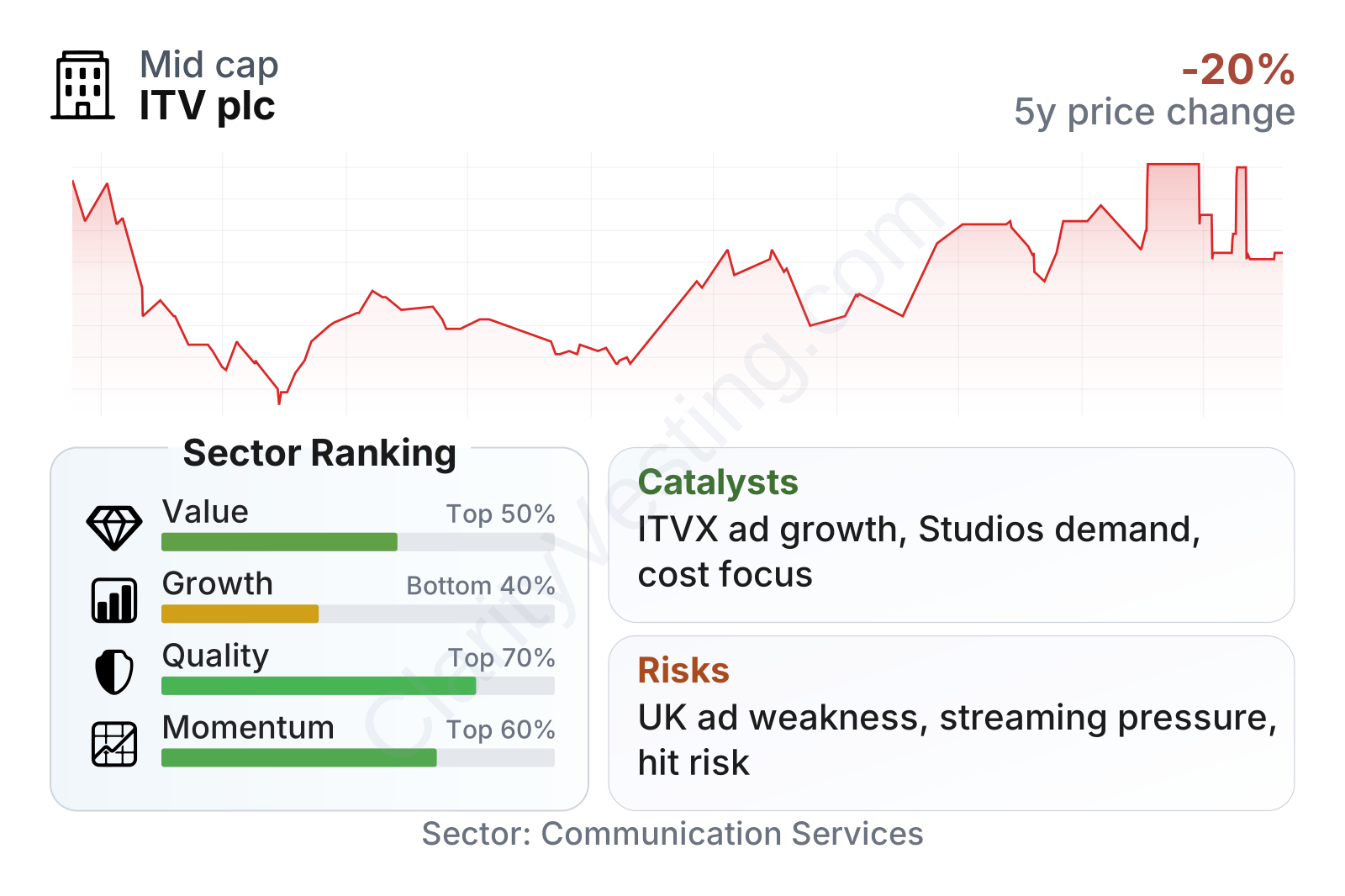
ITV currently looks more notable for cash generation and balance-sheet discipline than for fast expansion. The company’s value metrics are generally better than the sector median, with a lower earnings multiple, a free cash flow yield in the mid-teens, and a dividend yield clearly above the sector norm. Quality is also respectable: leverage is modest, interest coverage is strong, and long-term returns on invested capital have been well above the sector median.
The weaker area is growth. Revenue growth has been low, earnings growth over five years has been pressured, and margin trends have softened compared with many peers. Share-price momentum has also been mixed: the stock has improved from earlier lows, but recent performance has lagged the broader communication services group over longer periods.
Growth
ITV operates in a sector that is changing rather than expanding evenly. Traditional linear television is mature, and advertising linked to scheduled broadcasting is not a structural growth market. However, global demand for content remains strong, and ad-supported streaming has become an increasingly important part of the video market. That creates a more balanced picture for ITV: one part of the business faces long-term pressure, while another part can still find room to grow.
The company’s strategy broadly makes sense in that context. ITV has been investing in ITVX, its streaming platform, to capture more digital viewing and ad spending while keeping its mass-market U.K. reach. At the same time, ITV Studios gives the group an asset that is less dependent on the health of the domestic ad market. If ITV can keep building digital ad revenue and maintain demand for its productions, that combination offers a credible route to gradual modernization rather than simple decline.
A meaningful catalyst is the continued shift of advertisers toward streaming environments that still offer broad reach and premium video inventory. ITVX is designed around that trend, combining free ad-supported viewing with subscription options. Another catalyst is the global appetite for local-language and unscripted content, where ITV Studios already has scale and a broad catalog. This matters because successful formats can be sold repeatedly across countries and platforms, improving returns on intellectual property.
Recent company updates have also emphasized cost efficiency, cash generation, and the goal of growing digital revenues within the Media & Entertainment segment. For a company in a mature market, that is important: even if top-line growth remains moderate, stronger digital monetization and disciplined costs can still support earnings resilience.
Risks
This article is for informational purposes only and does not constitute financial advice. Some content is AI-generated. See Disclaimer


