Stock Analysis · ITT Inc (ITT)
Overview
ITT Inc is an industrial manufacturer focused on engineered components and systems used in demanding applications. Its products are sold into transportation, water and wastewater, energy, industrial process, aerospace, and defense markets. In simple terms, the company makes specialized equipment that helps move fluids, absorb shock and vibration, and connect critical systems in vehicles, factories, and infrastructure.
Its business is organized into three main segments. Based on recent annual reporting, revenue is split approximately as follows:
- Motion Technologies: about 39% of revenue. This segment mainly includes brake pads, shock absorbers, damping technologies, and friction materials for passenger vehicles, commercial vehicles, rail, and other transportation uses.
- Industrial Process: about 33% of revenue. This business includes pumps, valves, monitoring equipment, and aftermarket services used in chemical processing, energy, mining, and water infrastructure.
- Connect & Control Technologies: about 28% of revenue. This segment supplies connectors, fittings, pressure and flow-control components, and aerospace and defense products for harsh operating environments.
That mix matters because ITT is not dependent on a single end market. It combines automotive exposure with industrial infrastructure and aerospace-defense demand, which can help soften weakness in one area with strength in another.
Over the last several years, the company has also improved the amount of profit it keeps from sales. Revenue has climbed from roughly $2.8 billion in 2021 to nearly $3.9 billion in 2025, while operating income expanded faster than sales. Even so, interest expense has also moved up, showing that growth has come with a more leveraged balance sheet than in earlier years.
Key Figures
| Metric | Value | Sector ⓘ |
|---|---|---|
| Date | Oct 24, 2026 | |
| Context | ||
| Sector | Industrials | |
| Industry | Specialty Industrial Machinery | |
| Market Cap ⓘ | $17.83B | |
| Beta ⓘ | 1.25 | |
Value (Cheapness) | ||
| P/E Ratio ⓘ | 38.38 | 22.29 |
| P/B Ratio ⓘ | 3.75 | 1.98 |
| FCF Yield ⓘ | 2.85% | 6.26% |
| Dividend Yield ⓘ | 0.74% | 1.92% |
| EBIT / EV ⓘ | 3.23% | 4.83% |
| PEG ⓘ | 1.72 | |
Growth (Business expansion) | ||
| Revenue Growth ⓘ | 51.50% | 9.30% |
| RPS Growth (5Y CAGR) ⓘ | 11.44% | 7.76% |
| EPS Growth (5Y CAGR) ⓘ | -1.82% | -13.17% |
| BVPS Growth (5Y CAGR) ⓘ | 18.67% | 6.13% |
| Margin Growth (5Y Trend) ⓘ | 2.99% | 0.74% |
| FCF Growth (5Y CAGR) ⓘ | N/A | 10.79% |
| DPS Growth (5Y CAGR) ⓘ | 12.21% | 9.41% |
Quality (Business durability) | ||
| ROIC (Latest) ⓘ | 7.70% | 10.75% |
| ROA (Latest) ⓘ | 5.24% | 5.41% |
| ROIC (5Y Median) ⓘ | 14.82% | 9.37% |
| ROA (5Y Median) ⓘ | 9.99% | 4.95% |
| Net Debt / EBIT (Latest) ⓘ | 4.58 | 2.04 |
| Net Debt / EBIT (5Y Median) ⓘ | -0.38 | 2.27 |
| Net Debt / EBITDA (Latest) ⓘ | 3.50 | 1.39 |
| Net Debt / Assets ⓘ | 29.39% | 19.27% |
| EBITDA / Interest ⓘ | 9.22 | 9.58 |
| Operating Margin (Latest) ⓘ | 14.93% | 10.49% |
| Operating Margin (5Y Median) ⓘ | 16.41% | 10.30% |
| Debt to Equity (Latest) ⓘ | 79.88% | 64.82% |
| Profit Margin (Latest) ⓘ | 8.90% | 6.67% |
| Free Cash Flow (Latest) ⓘ | $508.80M | |
Momentum (Price trend) | ||
| 3Y Return ⓘ | +116.47% | +67.77% |
| 12M Return (excl. last month) ⓘ | +14.52% | +12.05% |
| 6M Return ⓘ | -8.29% | 0.00% |
| Price vs. 200-Day MA ⓘ | +1.16% | +0.67% |
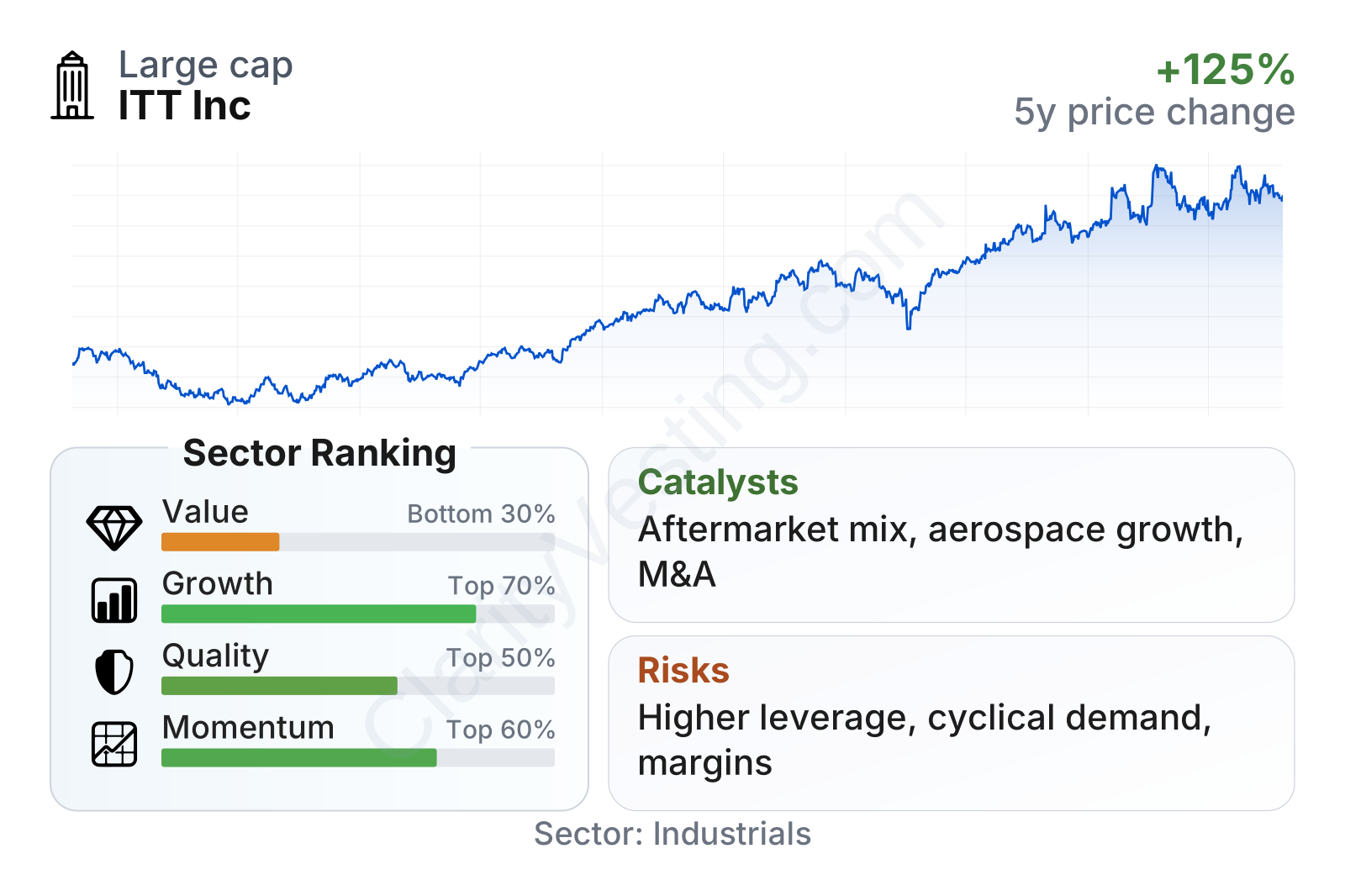
ITT is now a large industrial company with a market value around the high-teens billions of dollars. The overall picture from the metrics is mixed but interesting: growth and profitability look solid relative to much of the industrial sector, while valuation looks rich. Quality is still decent, but recent leverage has weakened one of the cleaner parts of the earlier investment case.
The stock’s long-term price trend has been strong, with gains over the past three years clearly ahead of the sector median. That suggests the market has increasingly rewarded ITT for steady execution, margin improvement, and exposure to attractive end markets. At the same time, the shares have become more expensive than many industrial peers on earnings, book value, and free-cash-flow yield.
Growth
ITT operates in parts of the industrial economy that still have favorable long-term demand drivers. Water infrastructure needs ongoing investment, aerospace and defense markets continue to require specialized components, and transportation customers increasingly value products that improve safety, efficiency, and durability. These are not speculative themes; they are practical, recurring needs tied to maintenance, replacement, regulation, and modernization.
The company’s strategy also makes sense for long-term growth because it leans on engineered products rather than commodity-like equipment. In industrial businesses, specialized components often support better pricing, closer customer relationships, and recurring aftermarket sales. ITT has been emphasizing margin expansion, product innovation, and portfolio shaping, which fits well with that model.
Recent revenue growth has accelerated sharply. Earlier years already showed mostly positive year-over-year expansion, but the latest readings moved much higher than the sector median. That kind of acceleration can come from a mix of acquisitions, stronger demand, and pricing, so it is important to separate durable growth from one-time effects. Still, the direction is clearly favorable.
Cash generation has also improved meaningfully from the weak level seen in 2022. Free cash flow moved back into clearly positive territory and has stayed around a solid level since then. For an industrial company, that matters because cash flow supports acquisitions, debt service, dividends, and internal investment without relying too heavily on outside financing.
A notable catalyst is the company’s exposure to aftermarket and mission-critical applications. Customers are often replacing worn parts or maintaining essential systems rather than making optional purchases. That can create steadier demand than purely discretionary industrial spending. Another positive factor is aerospace and defense content, where qualification requirements and long product cycles can support durable revenue streams.
Recent corporate updates have also pointed to continued portfolio expansion through acquisitions, including activity that increases ITT’s presence in connectors and harsh-environment products. If integrated well, this can broaden the company’s addressable market and deepen its position in higher-value niches.
Risks
This article is for informational purposes only and does not constitute financial advice. Some content is AI-generated. See Disclaimer


