Stock Analysis · Integer Holdings Corp (ITGR)
Overview
Integer Holdings is a medical device outsourcing company. In simple terms, it helps larger healthcare companies design, develop, and manufacture parts or complete devices that are used in areas such as heart rhythm management, electrophysiology, neuromodulation, cardiovascular procedures, and portable medical equipment. It also makes power solutions used in medical and other specialized applications. Rather than selling a broad consumer brand, Integer is mainly a behind-the-scenes manufacturing and engineering partner for other device makers.
The business is organized around two main reporting segments, with Medical representing the large majority of sales and Electrochem providing the smaller share. Based on the latest annual filing and recent quarterly updates, revenue is roughly distributed as follows:
- Cardio & Vascular: about 58% of total revenue. This includes products and components used in cardiac rhythm management, electrophysiology, structural heart, and vascular therapies.
- Cardiac Rhythm Management & Neuromodulation: about 21%. This area includes components and systems used in implantable pulse generators, leads, and devices supporting neurostimulation and related therapies.
- Advanced Surgical, Orthopedics & Portable Medical: about 13%. This includes products for minimally invasive procedures, orthopedic applications, and portable or connected medical systems.
- Electrochem: about 8%. This segment primarily covers specialized batteries and power solutions, including products for medical, energy, military, and environmental uses.
That mix matters because it shows Integer is heavily tied to higher-growth procedure categories inside medical devices, especially cardiac and vascular care, while keeping a smaller but differentiated power-solutions business. Over the last several years, revenue has trended upward overall, and operating income expanded meaningfully through 2024 before a softer profitability profile in 2025. The broad picture is a mid-sized contract manufacturer with deep exposure to critical healthcare applications rather than a single-product company.
The long-term pattern has been favorable on the revenue line, with sales rising from roughly $1.2 billion in 2021 to about $1.8 billion in 2025. Gross profit and operating income also improved over that stretch, although 2025 showed some pressure on margins even as revenue kept growing. That combination suggests demand remained healthy, but cost absorption and operating efficiency became more important issues.
Key Figures
| Metric | Value | Sector ⓘ |
|---|---|---|
| Date | Oct 17, 2026 | |
| Context | ||
| Sector | Healthcare | |
| Industry | Medical Devices | |
| Market Cap ⓘ | $4.30B | |
| Beta ⓘ | 0.58 | |
Value (Cheapness) | ||
| P/E Ratio ⓘ | 34.59 | 24.79 |
| P/B Ratio ⓘ | 2.52 | 3.08 |
| FCF Yield ⓘ | 2.60% | 3.15% |
| Dividend Yield ⓘ | N/A | 1.94% |
| EBIT / EV ⓘ | 3.10% | 0.57% |
| PEG ⓘ | 2.80 | |
Growth (Business expansion) | ||
| Revenue Growth ⓘ | -2.60% | 7.45% |
| RPS Growth (5Y CAGR) ⓘ | 9.03% | 8.61% |
| EPS Growth (5Y CAGR) ⓘ | -8.34% | -17.81% |
| BVPS Growth (5Y CAGR) ⓘ | 4.77% | 3.72% |
| Margin Growth (5Y Trend) ⓘ | -2.63% | -0.62% |
| FCF Growth (5Y CAGR) ⓘ | 0.46% | 1.04% |
| DPS Growth (5Y CAGR) ⓘ | N/A | 6.77% |
Quality (Business durability) | ||
| ROIC (Latest) ⓘ | 5.58% | 3.24% |
| ROA (Latest) ⓘ | 3.76% | 3.01% |
| ROIC (5Y Median) ⓘ | 6.27% | 4.60% |
| ROA (5Y Median) ⓘ | 3.17% | 1.89% |
| Net Debt / EBIT (Latest) ⓘ | 7.68 | 1.34 |
| Net Debt / EBIT (5Y Median) ⓘ | 6.21 | 1.84 |
| Net Debt / EBITDA (Latest) ⓘ | 4.29 | 1.00 |
| Net Debt / Assets ⓘ | 39.23% | 5.45% |
| EBITDA / Interest ⓘ | 8.13 | 9.64 |
| Operating Margin (Latest) ⓘ | 9.50% | 9.27% |
| Operating Margin (5Y Median) ⓘ | 11.49% | 7.38% |
| Debt to Equity (Latest) ⓘ | 79.39% | 28.58% |
| Profit Margin (Latest) ⓘ | 6.97% | 3.59% |
| Free Cash Flow (Latest) ⓘ | $111.98M | |
Momentum (Price trend) | ||
| 3Y Return ⓘ | +66.54% | +42.80% |
| 12M Return (excl. last month) ⓘ | +25.97% | +18.50% |
| 6M Return ⓘ | +44.10% | +7.57% |
| Price vs. 200-Day MA ⓘ | +28.90% | +5.12% |
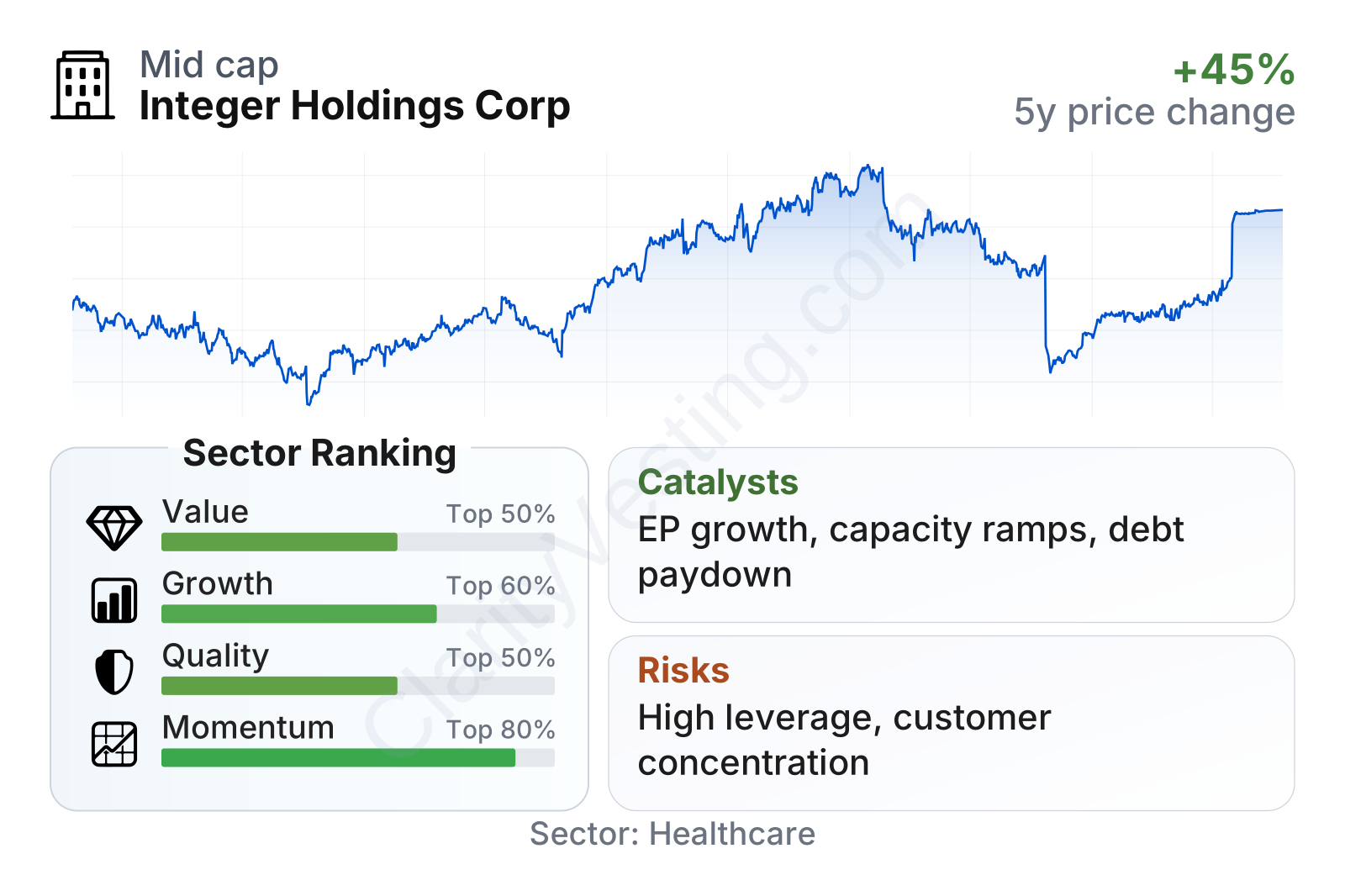
Integer sits in the mid-cap range and has shown relatively low share-price volatility, with a beta well below 1. The overall factor profile looks mixed but solid: quality and valuation metrics are around the better half of the healthcare sector, while growth and momentum are less uniform. Profitability measures such as return on invested capital and profit margin are better than many sector peers, but leverage is clearly heavier than average. The stock’s recent trading recovery has been strong, yet the valuation still reflects expectations for renewed execution.
Growth
Integer operates in a part of healthcare that generally benefits from durable long-term demand. Medical device outsourcing can grow as large original equipment manufacturers look for specialized partners that can handle complex design, precision manufacturing, regulatory requirements, and global supply needs. End markets such as electrophysiology, structural heart, neuromodulation, and cardiovascular intervention are also supported by aging populations and rising procedure volumes.
The company’s strategy is logical for that environment. Integer has been concentrating resources on higher-value categories where engineering depth, quality systems, and customer integration matter more than pure scale. That can create sticky relationships, because once a supplier is designed into a medical device program, switching becomes difficult due to validation, regulatory, and production risks. The company has also used acquisitions and internal investment to broaden its capabilities, which can help it win more complete programs rather than only individual components.
Recent growth has slowed compared with the stronger pace seen in 2022 through 2025. Annual and quarterly revenue expansion remained positive for an extended period, but the latest readings moved close to flat and then slightly negative year over year. For a long-term view, that matters less than the broader trend, but it does show that Integer is not immune to customer inventory adjustments, timing shifts in product ramps, or uneven procedure-related demand.
Cash generation has been positive, though not perfectly smooth. Free cash flow recovered well from an earlier dip and has stayed around the $100 million range more recently. That is an important support point for the business because it gives management room to fund capacity projects, reduce debt over time, and continue investing in new programs. A strong catalyst from here would be a combination of resumed top-line acceleration, better factory utilization, and further mix shift toward faster-growing cardiac and vascular categories.
Recent company communications have also emphasized capacity expansion and customer program activity in attractive therapy areas, especially electrophysiology and other interventional markets. Those areas are among the more dynamic niches in medtech, so continued production ramps there could become a meaningful opportunity if execution stays on track.
Risks
This article is for informational purposes only and does not constitute financial advice. Some content is AI-generated. See Disclaimer


