Stock Analysis · Indo Tambangraya Megah (ITAYY)
Overview
Indo Tambangraya Megah is an Indonesian coal producer whose American depositary shares trade in the U.S. under the symbol ITAYY. The company mainly produces and sells thermal coal, the type used by power plants to generate electricity. It also operates related activities around mining, logistics, and coal trading. In simple terms, this is a company tied closely to coal demand, especially in Asia, and to coal prices in global markets.
The business is still overwhelmingly driven by coal. Based on recent annual reporting and the company’s operating structure, revenue comes primarily from coal sales, with smaller contributions from coal trading and mining-related services. Precise percentages can vary from year to year with prices and volumes, but the mix is broadly concentrated as follows:
- Coal sales: approximately 85% to 95% of revenue. This includes thermal coal produced from the company’s Indonesian mining concessions and sold to domestic and export customers.
- Coal trading: approximately 5% to 15% of revenue. This activity involves sourcing and reselling coal in addition to production from its own mines.
- Other services and related activities: typically a low-single-share of revenue when disclosed separately, including mining support and infrastructure-related services.
What stands out is not diversification, but operational integration. The company combines mining assets, transport arrangements, and customer relationships across Asian coal markets. That can help it stay efficient, but it also means results are heavily exposed to one commodity.
Over the last several years, the business has shown how sensitive it is to the coal cycle. Revenue climbed sharply in 2022 during the energy price spike, then eased in 2023, 2024, and 2025 as pricing normalized. Even so, the company remained profitable, which says something about cost discipline and balance-sheet strength.
The earnings profile shows a clear post-2022 normalization. Revenue and profit peaked during exceptionally favorable coal markets, then stepped down over the following years. Even after that decline, the company still generated meaningful operating income, suggesting the business remains cash-capable at lower price levels than the 2022 peak.
Key Figures
| Metric | Value | Sector ⓘ |
|---|---|---|
| Date | Oct 17, 2026 | |
| Context | ||
| Sector | Energy | |
| Industry | Thermal Coal | |
| Market Cap ⓘ | $1.59B | |
| Beta ⓘ | -0.56 | |
Value (Cheapness) | ||
| P/E Ratio ⓘ | 7.57 | 15.44 |
| P/B Ratio ⓘ | 0.85 | 1.73 |
| FCF Yield ⓘ | -0.79% | 8.20% |
| Dividend Yield ⓘ | 6.97% | 3.59% |
| EBIT / EV ⓘ | 34.34% | 7.46% |
| PEG ⓘ | N/A | |
Growth (Business expansion) | ||
| Revenue Growth ⓘ | 15.10% | 26.90% |
| RPS Growth (5Y CAGR) ⓘ | -3.23% | 6.90% |
| EPS Growth (5Y CAGR) ⓘ | -49.92% | -15.73% |
| BVPS Growth (5Y CAGR) ⓘ | 10.97% | 6.07% |
| Margin Growth (5Y Trend) ⓘ | -15.82% | 0.58% |
| FCF Growth (5Y CAGR) ⓘ | -23.31% | 1.86% |
| DPS Growth (5Y CAGR) ⓘ | 16.52% | 16.79% |
Quality (Business durability) | ||
| ROIC (Latest) ⓘ | 10.29% | 11.40% |
| ROA (Latest) ⓘ | 8.59% | 6.06% |
| ROIC (5Y Median) ⓘ | 26.26% | 10.30% |
| ROA (5Y Median) ⓘ | 20.73% | 5.42% |
| Net Debt / EBIT (Latest) ⓘ | -2.18 | 1.64 |
| Net Debt / EBIT (5Y Median) ⓘ | -1.23 | 1.83 |
| Net Debt / EBITDA (Latest) ⓘ | -1.72 | 1.08 |
| Net Debt / Assets ⓘ | -26.41% | 17.29% |
| EBITDA / Interest ⓘ | 45.35 | 9.64 |
| Operating Margin (Latest) ⓘ | 14.94% | 16.27% |
| Operating Margin (5Y Median) ⓘ | 27.21% | 20.39% |
| Debt to Equity (Latest) ⓘ | 5.23% | 54.76% |
| Profit Margin (Latest) ⓘ | 10.50% | 8.82% |
| Free Cash Flow (Latest) ⓘ | -$12.47M | |
Momentum (Price trend) | ||
| 3Y Return ⓘ | +5.40% | +67.38% |
| 12M Return (excl. last month) ⓘ | +9.65% | +49.19% |
| 6M Return ⓘ | -3.85% | +7.07% |
| Price vs. 200-Day MA ⓘ | +1.85% | +9.56% |
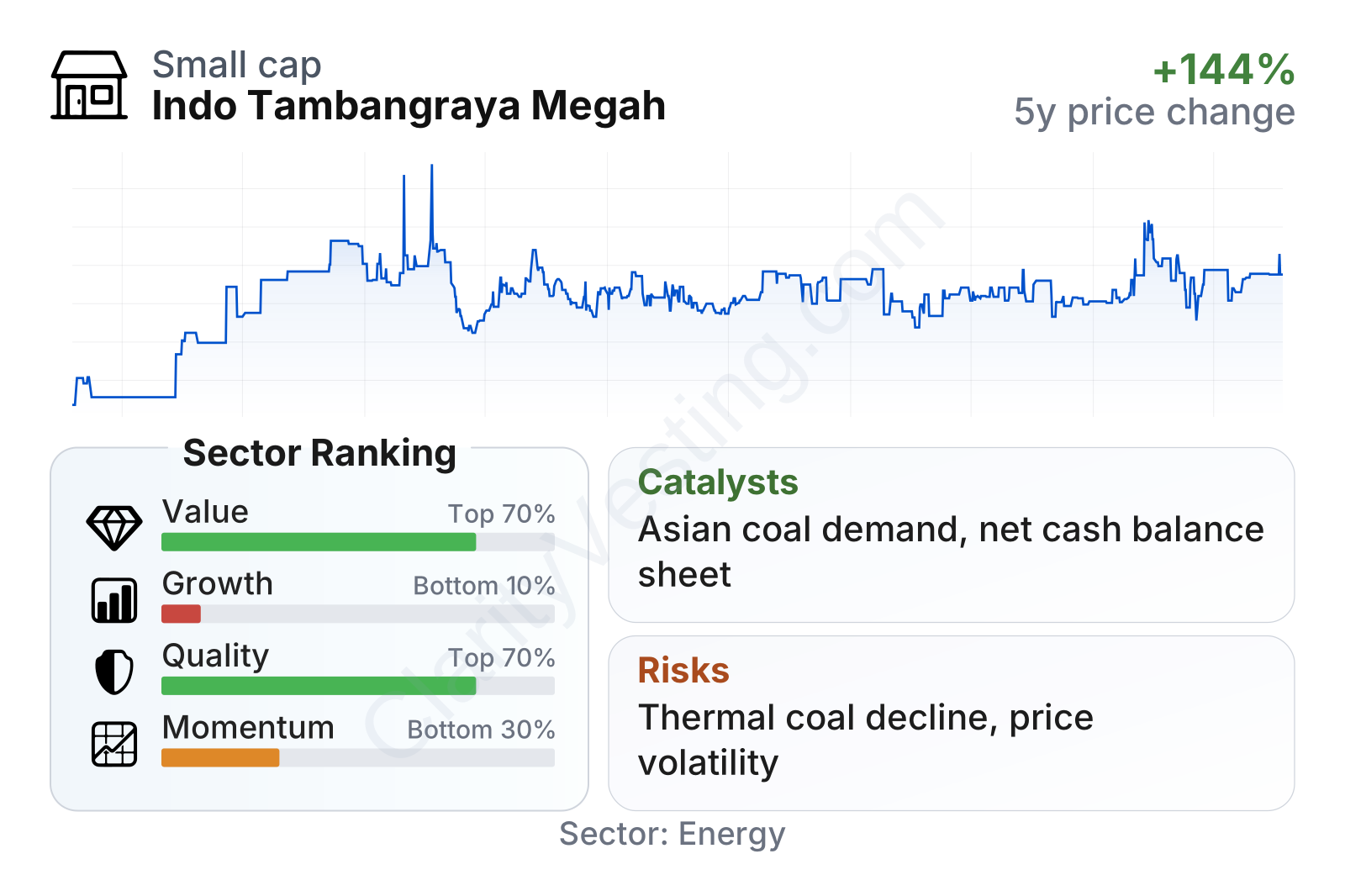
The overall picture is unusual but easy to read. On valuation, ITAYY screens cheaper than many energy peers, with a price-to-earnings ratio around 8 and a price-to-book ratio below 1. Profitability remains respectable, with profit margin slightly above the sector median, while balance-sheet quality is notably strong thanks to very low leverage and net cash characteristics. The weak point is growth: five-year revenue and earnings trends are poor, and recent market momentum has lagged the broader energy group. In short, the company looks financially sturdy and statistically inexpensive, but not like a business with strong structural expansion.
The share price history also reflects the commodity cycle. The stock surged during the coal boom in 2022, then gave back part of that move as coal prices cooled. More recently, the price has been relatively range-bound, which fits a company moving from windfall conditions back toward a more normal earnings base.
Growth
For long-term analysis, the first point is that thermal coal is not a classic growth industry. In many developed markets, coal faces long-term pressure from renewables, gas, and decarbonization policies. That said, demand has not disappeared. In several Asian economies, especially those still expanding electricity generation capacity, coal remains an important part of the power mix because it is available, established, and often cost-competitive. This makes Indo Tambangraya Megah less a pure growth company and more a cash-generation business linked to energy security in emerging Asia.
The company’s strategy has generally focused on keeping production marketable, preserving costs, maintaining logistics access, and widening downstream or adjacent activities where possible. That approach makes practical sense for a mature commodity business. It does not remove coal exposure, but it can improve resilience if coal prices soften. The more credible long-term growth angle is not explosive volume growth; it is the ability to extend mine life, maintain export relationships, and gradually broaden into energy-related activities beyond raw coal production.
Recent sales trends underline how cyclical this business is. Year-over-year revenue growth swung from extraordinary gains in 2021 and 2022 to declines in 2023 and much of 2025, before returning to modestly positive territory in 2026. That pattern suggests the company is recovering from a lower base rather than entering a new high-growth phase.
Cash generation has also been uneven. Free cash flow was very strong during the peak coal market, then became more volatile as earnings normalized and capital needs shifted. The latest trailing figure is slightly negative, which matters because the long-term case for a thermal coal producer often depends more on sustained cash extraction than on accounting earnings alone.
A meaningful catalyst is the company’s continued exposure to Asian coal demand, particularly if supply discipline or energy-security concerns keep seaborne coal prices firmer than many expect. Another supportive factor is its financial flexibility: with very low debt, the company has room to manage downturns and potentially fund selective expansion or diversification without balance-sheet strain. Recent company communications have also emphasized operational continuity, reserve development, and broader energy initiatives, which are worth watching as signs of adaptation rather than dependence on a single cycle.
Risks
This article is for informational purposes only and does not constitute financial advice. Some content is AI-generated. See Disclaimer


