Stock Analysis · ISS A/S (ISFFF)
Overview
ISS A/S is a global workplace services company. In simple terms, it helps large organizations run their buildings and daily operations. Its services usually include cleaning, technical maintenance, food services, workplace support, security, and other facilities-related tasks. Customers are typically large businesses and public-sector organizations that prefer to outsource these tasks to a specialist rather than manage them in-house.
The business model is based on long-term service contracts. That makes revenue relatively recurring, but it also means execution matters a lot: contracts are labor-intensive, margins are usually modest, and profitability depends on staffing, wage control, service quality, and retaining large clients.
ISS reports revenue mainly by customer segment rather than by a very detailed service split. Based on recent annual reporting, the main sources of revenue are approximately:
- Office and manufacturing clients: about 46% — integrated workplace services for corporate offices and industrial sites, often combining cleaning, technical, catering, and support services.
- Public sector clients: about 24% — services for government-related institutions and public buildings.
- Healthcare clients: about 17% — cleaning, support, and technical services for hospitals and healthcare facilities.
- Education clients: about 8% — services for schools, campuses, and related institutions.
- Other segments: about 5% — additional customer categories not large enough to stand alone.
Geographically, ISS is broadly diversified across Europe and other developed markets, with the U.K., Denmark, Switzerland, Germany, and Spain among important countries in its footprint. That diversification helps reduce reliance on any one economy, although it also adds complexity in labor regulation, wage inflation, and contract management.
One noticeable financial trend over recent years is that revenue has continued to rise, while operating profit has recovered more unevenly. That fits the nature of the sector: sales can grow through contract wins and price adjustments, but translating that growth into stronger margins depends on disciplined execution.
The long-term picture is one of a very large service business with expanding revenue and improving operating income since 2021, but also with periods where financing costs and contract execution have had an outsized impact on bottom-line earnings.
Key Figures
| Metric | Value | Sector ⓘ |
|---|---|---|
| Date | Oct 03, 2026 | |
| Context | ||
| Sector | Industrials | |
| Industry | Specialty Business Services | |
| Market Cap ⓘ | $6.66B | |
| Beta ⓘ | 0.85 | |
Value (Cheapness) | ||
| P/E Ratio ⓘ | 16.72 | 22.45 |
| P/B Ratio ⓘ | 0.77 | 1.98 |
| FCF Yield ⓘ | 53.20% | 6.31% |
| Dividend Yield ⓘ | 7.39% | 1.96% |
| EBIT / EV ⓘ | N/A | 4.81% |
| PEG ⓘ | N/A | |
Growth (Business expansion) | ||
| Revenue Growth ⓘ | 7.40% | 9.10% |
| RPS Growth (5Y CAGR) ⓘ | 6.86% | 7.75% |
| EPS Growth (5Y CAGR) ⓘ | -84.30% | -13.59% |
| BVPS Growth (5Y CAGR) ⓘ | 6.90% | 6.22% |
| Margin Growth (5Y Trend) ⓘ | 3.13% | 0.72% |
| FCF Growth (5Y CAGR) ⓘ | 6.33% | 10.98% |
| DPS Growth (5Y CAGR) ⓘ | -11.92% | 9.48% |
Quality (Business durability) | ||
| ROIC (Latest) ⓘ | N/A | 10.92% |
| ROA (Latest) ⓘ | 5.37% | 5.41% |
| ROIC (5Y Median) ⓘ | 30.01% | 9.21% |
| ROA (5Y Median) ⓘ | 4.54% | 4.94% |
| Net Debt / EBIT (Latest) ⓘ | N/A | 2.07 |
| Net Debt / EBIT (5Y Median) ⓘ | 3.34 | 2.28 |
| Net Debt / EBITDA (Latest) ⓘ | N/A | 1.43 |
| Net Debt / Assets ⓘ | N/A | 19.27% |
| EBITDA / Interest ⓘ | 10.67 | 9.53 |
| Operating Margin (Latest) ⓘ | 4.69% | 10.50% |
| Operating Margin (5Y Median) ⓘ | 4.12% | 10.27% |
| Debt to Equity (Latest) ⓘ | N/A | 65.48% |
| Profit Margin (Latest) ⓘ | 3.18% | 6.62% |
| Free Cash Flow (Latest) ⓘ | $3.54B | |
Momentum (Price trend) | ||
| 3Y Return ⓘ | +177.60% | +58.56% |
| 12M Return (excl. last month) ⓘ | +51.63% | +15.63% |
| 6M Return ⓘ | +43.67% | +4.19% |
| Price vs. 200-Day MA ⓘ | N/A | +0.93% |
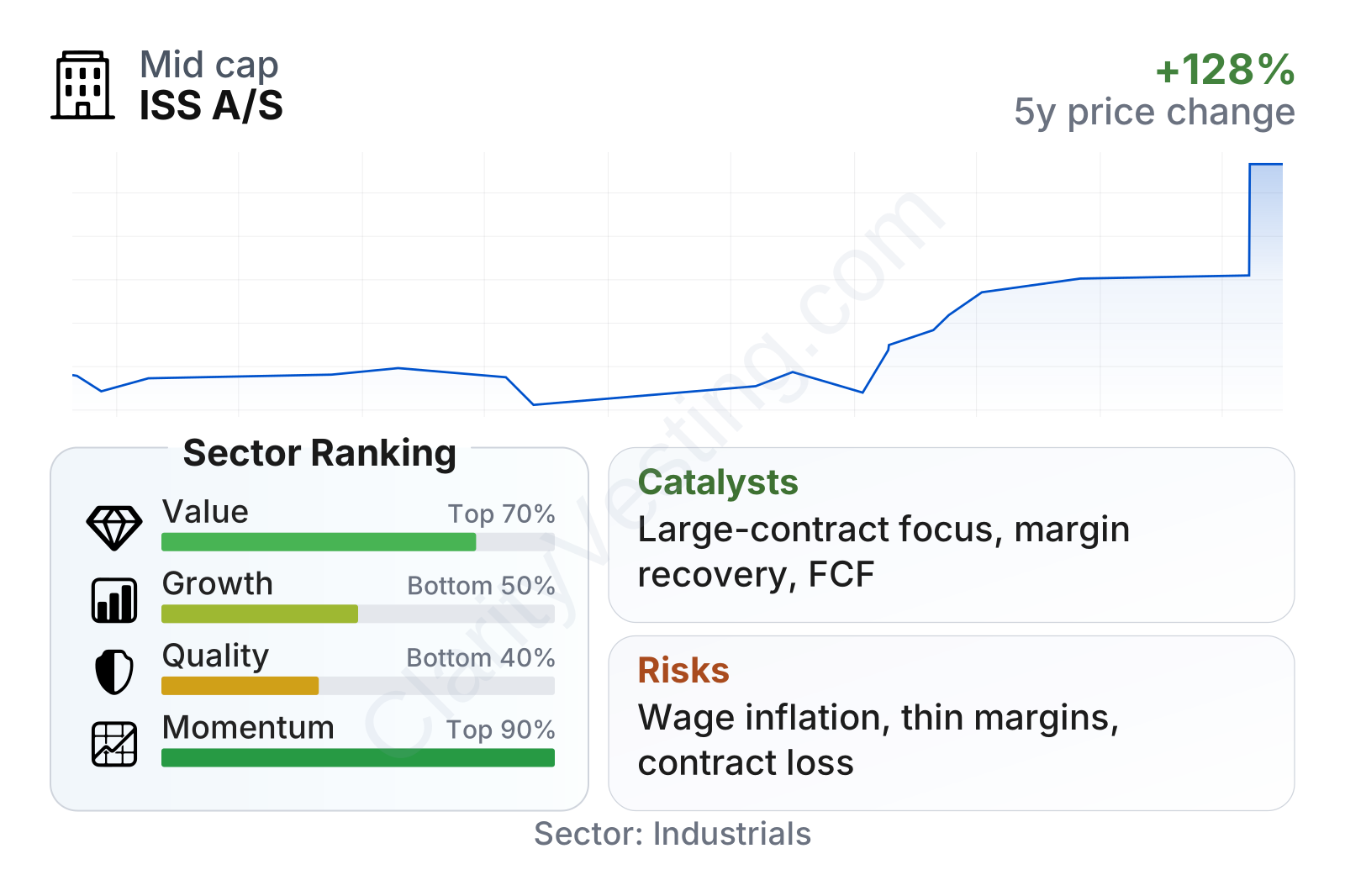
ISS currently sits in an interesting position. On valuation measures, it looks cheaper than many companies in its sector, with a lower earnings multiple and a much lower price-to-book ratio than the sector median. Cash generation also stands out: free cash flow yield is far above the sector norm, and the trailing dividend yield is also meaningfully higher.
Growth metrics are more mixed. Revenue has still been increasing at a healthy pace, but not faster than the broader sector. Over five years, revenue per share growth has been solid rather than exceptional, while earnings growth has been volatile. The more encouraging sign is margin direction: the operating margin trend has improved materially over the last five years even if the absolute margin remains below many peers.
Quality is the weakest area in the current profile. Profitability ratios are around or below sector medians, and leverage appears somewhat heavier than average. Even so, interest coverage remains decent, suggesting debt is manageable as long as operating performance stays stable. Momentum is the strongest area by far, with the share price outperforming much of the sector over one, three, and six-month periods. In other words, the market has already recognized some improvement, even though the business still does not look like a high-margin operator.
Growth
ISS operates in a sector with steady structural demand rather than explosive expansion. Outsourced facilities services tend to benefit from three durable trends: companies want to simplify operations, large clients increasingly prefer integrated service providers that can bundle multiple tasks under one contract, and environmental and workplace standards are becoming more demanding. Those trends support long-term demand even if the sector itself is not a fast-growth industry.
The company’s strategy is built around focusing on larger key-account customers, deepening integrated service offerings, and improving contract quality rather than simply chasing volume. That approach makes strategic sense. Large multinational clients can produce more stable and longer-lasting revenue, and bundling services can strengthen customer relationships while raising switching costs.
Another support for future growth is pricing discipline. In labor-heavy businesses, inflation can hurt margins quickly if contracts are poorly structured. ISS has been working to pass through cost increases and improve contract terms. If that discipline continues, growth in revenue could increasingly translate into growth in profit rather than being absorbed by wages and operating costs.
There is also a digital and sustainability angle. Corporate customers are paying more attention to energy efficiency, workplace experience, and data-driven building operations. ISS is not a software company, but it can use technology and sustainability services to make its offering more relevant and more embedded in client operations. That can help preserve contracts and support selective expansion.
Recent company communication has also emphasized organizational simplification, portfolio discipline, and operational improvement. For a business like ISS, that may matter more than dramatic new product launches. The biggest upside usually comes from better execution on a very large revenue base, not from inventing a new category.
Risks
This article is for informational purposes only and does not constitute financial advice. Some content is AI-generated. See Disclaimer