Stock Analysis · iRhythm Technologies Inc (IRTC)
Overview
iRhythm Technologies is a medical device company focused on cardiac monitoring. Its main product family is the Zio platform, a wearable heart rhythm monitor that helps detect irregular heartbeats such as atrial fibrillation. Instead of relying only on a traditional Holter monitor, patients wear a small patch for an extended period, and iRhythm then provides data analysis and reporting to physicians. In simple terms, the company combines a medical device, cloud-based data processing, and clinical reporting into one service.
The business is heavily concentrated in one core area: ambulatory cardiac monitoring. Based on the company’s recent annual disclosures, revenue is overwhelmingly generated from the Zio service line, with a very large majority coming from the United States. iRhythm does have some international activity, but it remains much smaller than its domestic business.
Main revenue sources can be summarized as follows:
- Zio XT and related long-term continuous monitoring services: approximately 80% to 90% of revenue. This is the company’s established patch-based monitoring service used to detect arrhythmias over multiple days.
- Zio AT and other mobile cardiac telemetry or advanced monitoring services: approximately 10% to 20% of revenue. These offerings provide additional monitoring capabilities, including near-real-time data transmission in certain use cases.
- International and other revenue: currently a small share of total sales, likely under 10%, mainly tied to expansion outside the U.S. and related service activity.
The financial profile shows a company that has expanded revenue quickly over the last several years while gradually narrowing losses. Gross profit has grown strongly as sales increased, but selling, general, and administrative expense has remained very high, which explains why net income is still negative. That said, losses have come down sharply from earlier years, suggesting that scale is beginning to help.
Revenue has climbed steadily from 2021 through 2025, and the business appears to be keeping a solid gross margin structure. The main tension is that operating costs, especially commercial and administrative spending, still absorb most of that gross profit. The improvement in net losses by 2025 is a meaningful step, but not yet the end of the profitability debate.
Key Figures
| Metric | Value | Sector ⓘ |
|---|---|---|
| Date | Oct 24, 2026 | |
| Context | ||
| Sector | Healthcare | |
| Industry | Medical Devices | |
| Market Cap ⓘ | $3.74B | |
| Beta ⓘ | 1.46 | |
Value (Cheapness) | ||
| P/E Ratio ⓘ | N/A | 25.42 |
| P/B Ratio ⓘ | 21.16 | 3.08 |
| FCF Yield ⓘ | 1.04% | 3.12% |
| Dividend Yield ⓘ | N/A | 1.85% |
| EBIT / EV ⓘ | 0.01% | 0.56% |
| PEG ⓘ | N/A | |
Growth (Business expansion) | ||
| Revenue Growth ⓘ | 20.10% | 7.50% |
| RPS Growth (5Y CAGR) ⓘ | 20.68% | 8.60% |
| EPS Growth (5Y CAGR) ⓘ | N/A | -17.73% |
| BVPS Growth (5Y CAGR) ⓘ | -15.88% | 3.72% |
| Margin Growth (5Y Trend) ⓘ | N/A | -0.57% |
| FCF Growth (5Y CAGR) ⓘ | N/A | 0.96% |
| DPS Growth (5Y CAGR) ⓘ | N/A | 6.69% |
Quality (Business durability) | ||
| ROIC (Latest) ⓘ | 0.19% | 3.17% |
| ROA (Latest) ⓘ | -1.34% | 2.98% |
| ROIC (5Y Median) ⓘ | -23.05% | 4.56% |
| ROA (5Y Median) ⓘ | -20.80% | 1.87% |
| Net Debt / EBIT (Latest) ⓘ | 2,278.06 | 1.34 |
| Net Debt / EBIT (5Y Median) ⓘ | N/A | 1.86 |
| Net Debt / EBITDA (Latest) ⓘ | 17.90 | 1.00 |
| Net Debt / Assets ⓘ | 43.96% | 5.06% |
| EBITDA / Interest ⓘ | 2.04 | 9.55 |
| Operating Margin (Latest) ⓘ | 0.03% | 9.25% |
| Operating Margin (5Y Median) ⓘ | -24.15% | 7.33% |
| Debt to Equity (Latest) ⓘ | 391.08% | 26.68% |
| Profit Margin (Latest) ⓘ | -1.69% | 3.34% |
| Free Cash Flow (Latest) ⓘ | $38.98M | |
Momentum (Price trend) | ||
| 3Y Return ⓘ | +48.88% | +51.61% |
| 12M Return (excl. last month) ⓘ | -40.17% | +19.90% |
| 6M Return ⓘ | -1.89% | +10.10% |
| Price vs. 200-Day MA ⓘ | -3.43% | +6.44% |
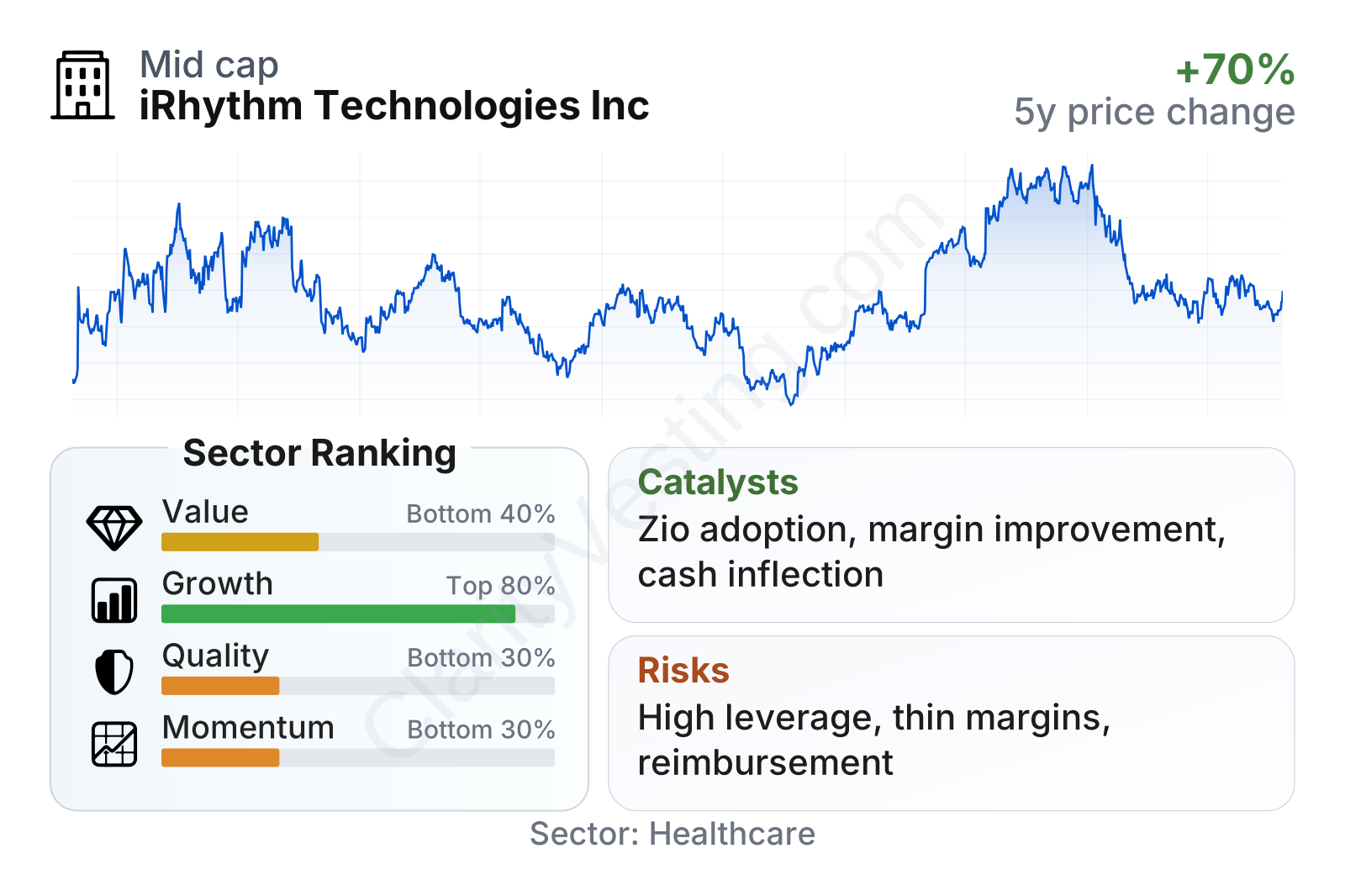
iRhythm sits in the mid-cap range and shows a more volatile trading profile than the broader market, which is not unusual for a medical technology company still moving toward steadier profitability. On growth, the company ranks well versus much of the healthcare sector, with revenue expansion clearly above sector medians over both the last year and the last five years.
By contrast, value and quality metrics remain weak. The stock trades at a high price-to-book multiple, while free cash flow yield is lower than the sector median. Profitability and returns on capital are still below typical healthcare peers, even though recent trends show improvement. Momentum has also been soft, reflecting that the share price has been uneven despite better operating progress.
Growth
iRhythm operates in a part of healthcare with favorable long-term demand. Cardiac arrhythmias are common, the population is aging, and clinicians increasingly want longer monitoring periods because short tests can miss intermittent heart rhythm problems. That gives structural support to patch-based monitoring, especially when paired with streamlined reporting for physicians.
The company’s strategy is logical for this market. It is not just selling a patch; it is offering an end-to-end service that includes device distribution, data processing, and diagnostic reporting. That can make the offering more embedded in clinical workflows than a stand-alone hardware device. It also creates a recurring-use model because each new patient episode can generate new revenue.
Revenue growth has remained consistently strong, often around 20% or more year over year, and clearly above the broader sector median. This matters because it suggests iRhythm is still gaining adoption rather than merely benefiting from a one-time rebound. The multi-year pattern points to durable demand, not just a temporary spike.
Another encouraging sign is the shift in cash generation. Free cash flow moved from clearly negative levels to positive territory more recently. That does not mean the business is fully mature, but it suggests operating leverage is starting to appear. For a company that spent years prioritizing expansion, this transition is important because it reduces dependence on outside capital and gives management more flexibility.
Recent company developments also support the growth case. iRhythm has continued expanding the reach of its Zio platform, investing in product development, and improving reimbursement and workflow integration. In addition, artificial intelligence and software-driven interpretation can strengthen the usefulness of long-duration cardiac monitoring over time. If the company can keep improving report turnaround, diagnostic accuracy, and physician adoption, it has a credible path to continued expansion.
Risks
This article is for informational purposes only and does not constitute financial advice. Some content is AI-generated. See Disclaimer


