Stock Analysis · Independence Realty Trust Inc (IRT)
Overview
Independence Realty Trust Inc is a residential real estate investment trust focused on owning, operating, and improving apartment communities. The company mainly targets multifamily properties in non-gateway U.S. markets, with a concentration in the Sun Belt and other large metropolitan areas where population growth, job creation, and housing affordability have generally supported rental demand. In simple terms, it collects rent from apartment residents, manages the buildings, renovates units when it sees an opportunity to raise returns, and distributes a meaningful part of its cash flow to shareholders as required for a REIT.
The business model is relatively straightforward: buy apartment communities, keep occupancy high, manage expenses, improve selected units and common areas, and use rental income to cover property costs, interest, and dividends. Because it is a residential REIT, the company’s performance depends less on one-time property sales and more on recurring rent collections and the efficiency of day-to-day operations.
Revenue is heavily concentrated in apartment operations. Based on the company’s filings, the main sources are approximately:
- Rental and other property revenue: about 97% to 99% — this includes base rent from residents, lease-related fees, utility reimbursements, parking, pet fees, and other property-level income.
- Other revenue: about 1% to 3% — this can include items such as ancillary income and limited non-property operating items.
That concentration is important for long-term analysis: Independence Realty Trust is not a diversified real estate platform spread across offices, malls, warehouses, and hotels. It is primarily a focused apartment landlord, so the long-term case depends on U.S. multifamily housing conditions, local market execution, and balance sheet discipline.
The broad financial flow shows a business that scaled up meaningfully after acquisitions, with revenue expanding sharply from 2021 to 2023 and then leveling off. Profitability has been more uneven than revenue, however, because interest expense and operating pressures have had a visible impact on the bottom line.
Key Figures
| Metric | Value | Sector ⓘ |
|---|---|---|
| Date | Oct 17, 2026 | |
| Context | ||
| Sector | Real Estate | |
| Industry | REIT - Residential | |
| Market Cap ⓘ | $3.54B | |
| Beta ⓘ | 0.98 | |
Value (Cheapness) | ||
| P/E Ratio ⓘ | 81.39 | 17.38 |
| P/B Ratio ⓘ | 1.07 | 0.85 |
| FCF Yield ⓘ | 4.02% | 7.38% |
| Dividend Yield ⓘ | 4.65% | 4.85% |
| EBIT / EV ⓘ | 2.18% | 3.78% |
| PEG ⓘ | 4.57 | |
Growth (Business expansion) | ||
| Revenue Growth ⓘ | 3.00% | 5.30% |
| RPS Growth (5Y CAGR) ⓘ | 5.30% | 6.02% |
| EPS Growth (5Y CAGR) ⓘ | -15.27% | -11.37% |
| BVPS Growth (5Y CAGR) ⓘ | -17.23% | 0.45% |
| Margin Growth (5Y Trend) ⓘ | -11.95% | -0.22% |
| FCF Growth (5Y CAGR) ⓘ | 99.32% | 5.40% |
| DPS Growth (5Y CAGR) ⓘ | 9.73% | 5.02% |
Quality (Business durability) | ||
| ROIC (Latest) ⓘ | 1.72% | 5.69% |
| ROE (Latest) ⓘ | 1.32% | 7.56% |
| ROA (Latest) ⓘ | 0.71% | 2.85% |
| ROIC (5Y Median) ⓘ | 0.93% | 4.22% |
| ROE (5Y Median) ⓘ | 1.70% | 6.03% |
| ROA (5Y Median) ⓘ | 0.94% | 2.44% |
| Net Debt / EBIT (Latest) ⓘ | 18.99 | 7.59 |
| Net Debt / EBIT (5Y Median) ⓘ | 19.91 | 8.40 |
| Net Debt / EBITDA (Latest) ⓘ | 6.34 | 5.27 |
| Net Debt / Assets ⓘ | 39.74% | 37.76% |
| EBITDA / Interest ⓘ | 4.59 | 4.10 |
| Operating Margin (Latest) ⓘ | 19.12% | 35.29% |
| Operating Margin (5Y Median) ⓘ | 20.79% | 37.31% |
| Debt to Equity (Latest) ⓘ | 72.74% | 88.87% |
| Profit Margin (Latest) ⓘ | 6.42% | 19.61% |
| Free Cash Flow (Latest) ⓘ | $142.18M | |
Momentum (Price trend) | ||
| 3Y Return ⓘ | +18.61% | +30.75% |
| 12M Return (excl. last month) ⓘ | -7.94% | +4.36% |
| 6M Return ⓘ | -4.01% | -2.52% |
| Price vs. 200-Day MA ⓘ | -7.30% | -2.34% |
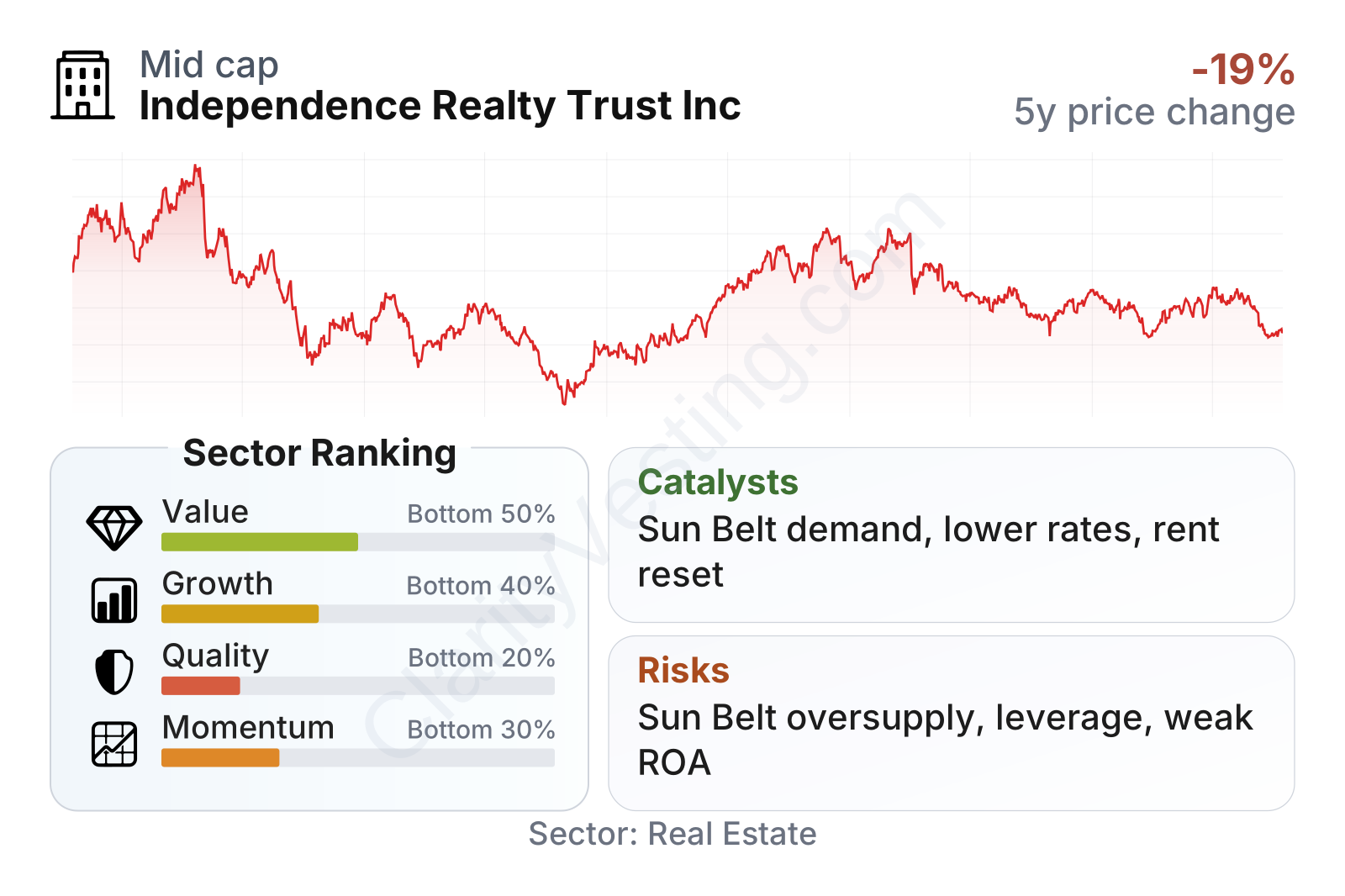
Independence Realty Trust is a mid-sized public apartment REIT with a market value around the mid-single-digit billions of dollars and a share price that has been volatile over the last several years. The stock recovered from its 2023 lows but has not clearly broken into a stronger sustained trend, which matches its weaker momentum ranking versus the broader real estate sector.
The table points to a mixed profile. On valuation factors, the company sits in the lower half of the sector, with a dividend yield close to the sector median but weaker free cash flow yield and earnings-based measures that look stretched. On growth, recent revenue expansion has been positive but below the sector median, while dividend growth has been stronger. The weakest area is quality: returns on assets, equity, and invested capital are well below typical sector levels, and leverage remains above the median. In short, the business offers income and scale, but current profitability and capital efficiency lag many peers.
Growth
The company operates in a part of real estate that still has a credible long-term demand base. Apartment housing tends to benefit from population growth, household formation, high single-family home prices, and the growing cost of home ownership. These trends have been especially relevant in Sun Belt and more affordable markets, where Independence Realty Trust has built much of its portfolio. Even when apartment supply rises, rental housing often remains structurally necessary because many households either cannot or do not want to buy a home.
Its strategy also makes sense on paper for long-term expansion. The company has emphasized markets with population inflows and has used acquisitions, portfolio recycling, and property improvements to lift rents and cash flow. For a residential REIT, growth does not need to come only from buying more buildings. It can also come from raising rents on renewals, leasing renovated units at higher rates, improving occupancy, and controlling property-level costs.
Revenue per share improved meaningfully from 2021 through 2023, then softened slightly in 2024 and 2025. That pattern suggests the large step-up from prior portfolio expansion has already been absorbed, and the company is now in a slower phase where same-store execution matters more than headline scale. This is still consistent with a business that has grown over a five-year period, but it is not currently showing the pace seen in the strongest residential REITs.
Dividend per share has moved upward steadily over the last five years, with growth notably stronger than the sector median over that period. That is a favorable sign for readers who want to understand whether cash distributions have been moving in the right direction. Even so, dividend growth alone does not settle the long-term picture; it works best when paired with stronger asset returns and a conservative balance sheet.
A practical catalyst for the next few years is the possibility that apartment fundamentals improve as the current wave of new multifamily supply is absorbed in several Sun Belt markets. If rent growth stabilizes while expense growth cools and financing conditions become friendlier, a company like Independence Realty Trust could see better margins and improved valuation support. Another potential catalyst is refinancing progress: if interest costs ease over time, more of recurring rental income can fall through to cash flow.
Recent company communications have continued to emphasize portfolio optimization, internal growth through operations, and balance sheet management rather than highly aggressive expansion. For long-term observers, that is a more disciplined message than a rapid acquisition push during an uncertain rate environment.
Risks
This article is for informational purposes only and does not constitute financial advice. Some content is AI-generated. See Disclaimer


