Stock Analysis · Interroll Holding AG (IRRHF)
Overview
Interroll Holding AG is a Swiss industrial company that makes equipment used to move, sort, store, and process goods inside warehouses, distribution centers, airports, and production sites. Its products are part of the infrastructure behind parcel handling, e-commerce fulfillment, food processing, and factory automation. In simple terms, Interroll helps companies move boxes, pallets, luggage, and materials more efficiently.
The business is centered on material handling components and platforms rather than broad heavy industrial systems. Its portfolio includes conveyor rollers, drum motors, conveyors, sorters, pallet handling systems, and modular platforms that can be combined into larger automated solutions. This gives the company exposure to both replacement demand for installed equipment and new investment in automated logistics sites.
Based on the company’s reporting structure in recent annual disclosures, revenue mainly comes from these product groups:
- Rollers – approximately 30% to 35% of revenue. This includes conveyor rollers and related components used in a wide range of transport and storage systems.
- Drives – approximately 20% to 25%. This segment includes drum motors and other drive solutions that power conveyor systems.
- Conveyors & Sorters – approximately 20% to 25%. This covers conveyor modules and sorting equipment used heavily in parcel, warehouse, and e-commerce applications.
- Pallet Handling – approximately 15% to 20%. These systems move and store pallets in manufacturing and distribution facilities.
- Services and other activities – a smaller share, typically the remaining low single-digit percentage where separately disclosed.
End-market exposure is diversified, with strong positions in e-commerce and parcel logistics, food and beverage, airport baggage handling, and general manufacturing. Geographically, Interroll has historically generated a large share of sales in Europe, with additional business in the Americas and Asia-Pacific.
The financial flow over the past several years shows a business with solid gross profitability but lower sales than its 2021–2022 peak. Revenue declined from roughly CHF 640 million to CHF 514 million between 2021 and 2025, while gross profit held up better than sales because product mix and cost discipline partly offset the downturn. Operating profit and net income also softened, which fits with weaker order activity across industrial automation markets after the post-pandemic boom.
The broader pattern is a cyclical slowdown rather than a collapse in the business model. Cost of revenue has fallen faster than sales over time, helping preserve margins, but earnings still remain below earlier highs because fixed costs and softer factory utilization matter in this industry.
Key Figures
| Metric | Value | Sector ⓘ |
|---|---|---|
| Date | Oct 17, 2026 | |
| Context | ||
| Sector | Industrials | |
| Industry | Specialty Industrial Machinery | |
| Market Cap ⓘ | $1.70B | |
| Beta ⓘ | 1.32 | |
Value (Cheapness) | ||
| P/E Ratio ⓘ | 25.11 | 22.10 |
| P/B Ratio ⓘ | 3.38 | 1.97 |
| FCF Yield ⓘ | N/A | 6.38% |
| Dividend Yield ⓘ | 1.58% | 1.94% |
| EBIT / EV ⓘ | 7.59% | 4.79% |
| PEG ⓘ | N/A | |
Growth (Business expansion) | ||
| Revenue Growth ⓘ | 9.00% | 9.30% |
| RPS Growth (5Y CAGR) ⓘ | -5.77% | 7.81% |
| EPS Growth (5Y CAGR) ⓘ | -22.24% | -13.06% |
| BVPS Growth (5Y CAGR) ⓘ | 8.76% | 6.14% |
| Margin Growth (5Y Trend) ⓘ | -1.46% | 0.88% |
| FCF Growth (5Y CAGR) ⓘ | N/A | 11.01% |
| DPS Growth (5Y CAGR) ⓘ | 4.16% | 9.48% |
Quality (Business durability) | ||
| ROIC (Latest) ⓘ | N/A | 10.84% |
| ROA (Latest) ⓘ | N/A | 5.41% |
| ROIC (5Y Median) ⓘ | N/A | 9.38% |
| ROA (5Y Median) ⓘ | 12.18% | 4.95% |
| Net Debt / EBIT (Latest) ⓘ | N/A | 2.08 |
| Net Debt / EBIT (5Y Median) ⓘ | N/A | 2.27 |
| Net Debt / EBITDA (Latest) ⓘ | N/A | 1.39 |
| Net Debt / Assets ⓘ | N/A | 19.28% |
| EBITDA / Interest ⓘ | N/A | 9.58 |
| Operating Margin (Latest) ⓘ | N/A | 10.50% |
| Operating Margin (5Y Median) ⓘ | 15.40% | 10.29% |
| Debt to Equity (Latest) ⓘ | N/A | 65.48% |
| Profit Margin (Latest) ⓘ | 10.16% | 6.67% |
| Free Cash Flow (Latest) ⓘ | N/A | |
Momentum (Price trend) | ||
| 3Y Return ⓘ | -7.22% | +61.68% |
| 12M Return (excl. last month) ⓘ | -28.79% | +12.58% |
| 6M Return ⓘ | +4.02% | 0.00% |
| Price vs. 200-Day MA ⓘ | -6.52% | +0.02% |
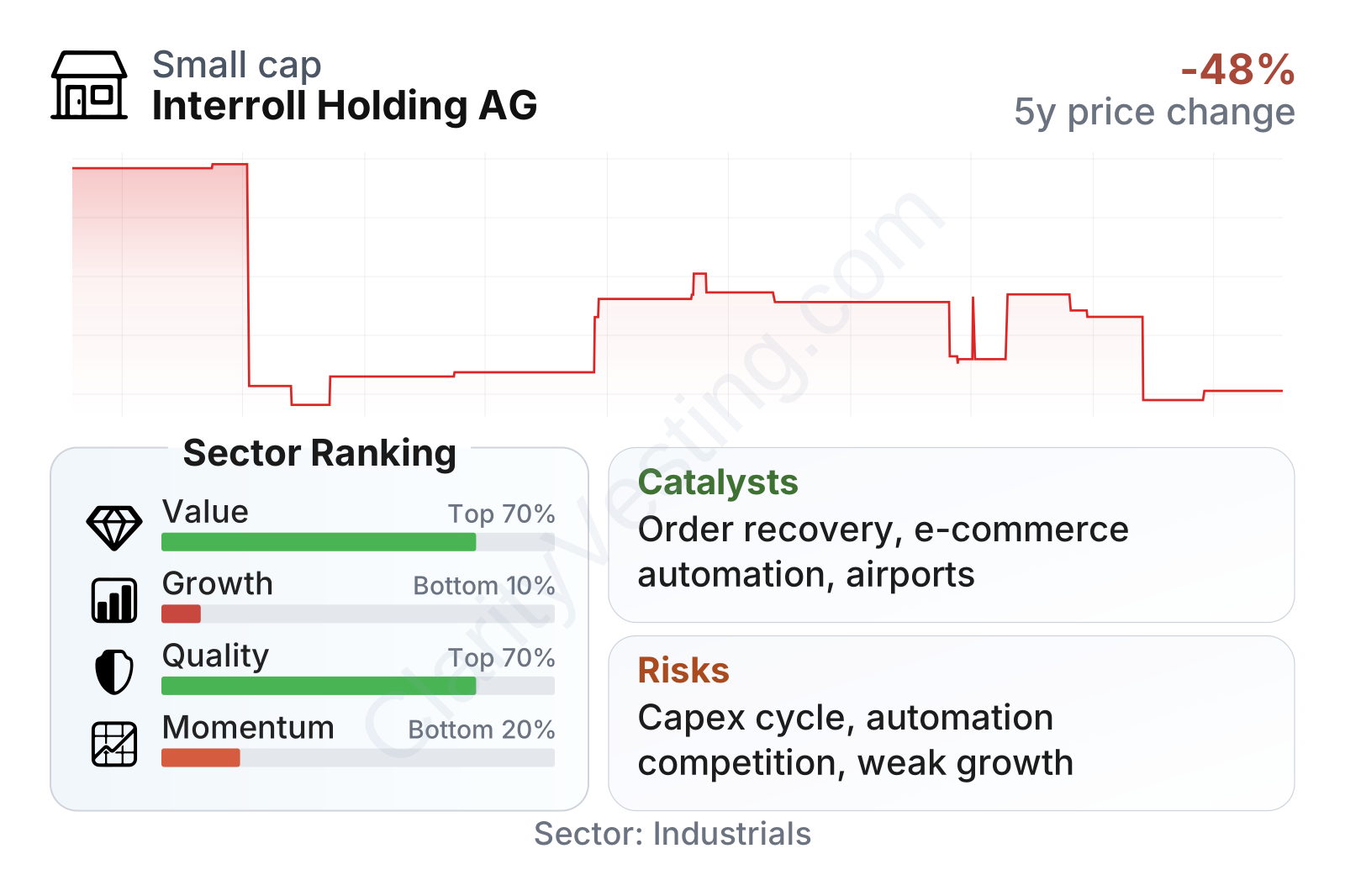
Interroll currently sits in an interesting middle ground. On valuation, earnings and asset multiples are somewhat above the sector median, while its operating earnings relative to enterprise value look stronger than average. That suggests the market is not pricing the company as distressed, even though share performance has been weak.
Quality is where the profile stands out most. Profit margin is above the sector median, historical operating margin has also been stronger than many peers, and balance-sheet leverage appears conservative relative to the industry. That combination points to a business with real resilience even during a softer demand cycle.
Growth metrics are the weakest part of the picture. Recent yearly revenue growth is close to the sector median, but the five-year record for revenue per share, earnings per share, and margin trend is notably behind much of the industrial peer group. Price momentum also remains weak over both one-year and three-year periods, which aligns with the market’s caution toward capital equipment names exposed to warehouse automation spending.
Growth
Interroll operates in a sector with long-term structural support. Warehouses, parcel hubs, and factories are under constant pressure to improve speed, labor efficiency, traceability, and energy use. E-commerce growth, rising package volumes, labor shortages, and the need for more automated intralogistics all support demand for conveyor, sorting, and pallet-handling equipment over time. These are favorable industry conditions, even if orders can be uneven from year to year.
The company’s strategy is logical for that environment. Interroll focuses on standardized, modular platforms that can be reused across many customer projects. This matters because integrators and end customers increasingly want systems that are easier to design, install, and maintain. A modular approach can improve manufacturing efficiency, shorten project timelines, and support recurring replacement demand once a product family is widely installed.
Another important growth angle is the company’s position in the value chain. Interroll is not only selling large one-off systems; it also provides core components such as rollers and drum motors that are used across many types of conveyor architecture. That creates broad exposure to automation spending without depending entirely on a few giant turnkey contracts.
A meaningful catalyst would be a recovery in order intake across warehouse automation and parcel infrastructure after several slower years. Many customers reduced capital spending as interest rates rose and post-pandemic demand normalized. If those projects restart, Interroll could benefit from operating leverage because its margin structure has historically been solid. Expansion in airport baggage handling and food processing automation also adds optionality beyond e-commerce.
Recent company communications have emphasized efficiency initiatives, product platform development, and regional manufacturing capabilities. None of these alone transform the outlook, but together they support the idea that Interroll is positioning itself for the next upcycle rather than simply waiting for demand to recover.
Risks
This article is for informational purposes only and does not constitute financial advice. Some content is AI-generated. See Disclaimer


