Stock Analysis · Disc Medicine Inc (IRON)
Overview
Disc Medicine is a clinical-stage biotechnology company focused on severe blood disorders. Its research centers on the biology of red blood cells, iron balance, and heme synthesis, which are essential processes for making healthy blood. The company’s goal is to develop medicines for rare hematology diseases where current treatment options are limited or burdensome. Its pipeline includes programs in heme biosynthesis disorders, anemia-related conditions, and iron-loading diseases.
For a long-term reader, the most important starting point is that Disc Medicine is still in the development stage rather than the commercial stage. That means its value depends mainly on whether its drug candidates progress successfully through clinical trials and eventually reach the market. As of the latest public filings in 2026, the business is not yet built around recurring product sales.
Main sources of revenue are currently very limited and not representative of a mature pharmaceutical company.
- Product revenue: 0%. Disc Medicine has not yet launched an approved commercial product.
- Collaboration, licensing, or other operating revenue: approximately 0% in the most recent annual period shown in public filings and reported financial history.
- Non-operating or accounting-related items: any reported net results are driven mainly by expenses, financing, and accounting effects rather than business sales.
This makes Disc Medicine a pure pipeline company at this stage. Financially, the business behaves more like a research platform funded by capital markets than a traditional operating company funded by customer demand. Spending has been increasingly directed toward research and development, which is typical for a biotech moving multiple programs deeper into clinical testing.
The cost structure shows a company with essentially no recurring revenue and a rapidly expanding research budget. Research and development has grown sharply over the past several years and remains the dominant use of capital, while administrative costs have also increased as the pipeline has expanded. That pattern is consistent with a biotech trying to create future value through clinical progress rather than current sales.
Key Figures
| Metric | Value | Sector ⓘ |
|---|---|---|
| Date | Oct 24, 2026 | |
| Context | ||
| Sector | Healthcare | |
| Industry | Biotechnology | |
| Market Cap ⓘ | $2.92B | |
| Beta ⓘ | 2.11 | |
Value (Cheapness) | ||
| P/E Ratio ⓘ | N/A | 25.42 |
| P/B Ratio ⓘ | 4.51 | 3.08 |
| FCF Yield ⓘ | -6.77% | 3.12% |
| Dividend Yield ⓘ | N/A | 1.85% |
| EBIT / EV ⓘ | -12.88% | 0.56% |
| PEG ⓘ | N/A | |
Growth (Business expansion) | ||
| Revenue Growth ⓘ | N/A | 7.50% |
| RPS Growth (5Y CAGR) ⓘ | N/A | 8.60% |
| EPS Growth (5Y CAGR) ⓘ | -16.95% | -17.73% |
| BVPS Growth (5Y CAGR) ⓘ | N/A | 3.72% |
| Margin Growth (5Y Trend) ⓘ | N/A | -0.57% |
| FCF Growth (5Y CAGR) ⓘ | N/A | 0.96% |
| DPS Growth (5Y CAGR) ⓘ | N/A | 6.69% |
Quality (Business durability) | ||
| ROIC (Latest) ⓘ | -27.04% | 3.17% |
| ROA (Latest) ⓘ | -36.01% | 2.98% |
| ROIC (5Y Median) ⓘ | -23.48% | 4.56% |
| ROA (5Y Median) ⓘ | -31.50% | 1.87% |
| Net Debt / EBIT (Latest) ⓘ | N/A | 1.34 |
| Net Debt / EBIT (5Y Median) ⓘ | N/A | 1.86 |
| Net Debt / EBITDA (Latest) ⓘ | N/A | 1.00 |
| Net Debt / Assets ⓘ | -5.14% | 5.06% |
| EBITDA / Interest ⓘ | N/A | 9.55 |
| Operating Margin (Latest) ⓘ | 2020.41% | 9.25% |
| Operating Margin (5Y Median) ⓘ | N/A | 7.33% |
| Debt to Equity (Latest) ⓘ | 9.45% | 26.68% |
| Profit Margin (Latest) ⓘ | N/A | 3.34% |
| Free Cash Flow (Latest) ⓘ | -$197.58M | |
Momentum (Price trend) | ||
| 3Y Return ⓘ | +77.92% | +51.61% |
| 12M Return (excl. last month) ⓘ | +11.36% | +19.90% |
| 6M Return ⓘ | +7.63% | +10.10% |
| Price vs. 200-Day MA ⓘ | +6.22% | +6.44% |
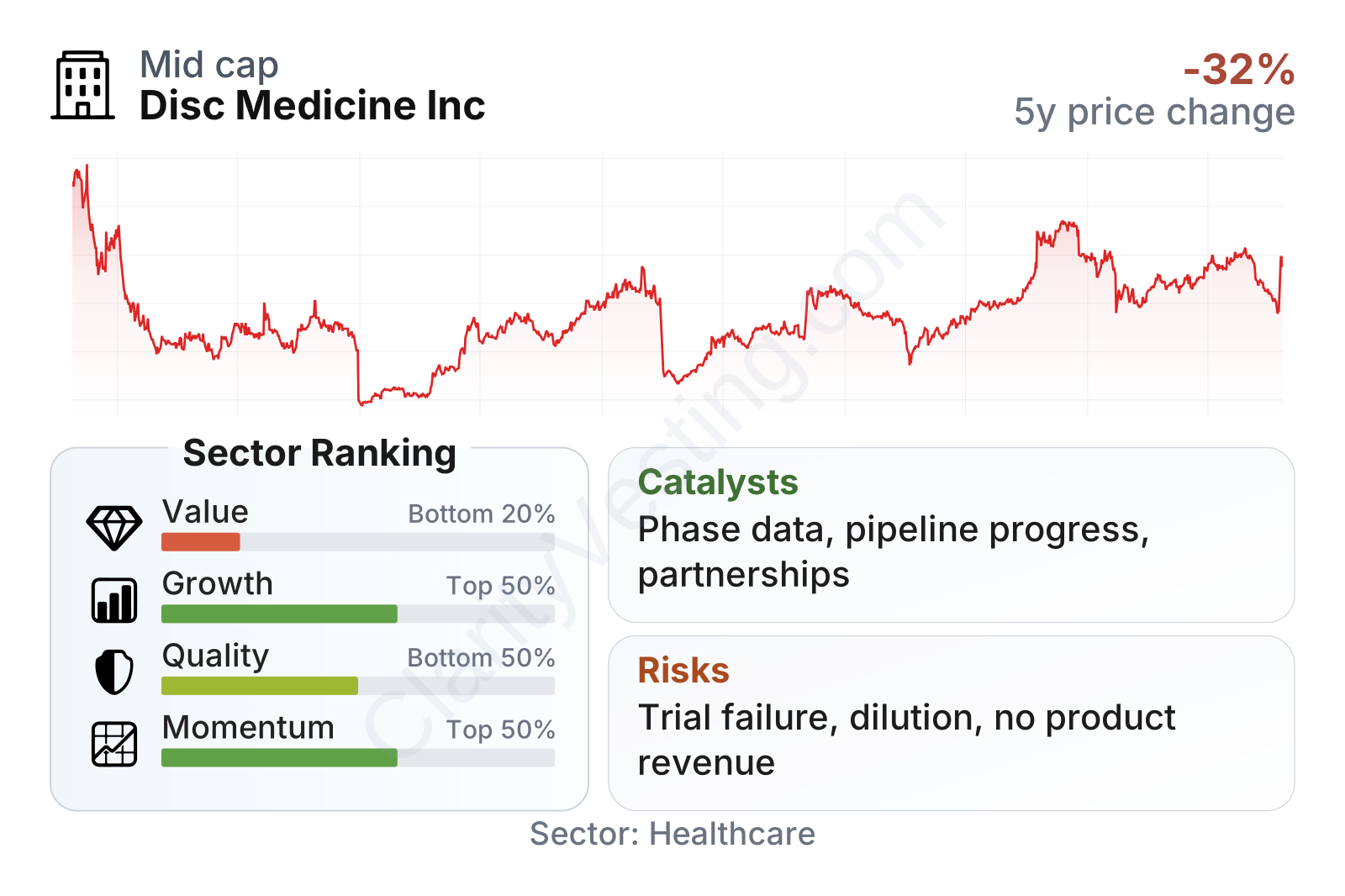
Disc Medicine is a mid-sized biotech by market value, but its trading pattern remains volatile, with a beta above 2. The share price history reflects that reality: large drawdowns have been followed by equally sharp recoveries, which is common for development-stage drug companies where each clinical update can materially change expectations.
The broader factor picture is mixed. On growth, the company sits around the middle of the healthcare group, which makes sense for a business without product sales but with expanding clinical activity. On value, it ranks in the lower end of the sector, largely because conventional valuation metrics look weak or not meaningful when a company has losses and negative cash flow. Quality also screens below average because returns on capital and assets are still negative, even though leverage is relatively modest.
Growth
Disc Medicine operates in a part of healthcare that remains attractive over the long run: rare-disease biotechnology and specialty hematology. This area often draws strong interest because successful drugs can command premium pricing, face concentrated specialist competition rather than mass-market competition, and benefit from orphan-drug incentives. Blood disorders also offer a relatively focused treatment ecosystem, which can help smaller biotech companies build clear clinical and commercial strategies if their medicines work.
The company’s strategy is coherent. Instead of pursuing broad primary-care markets, it is targeting diseases where biology is well defined and where treatment benefit can potentially be measured with clearer biomarkers and clinical endpoints. That raises the odds of generating meaningful data, although it does not eliminate development risk. Disc Medicine’s lead programs have been aimed at disorders such as erythropoietic protoporphyria and other hematologic conditions linked to iron and heme regulation, giving the company several shots on goal rather than reliance on a single asset.
One of the main potential catalysts is clinical readouts from its lead and follow-on programs. In biotech, strong mid-stage or late-stage data can meaningfully change how the market values a company, especially when the underlying disease has few effective options. Another growth driver is the possibility of partnerships or licensing agreements with larger pharmaceutical companies that want access to specialized blood-disease programs.
Recent company communications in 2026 have continued to emphasize pipeline advancement, enrollment progress, and preparation for additional data milestones. For a company like Disc Medicine, these updates matter more than near-term income statement trends because future commercial potential depends first on de-risking the science.
Cash usage has been moving in the wrong direction in the short term, with trailing free cash flow becoming more negative as clinical development has accelerated. That is not surprising for a company scaling trials, but it does mean growth is currently being purchased through heavier spending. In practical terms, Disc Medicine is growing its pipeline footprint faster than it is growing financial self-sufficiency.
Risks
This article is for informational purposes only and does not constitute financial advice. Some content is AI-generated. See Disclaimer


