Stock Analysis · Iradimed Co (IRMD)
Overview
Iradimed Corporation is a specialized medical device company focused on equipment that can be used safely in the magnetic resonance imaging, or MRI, environment. Standard hospital equipment often cannot be brought close to MRI machines because of strong magnetic fields. Iradimed designs products specifically for that setting, which addresses a real operational problem for hospitals treating critically ill patients who need imaging while still requiring monitoring or drug delivery.
The company’s business is concentrated in a small number of highly specialized product categories. Based on recent annual reporting, revenue is primarily generated from the following sources:
- MRidium MRI-compatible IV infusion pump systems: approximately 55% to 65%. This is the company’s largest business. It includes the pump system itself as well as related disposables and accessories used to deliver fluids and medications during MRI procedures.
- MRI-compatible patient vital signs monitoring systems: approximately 30% to 40%. These systems allow care teams to track a patient’s condition during MRI scans. Revenue includes monitors, related components, and accessories.
- Service and other revenue: generally under 10%. This includes service-related activity and smaller ancillary items tied to the installed base.
Iradimed’s appeal as a business starts with its niche. Rather than competing across the entire medical device market, it focuses on a narrow and technically demanding use case where product reliability, regulatory approvals, and hospital workflow integration matter a great deal. The result is a company with a relatively small revenue base compared with large medtech peers, but one that has historically produced unusually strong profitability for its size.
The financial profile also shows expanding revenue and operating income over the last several years, with cost of revenue staying relatively controlled relative to sales. That combination points to a business with pricing discipline and attractive unit economics, even as it continues to spend on selling and product development.
The long-term pattern is notable: revenue has climbed steadily from the low-$40 million range a few years ago to above $80 million more recently, while net income and operating profit have also moved upward. That suggests growth has not been bought at the expense of profitability.
Key Figures
| Metric | Value | Sector ⓘ |
|---|---|---|
| Date | Oct 17, 2026 | |
| Context | ||
| Sector | Healthcare | |
| Industry | Medical Devices | |
| Market Cap ⓘ | $1.15B | |
| Beta ⓘ | 0.91 | |
Value (Cheapness) | ||
| P/E Ratio ⓘ | 50.18 | 24.79 |
| P/B Ratio ⓘ | 11.31 | 3.08 |
| FCF Yield ⓘ | 2.17% | 3.15% |
| Dividend Yield ⓘ | 0.86% | 1.94% |
| EBIT / EV ⓘ | 2.78% | 0.57% |
| PEG ⓘ | 4.46 | |
Growth (Business expansion) | ||
| Revenue Growth ⓘ | 0.30% | 7.45% |
| RPS Growth (5Y CAGR) ⓘ | 18.37% | 8.61% |
| EPS Growth (5Y CAGR) ⓘ | -4.98% | -17.81% |
| BVPS Growth (5Y CAGR) ⓘ | 6.45% | 3.72% |
| Margin Growth (5Y Trend) ⓘ | 10.31% | -0.62% |
| FCF Growth (5Y CAGR) ⓘ | 13.06% | 1.04% |
| DPS Growth (5Y CAGR) ⓘ | 4.07% | 6.77% |
Quality (Business durability) | ||
| ROIC (Latest) ⓘ | 23.07% | 3.24% |
| ROA (Latest) ⓘ | 20.07% | 3.01% |
| ROIC (5Y Median) ⓘ | 21.84% | 4.60% |
| ROA (5Y Median) ⓘ | 19.35% | 1.89% |
| Net Debt / EBIT (Latest) ⓘ | -2.02 | 1.34 |
| Net Debt / EBIT (5Y Median) ⓘ | -2.38 | 1.84 |
| Net Debt / EBITDA (Latest) ⓘ | -1.91 | 1.00 |
| Net Debt / Assets ⓘ | -51.39% | 5.45% |
| EBITDA / Interest ⓘ | N/A | 9.64 |
| Operating Margin (Latest) ⓘ | 33.88% | 9.27% |
| Operating Margin (5Y Median) ⓘ | 30.56% | 7.38% |
| Debt to Equity (Latest) ⓘ | N/A | 28.58% |
| Profit Margin (Latest) ⓘ | 26.70% | 3.59% |
| Free Cash Flow (Latest) ⓘ | $24.93M | |
Momentum (Price trend) | ||
| 3Y Return ⓘ | +140.30% | +42.80% |
| 12M Return (excl. last month) ⓘ | +16.67% | +18.50% |
| 6M Return ⓘ | -3.51% | +7.57% |
| Price vs. 200-Day MA ⓘ | -3.85% | +5.12% |
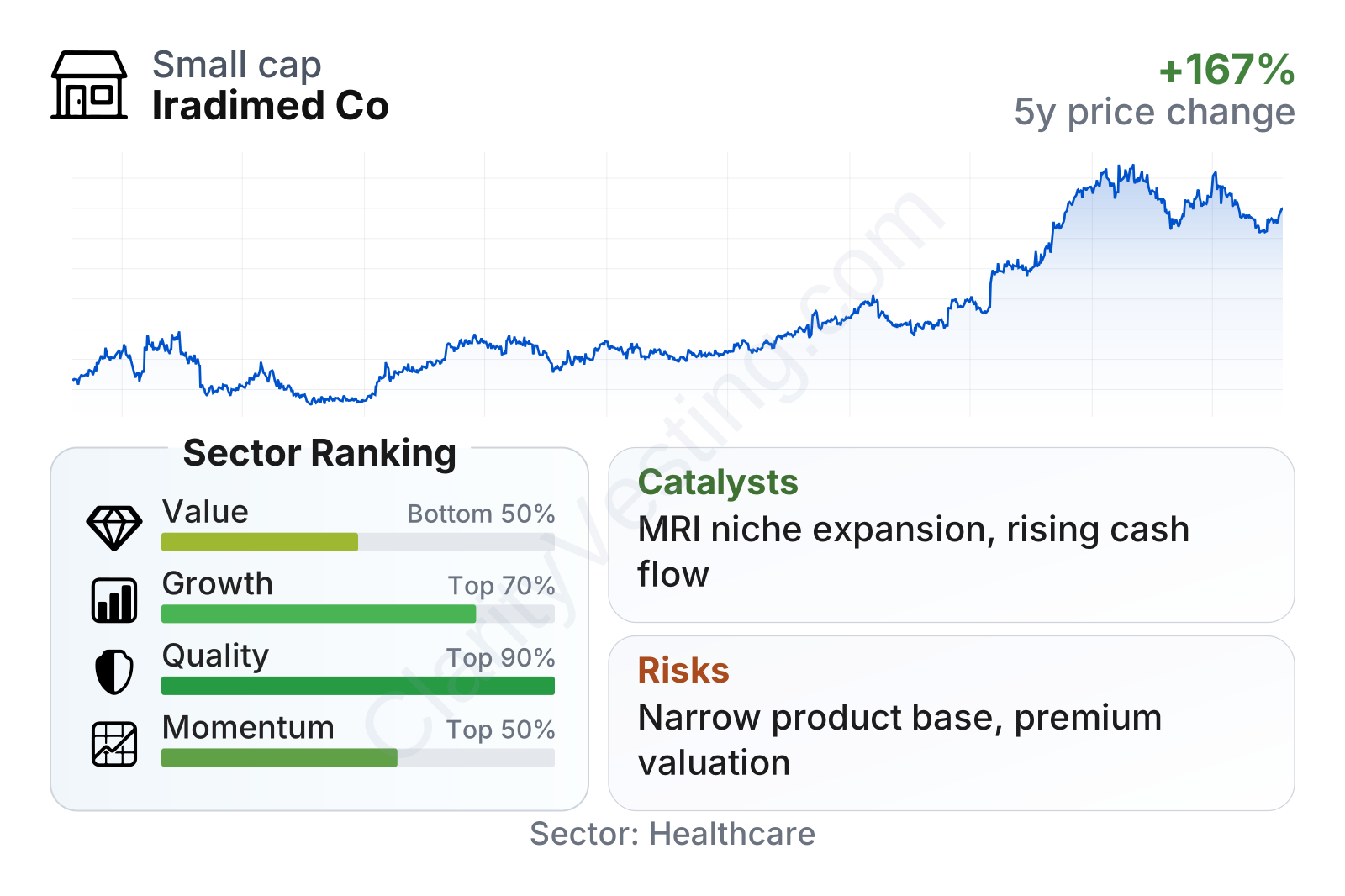
Iradimed stands out most on business quality. Profitability, returns on capital, and balance-sheet strength are well above much of the healthcare equipment group. Growth has also been solid over a five-year period, especially in revenue per share and free cash flow, even though the most recent year-over-year sales pace has slowed sharply. On valuation, the picture is less favorable: earnings and book-based multiples are materially above sector norms, which means the market is already recognizing many of the company’s strengths.
The stock’s longer-term performance has been very strong, but recent momentum has cooled. That combination often reflects a market reassessment after a period of rapid rerating rather than a breakdown in the underlying business.
Growth
Iradimed operates in a healthcare niche that benefits from durable structural demand. MRI usage remains important in modern diagnosis, and hospitals continue to seek safer ways to monitor and treat higher-acuity patients during scans. As imaging volumes rise and care becomes more complex, the need for MRI-compatible pumps and monitoring equipment remains relevant. This is not a mass-market category, but it is one with practical barriers to entry and a clear clinical use case.
The company’s strategy appears coherent for long-term expansion. Growth can come from selling more systems into hospitals that do not yet have MRI-compatible equipment, increasing usage of accessories and disposables tied to the installed base, and expanding internationally. Another driver is broader adoption across more departments within a hospital system once a facility has already integrated the company’s products into its workflow.
One point to watch is the recent slowdown in year-over-year growth. The company had been posting very strong double-digit increases for several years, then moved down to low double digits, and most recently to nearly flat growth. For a long-term view, that does not automatically negate the business thesis, but it does raise the question of whether growth is temporarily pausing, becoming more uneven, or facing tougher comparisons after a strong run.
Cash generation has been more encouraging. Free cash flow has trended upward meaningfully over the last several years and recently reached a much higher level than earlier periods. That matters because it suggests earnings quality is solid and that the business is not heavily dependent on borrowing or aggressive accounting to support expansion.
A meaningful catalyst is product broadening within the same MRI safety niche. Iradimed has worked to build a more complete MRI room offering rather than remaining a single-product company. When a medical device company can expand around an existing customer problem using the same sales channel and regulatory know-how, that can improve growth efficiency. Recent company communications have also emphasized continued hospital demand, international opportunities, and the ability to add placements through direct sales and distribution relationships.
Risks
This article is for informational purposes only and does not constitute financial advice. Some content is AI-generated. See Disclaimer


