Stock Analysis · Iron Mountain Incorporated (IRM)
Overview
Iron Mountain Incorporated is a specialty real estate investment trust that started with physical records storage and has gradually expanded into information management, data center capacity, digital services, and asset lifecycle services. In simple terms, the company helps organizations store, protect, access, and manage important information and physical assets. Its customers include businesses, governments, healthcare systems, financial institutions, and other large organizations that need secure handling of records and data.
The core business still comes from storage rental and related services tied to physical records management, but the company has been building faster-growing businesses around digital infrastructure. Iron Mountain operates a large global network of records storage facilities, secure shredding operations, and data centers. That combination matters because it gives the company long customer relationships, recurring revenue, and many opportunities to sell additional services to the same clients.
Based on the company’s recent annual reporting structure, revenue is broadly driven by the following activities, ordered from largest to smallest:
- Storage rental from records management: approximately 45% to 50% of revenue. This is the recurring monthly fee customers pay to keep physical records, tapes, and other materials in Iron Mountain facilities.
- Service revenue tied to records management: approximately 25% to 30%. This includes retrieval, transportation, refiling, secure shredding, and other activity-based services connected to stored items.
- Data centers: approximately 10% to 15%. This business provides colocation capacity and related digital infrastructure services for enterprise and hyperscale customers.
- Asset lifecycle management and other digital services: approximately 10% to 15%. This includes IT asset disposition, device remarketing, secure destruction, digitization, and related information management services.
Over the last several years, the business mix has been shifting gradually toward higher-growth digital activities, especially data centers and asset lifecycle management, while the legacy storage business continues to provide a stable base of recurring cash flow. Revenue has climbed steadily, but the profit flow to shareholders has been pressured by rising interest expense and capital needs.
The long-term pattern is clear: sales have expanded meaningfully since 2021, and operating income has remained positive, but financing costs have taken a larger share of the economics. That is an important theme for understanding both the attraction and the risk of the company.
Key Figures
| Metric | Value | Sector ⓘ |
|---|---|---|
| Date | Oct 17, 2026 | |
| Context | ||
| Sector | Real Estate | |
| Industry | REIT - Specialty | |
| Market Cap ⓘ | $33.00B | |
| Beta ⓘ | 1.19 | |
Value (Cheapness) | ||
| P/E Ratio ⓘ | 82.12 | 17.38 |
| P/B Ratio ⓘ | N/A | 0.85 |
| FCF Yield ⓘ | -1.46% | 7.38% |
| Dividend Yield ⓘ | 2.95% | 4.85% |
| EBIT / EV ⓘ | 2.72% | 3.78% |
| PEG ⓘ | 2.70 | |
Growth (Business expansion) | ||
| Revenue Growth ⓘ | 18.50% | 5.30% |
| RPS Growth (5Y CAGR) ⓘ | 10.69% | 6.02% |
| EPS Growth (5Y CAGR) ⓘ | 4.18% | -11.37% |
| BVPS Growth (5Y CAGR) ⓘ | N/A | 0.45% |
| Margin Growth (5Y Trend) ⓘ | -8.13% | -0.22% |
| FCF Growth (5Y CAGR) ⓘ | N/A | 5.40% |
| DPS Growth (5Y CAGR) ⓘ | 5.75% | 5.02% |
Quality (Business durability) | ||
| ROIC (Latest) ⓘ | 8.06% | 5.69% |
| ROE (Latest) ⓘ | N/A | 7.56% |
| ROA (Latest) ⓘ | 1.97% | 2.85% |
| ROIC (5Y Median) ⓘ | 5.83% | 4.22% |
| ROE (5Y Median) ⓘ | 43.60% | 6.03% |
| ROA (5Y Median) ⓘ | 1.10% | 2.44% |
| Net Debt / EBIT (Latest) ⓘ | 13.28 | 7.59 |
| Net Debt / EBIT (5Y Median) ⓘ | 16.53 | 8.40 |
| Net Debt / EBITDA (Latest) ⓘ | 7.76 | 5.27 |
| Net Debt / Assets ⓘ | 88.41% | 37.76% |
| EBITDA / Interest ⓘ | 2.78 | 4.10 |
| Operating Margin (Latest) ⓘ | 19.33% | 35.29% |
| Operating Margin (5Y Median) ⓘ | 15.95% | 37.31% |
| Debt to Equity (Latest) ⓘ | -1531.32% | 88.87% |
| Profit Margin (Latest) ⓘ | 5.54% | 19.61% |
| Free Cash Flow (Latest) ⓘ | -$481.02M | |
Momentum (Price trend) | ||
| 3Y Return ⓘ | +103.12% | +30.75% |
| 12M Return (excl. last month) ⓘ | +16.02% | +4.36% |
| 6M Return ⓘ | +0.69% | -2.52% |
| Price vs. 200-Day MA ⓘ | +0.28% | -2.34% |
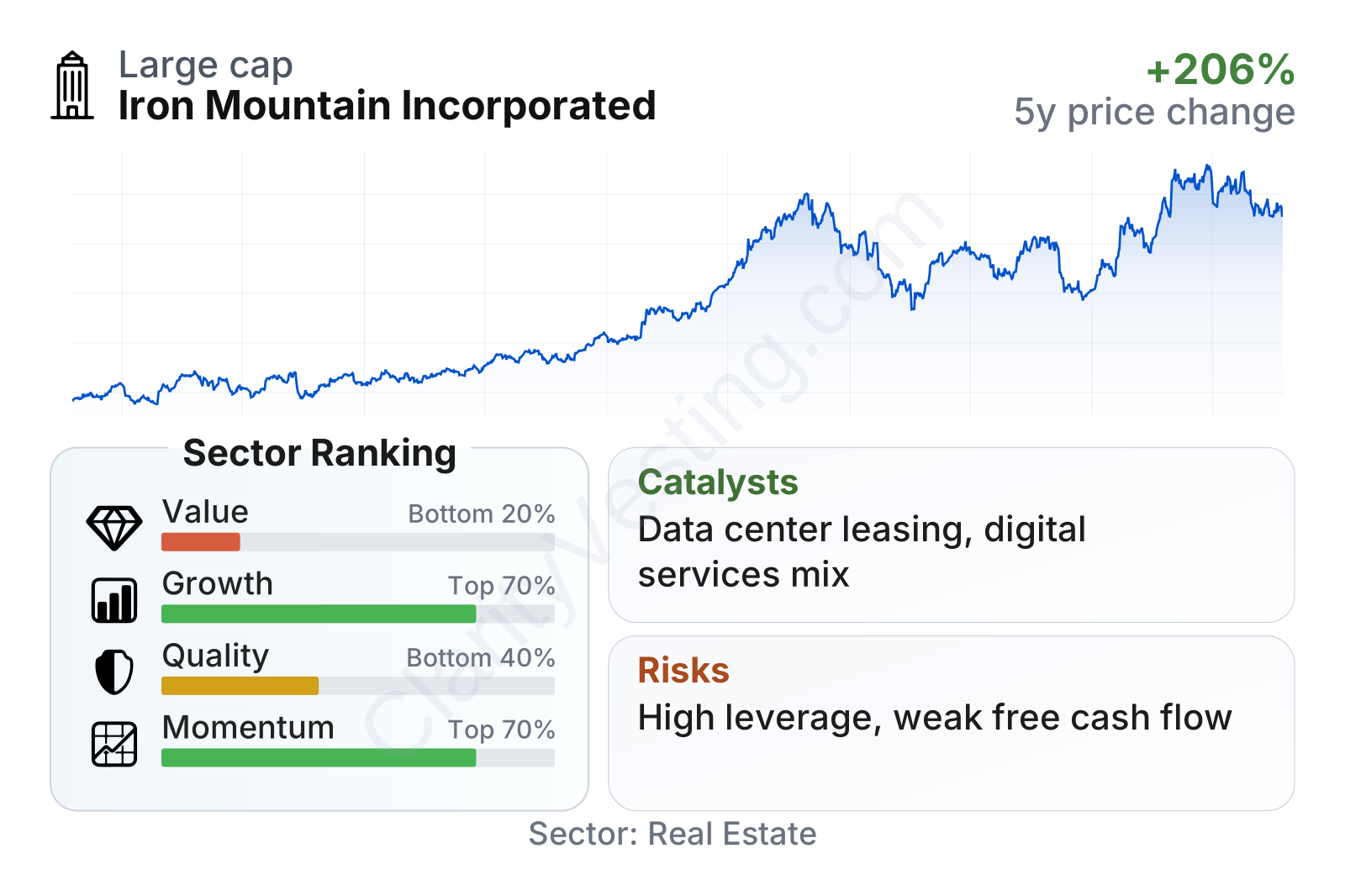
Iron Mountain is a large company within the specialty REIT space, and its stock has significantly outperformed the broader real estate sector over the last three years. Growth and market momentum rank well relative to peers, helped by strong revenue expansion and enthusiasm around its data center strategy. At the same time, the valuation profile looks demanding, while balance-sheet and cash-flow measures remain weaker than much of the sector. In short, the market is giving the company credit for transformation and growth, but not overlooking its leverage and funding needs.
Growth
Iron Mountain operates in two different markets at once: a mature but resilient physical storage business, and a faster-growing digital infrastructure market. That combination is one of the most interesting parts of the company. Physical records storage is not a fast-growth industry, but it tends to be sticky because customers rarely move large archives once they are stored. At the same time, data center demand is being supported by cloud adoption, enterprise outsourcing, and AI-related computing needs, which gives Iron Mountain exposure to a stronger long-term growth area than traditional real estate alone.
The company’s strategy makes sense on paper because it uses the stable cash generation of records management to support expansion into data centers and digital services. Management has spent the last few years increasing investment in digital infrastructure, expanding leasing capacity, and developing a broader information-management platform rather than relying only on box storage. That strategic shift is one reason revenue has grown faster than the typical company in its sector.
Revenue per share has moved up consistently over the last five years, which suggests that growth has not been coming only from financial engineering or acquisitions without scale benefits. The pace has been solid for a REIT, and clearly ahead of the sector median.
Dividend per share has also risen over time, showing that management has continued to increase shareholder distributions while expanding the business. Still, the current yield is below the sector median because the share price has appreciated strongly. That makes the dividend less of the main attraction than it once was; the bigger driver of attention today is the company’s repositioning toward digital infrastructure.
A major catalyst is the data center platform. Iron Mountain has highlighted strong leasing activity and development opportunities in this segment through investor materials and recent reporting periods. If that business keeps scaling, it could gradually improve the company’s growth profile and support a valuation premium compared with slower-growing REIT peers. Another favorable element is customer stickiness in the legacy business, which can provide funding support for long-dated expansion projects.
Recent company communications have also continued to emphasize capital deployment into data center development and the expansion of digital solutions. That does not remove execution risk, but it does show a clear strategic direction: Iron Mountain is trying to become more than a storage REIT and more of a hybrid information infrastructure company.
Risks
This article is for informational purposes only and does not constitute financial advice. Some content is AI-generated. See Disclaimer


