Stock Analysis · Israel Corporation Ltd (IRLCF)
Overview
Israel Corporation Ltd is an Israeli holding company whose investment case is largely tied to its controlling stake in ICL Group, a global specialty minerals and specialty chemicals producer. In practical terms, this means the company is not a diversified industrial operator in the usual sense: its economic value mainly comes from one major underlying business. ICL produces potash, phosphate products, specialty fertilizers, food ingredients, flame retardants, and other mineral-based products used in agriculture, food, and industrial applications.
Because Israel Corporation is primarily a holding company, its revenue exposure is effectively driven by ICL’s operating segments. Based on ICL’s recent annual reporting, the underlying business mix is centered on crop nutrition and specialty mineral products rather than on a broad set of unrelated activities.
- Potash: approximately 25% to 30% of underlying revenue. This includes potash used mainly in fertilizers for global agriculture markets.
- Phosphate Solutions: approximately 20% to 25%. This covers phosphate-based fertilizers and industrial phosphate products.
- Growing Solutions: approximately 20% to 25%. This segment includes specialty fertilizers, controlled-release products, and plant nutrition solutions with more value-added characteristics.
- Industrial Products: approximately 15% to 20%. This business includes bromine-based flame retardants and other industrial specialty materials.
- Other activities, including food and specialty ingredients: approximately 10% to 15%, depending on period and classification.
This structure matters for long-term analysis because it gives Israel Corporation a mix of cyclical commodity exposure and specialty-product exposure. Potash and phosphates can swing with fertilizer prices, while specialty plant nutrition and food ingredients tend to offer steadier demand and somewhat better differentiation.
The earnings path in recent years also shows how sensitive the business remains to commodity cycles. Revenue rose sharply in 2022, then moderated in 2023 and 2024 before recovering in 2025. Profitability, however, compressed much more than sales, which suggests that pricing and cost conditions became less favorable after the exceptionally strong period in 2022.
The flow of revenue to profit shows a clear pattern: sales have remained large, but operating income and net income have fallen substantially from the 2022 peak. That points to a business with meaningful earnings power, but also one where margins can move sharply when fertilizer and specialty mineral markets weaken.
Key Figures
| Metric | Value | Sector ⓘ |
|---|---|---|
| Date | Oct 10, 2026 | |
| Context | ||
| Sector | Basic Materials | |
| Industry | Specialty Chemicals | |
| Market Cap ⓘ | $2.15B | |
| Beta ⓘ | 0.23 | |
Value (Cheapness) | ||
| P/E Ratio ⓘ | 16.71 | 17.36 |
| P/B Ratio ⓘ | 0.67 | 1.73 |
| FCF Yield ⓘ | 6.32% | 5.81% |
| Dividend Yield ⓘ | 0.59% | 1.98% |
| EBIT / EV ⓘ | 21.19% | 6.34% |
| PEG ⓘ | N/A | |
Growth (Business expansion) | ||
| Revenue Growth ⓘ | 16.50% | 11.15% |
| RPS Growth (5Y CAGR) ⓘ | 2.17% | 4.49% |
| EPS Growth (5Y CAGR) ⓘ | N/A | -12.80% |
| BVPS Growth (5Y CAGR) ⓘ | 18.76% | 5.49% |
| Margin Growth (5Y Trend) ⓘ | -9.52% | -1.54% |
| FCF Growth (5Y CAGR) ⓘ | -31.07% | 0.20% |
| DPS Growth (5Y CAGR) ⓘ | -21.96% | 5.91% |
Quality (Business durability) | ||
| ROIC (Latest) ⓘ | 15.99% | 9.26% |
| ROA (Latest) ⓘ | 0.90% | 4.92% |
| ROIC (5Y Median) ⓘ | 15.61% | 7.82% |
| ROA (5Y Median) ⓘ | 1.50% | 3.88% |
| Net Debt / EBIT (Latest) ⓘ | 0.24 | 1.37 |
| Net Debt / EBIT (5Y Median) ⓘ | 0.95 | 1.70 |
| Net Debt / EBITDA (Latest) ⓘ | 0.14 | 0.92 |
| Net Debt / Assets ⓘ | 1.60% | 13.56% |
| EBITDA / Interest ⓘ | 3.45 | 12.28 |
| Operating Margin (Latest) ⓘ | 12.58% | 13.20% |
| Operating Margin (5Y Median) ⓘ | 15.46% | 11.82% |
| Debt to Equity (Latest) ⓘ | N/A | 39.91% |
| Profit Margin (Latest) ⓘ | 1.62% | 6.43% |
| Free Cash Flow (Latest) ⓘ | $135.90M | |
Momentum (Price trend) | ||
| 3Y Return ⓘ | +1099.81% | +68.93% |
| 12M Return (excl. last month) ⓘ | +981.99% | +36.53% |
| 6M Return ⓘ | +1150.22% | 0.00% |
| Price vs. 200-Day MA ⓘ | N/A | -0.18% |
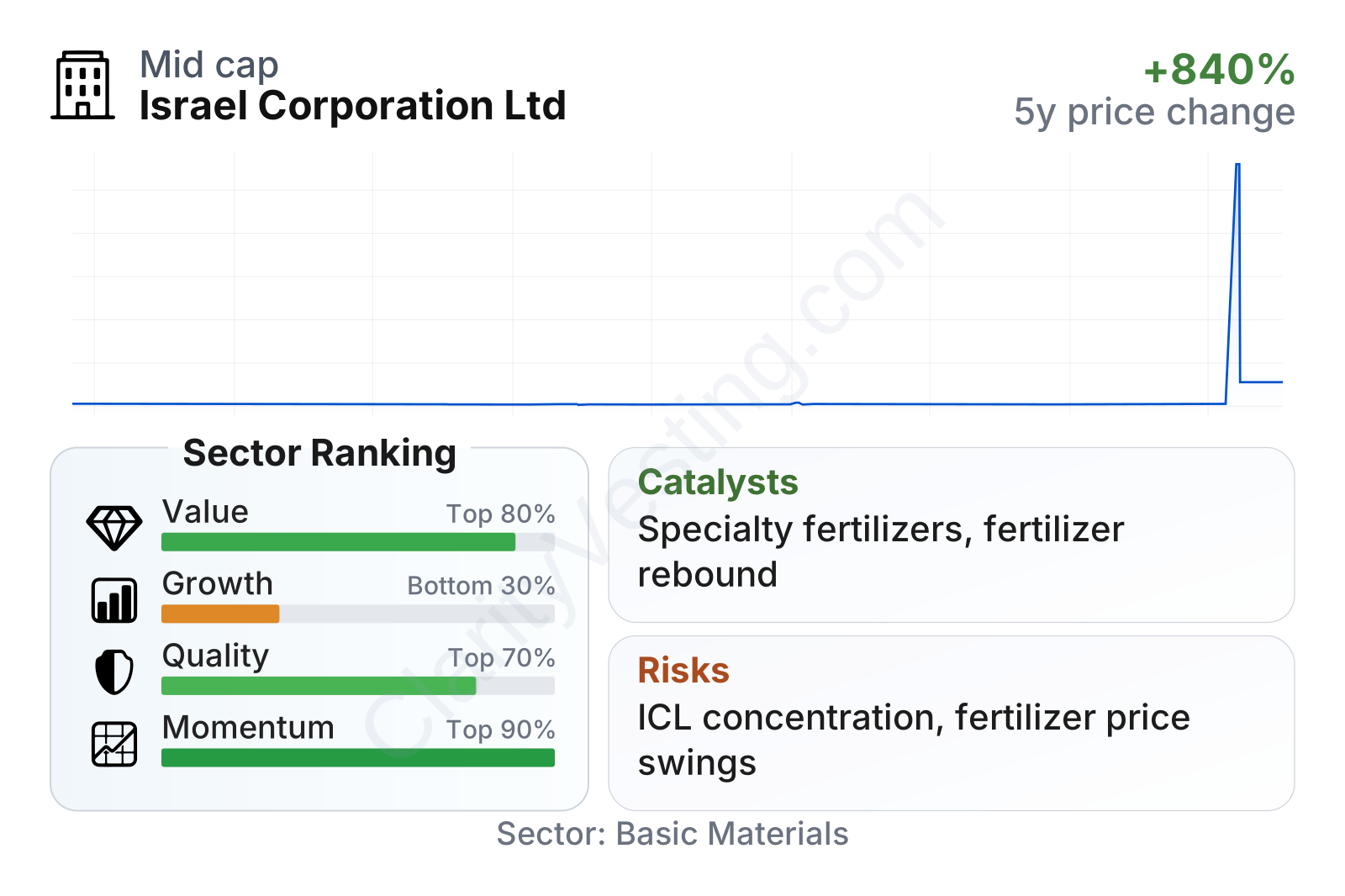
The market profile is unusual in a favorable way on some measures. Valuation looks moderate relative to the sector, with earnings multiples close to the industry median and a price-to-book ratio well below it. Cash generation is also respectable, with free cash flow yield slightly ahead of the sector median and EBIT relative to enterprise value standing out as notably strong.
Balance-sheet leverage appears conservative. Net debt relative to EBIT and EBITDA is much lower than sector norms, and net debt as a share of assets is very low. That gives the company more resilience than many commodity-linked peers when markets soften.
The weaker area is growth consistency. Recent year-over-year revenue growth has been solid, but the longer record is less convincing: five-year revenue-per-share growth is modest, free cash flow has contracted over that period, and margins have trended down. Profitability quality is mixed as well. Return on invested capital is strong, but net profit margin and return on assets remain below typical sector levels, which reflects the pressure from recent earnings normalization.
Share price performance has been very strong over the last several years compared with the broader sector, while volatility appears low based on beta. That combination usually signals that the market has already recognized some of the company’s balance-sheet strength and earnings recovery potential.
Growth
The company operates in markets that have durable long-term demand drivers, even if yearly results can be volatile. Agriculture remains supported by global food demand, the need to improve crop yields, and pressure on farmers to use inputs more efficiently. That is favorable for potash, phosphate products, and especially specialty crop nutrition. Industrial specialty minerals also benefit from stable end markets such as flame retardants, water treatment, and selected manufacturing applications.
Its strategy makes the most sense where ICL has been moving beyond pure commodity exposure. Specialty fertilizers, controlled-release nutrition, biostimulants, food ingredients, and other tailored mineral-based products generally offer better pricing power and closer customer relationships than bulk commodity fertilizers. For a holding company like Israel Corporation, that transition is important because it can reduce earnings volatility over time if execution continues.
A major catalyst is the continued development of specialty plant nutrition and higher-value downstream products. Another is any improvement in global fertilizer pricing after the weaker post-2022 environment. If volume growth and pricing recover at the same time, earnings can move faster than revenue because the company already operates at significant scale.
There is also a strategic materials angle. ICL has been active in battery-related and energy-storage materials, especially through phosphate-based products. This is still smaller than the core fertilizer franchise, but it gives the group exposure to electrification themes without changing the company’s identity as a mineral and specialty chemicals business.
More broadly, the group’s low leverage gives it room to keep investing through a weak cycle. In commodity-linked industries, that matters because financially stronger operators are often better positioned to preserve capacity, pursue selective expansion, and defend market share while weaker peers retrench.
Risks
This article is for informational purposes only and does not constitute financial advice. Some content is AI-generated. See Disclaimer