Stock Analysis · Irish Continental Group plc (IRCUF)
Overview
Irish Continental Group plc is an Irish transport and logistics company best known for operating ferries and freight services between Ireland, the U.K., and continental Europe. Through its main brands, including Irish Ferries and container-related logistics activities, the group moves passengers, tourist vehicles, roll-on/roll-off freight, and shipping containers. In simple terms, it earns money by carrying people and goods across important sea routes that are closely tied to Irish trade and travel.
The business is mainly organized into two divisions: ferries and container & terminal services. Based on recent annual reporting, ferries are the larger earnings engine, while containers provide an additional logistics platform that adds some diversification.
Main revenue sources are approximately:
- Ferries: about 75% to 85% of revenue. This includes passenger tickets, onboard spending, tourist vehicle transport, and freight carried on roll-on/roll-off ferry routes between Ireland, Britain, and France.
- Container and terminal services: about 15% to 25% of revenue. This includes container shipping, container terminals, storage, and related port and logistics activities.
The mix matters because freight tends to be steadier than leisure travel, while passenger traffic can lift profitability in strong tourism periods. That gives the company exposure both to essential trade flows and to discretionary travel demand.
The long-term financial picture shows a clear recovery from the disruption period earlier in the decade. Revenue has moved up materially since 2021, operating profit has turned firmly positive, and net income has improved. The broad pattern is that scale has returned, margins have normalized, and the company is now producing meaningfully stronger cash generation than it did a few years ago.
Key Figures
| Metric | Value | Sector ⓘ |
|---|---|---|
| Date | Oct 17, 2026 | |
| Context | ||
| Sector | Industrials | |
| Industry | Marine Shipping | |
| Market Cap ⓘ | $1.33B | |
| Beta ⓘ | 0.37 | |
Value (Cheapness) | ||
| P/E Ratio ⓘ | 16.56 | 22.10 |
| P/B Ratio ⓘ | 4.75 | 1.97 |
| FCF Yield ⓘ | 7.04% | 6.38% |
| Dividend Yield ⓘ | 1.23% | 1.94% |
| EBIT / EV ⓘ | N/A | 4.79% |
| PEG ⓘ | N/A | |
Growth (Business expansion) | ||
| Revenue Growth ⓘ | 16.10% | 9.30% |
| RPS Growth (5Y CAGR) ⓘ | 22.82% | 7.81% |
| EPS Growth (5Y CAGR) ⓘ | N/A | -13.06% |
| BVPS Growth (5Y CAGR) ⓘ | 6.71% | 6.14% |
| Margin Growth (5Y Trend) ⓘ | 12.87% | 0.88% |
| FCF Growth (5Y CAGR) ⓘ | 146.35% | 11.01% |
| DPS Growth (5Y CAGR) ⓘ | 3.16% | 9.48% |
Quality (Business durability) | ||
| ROIC (Latest) ⓘ | 34.64% | 10.84% |
| ROA (Latest) ⓘ | 20.08% | 5.41% |
| ROIC (5Y Median) ⓘ | 15.94% | 9.38% |
| ROA (5Y Median) ⓘ | 10.74% | 4.95% |
| Net Debt / EBIT (Latest) ⓘ | 1.39 | 2.08 |
| Net Debt / EBIT (5Y Median) ⓘ | 2.56 | 2.27 |
| Net Debt / EBITDA (Latest) ⓘ | 0.76 | 1.39 |
| Net Debt / Assets ⓘ | 30.04% | 19.28% |
| EBITDA / Interest ⓘ | 14.28 | 9.58 |
| Operating Margin (Latest) ⓘ | 12.13% | 10.50% |
| Operating Margin (5Y Median) ⓘ | 11.71% | 10.29% |
| Debt to Equity (Latest) ⓘ | 92.70% | 65.48% |
| Profit Margin (Latest) ⓘ | 10.35% | 6.67% |
| Free Cash Flow (Latest) ⓘ | $93.49M | |
Momentum (Price trend) | ||
| 3Y Return ⓘ | +93.08% | +61.68% |
| 12M Return (excl. last month) ⓘ | +25.55% | +12.58% |
| 6M Return ⓘ | +23.88% | 0.00% |
| Price vs. 200-Day MA ⓘ | +26.12% | +0.02% |
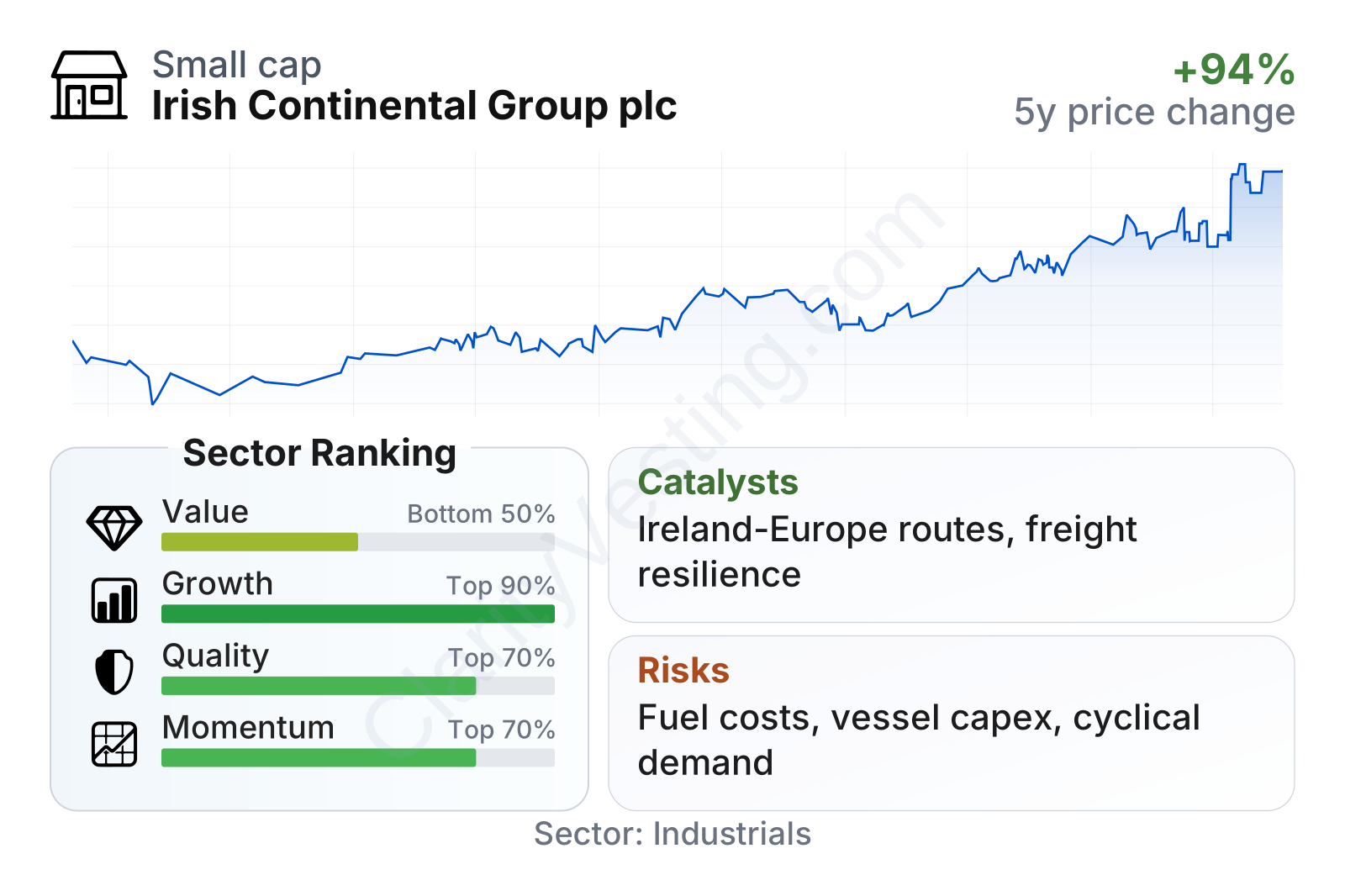
The recent market record points to strong share-price momentum over multi-year, one-year, and six-month periods, with performance ahead of the sector median. On fundamentals, growth stands out the most: revenue growth, revenue per share over five years, margin progression, and free cash flow expansion all rank well above many industry peers. Profitability is also solid, with returns on capital and assets clearly stronger than sector norms.
Valuation is more mixed. The earnings multiple is below the sector median, which suggests the stock is not priced at the high end on profits alone. However, the price-to-book ratio is much higher than the sector median, meaning the market is assigning a premium to the asset base and earnings quality. Balance-sheet leverage looks manageable rather than stretched: net debt relative to EBITDA is below sector norms and interest coverage is healthy, although debt to equity is somewhat higher than the median. The dividend yield is present but modest.
Growth
Irish Continental Group operates in parts of the transport market that have durable underlying demand. Ireland depends heavily on maritime links for trade, and freight transport on core sea corridors remains strategically important. That does not make the sector immune to slowdowns, but it does mean the company is tied to real economic infrastructure rather than a short-lived consumer trend.
Its strategy also has a practical logic for long-term expansion. The group is focused on a limited number of routes where it already has operating knowledge, established brands, and customer relationships. In ferries, that can support better vessel utilization and pricing discipline. In containers and terminals, it benefits from serving importers, exporters, and supply chains that need regular access to Irish ports. This combination of passenger, freight, and logistics revenue creates a business that is more balanced than a pure leisure operator.
A major catalyst is the continued normalization and development of direct shipping links involving Ireland and continental Europe. Since post-Brexit supply chains have encouraged some traffic to bypass the U.K. land bridge, operators with relevant routes and port access have had an opportunity to capture demand. Irish Continental Group has already been positioned in this corridor, so sustained route demand or capacity tightening could support utilization and pricing.
Another supportive element is cash generation. Free cash flow has improved sharply over the past several years, and recent profitability metrics indicate that earnings quality is not only accounting-based but also supported by cash production. For a capital-intensive transport business, that matters because stronger cash flow can support fleet investment, debt control, and shareholder distributions without depending too heavily on external financing.
Recent company updates and annual reporting have also highlighted continued freight resilience and disciplined capital allocation. That is important because in shipping and ferry markets, growth that comes from overexpansion can destroy returns. So far, the more encouraging sign is not aggressive empire-building but incremental strengthening of routes and operating economics.
Risks
This article is for informational purposes only and does not constitute financial advice. Some content is AI-generated. See Disclaimer


