Stock Analysis · Ingersoll Rand Inc (IR)
Overview
Ingersoll Rand is an industrial equipment company that designs, manufactures, and services products used to move air, liquids, energy, and materials in factories, laboratories, medical settings, trucks, and other commercial environments. Its products are often not highly visible to the public, but they are important in day-to-day operations for customers that need compressed air, pumps, vacuum systems, dosing equipment, loading systems, and related aftermarket support. The company has built itself as a diversified industrial platform with a strong emphasis on mission-critical equipment and recurring service demand.
The business is broadly organized around flow creation and industrial technologies. Based on recent company reporting, revenue is concentrated in one main segment, with a smaller but still meaningful second segment.
- Industrial Technologies and Services: about 85% to 90% of revenue. This includes air compressors, blowers, vacuum systems, fluid transfer equipment, power tools, lifting equipment, and a large aftermarket business made up of parts, repairs, rentals, and service contracts.
- Precision and Science Technologies: about 10% to 15% of revenue. This includes specialty pumps, liquid and gas handling systems, dosing and dispensing equipment, and other precision technologies used in life sciences, medical, industrial, and laboratory applications.
A key point for long-term analysis is that Ingersoll Rand does not rely only on one-time equipment sales. A meaningful share of revenue comes after the initial sale through replacement parts, maintenance, consumables, and service work. That tends to make the business more resilient than a pure capital-equipment model.
Over the last several years, the company has expanded revenue meaningfully while lifting operating income faster than sales. Gross profit has grown steadily from 2021 through 2024, showing improving mix and pricing power, although 2025 appears weaker at the net income level because interest expense rose and profitability came under pressure.
Key Figures
| Metric | Value | Sector ⓘ |
|---|---|---|
| Date | Oct 03, 2026 | |
| Context | ||
| Sector | Industrials | |
| Industry | Specialty Industrial Machinery | |
| Market Cap ⓘ | $29.67B | |
| Beta ⓘ | 1.15 | |
Value (Cheapness) | ||
| P/E Ratio ⓘ | 31.60 | 22.45 |
| P/B Ratio ⓘ | 2.91 | 1.98 |
| FCF Yield ⓘ | 4.11% | 6.31% |
| Dividend Yield ⓘ | 0.16% | 1.96% |
| EBIT / EV ⓘ | 4.41% | 4.81% |
| PEG ⓘ | 0.62 | |
Growth (Business expansion) | ||
| Revenue Growth ⓘ | 8.50% | 9.10% |
| RPS Growth (5Y CAGR) ⓘ | 11.75% | 7.75% |
| EPS Growth (5Y CAGR) ⓘ | -10.10% | -13.59% |
| BVPS Growth (5Y CAGR) ⓘ | 3.85% | 6.22% |
| Margin Growth (5Y Trend) ⓘ | 2.22% | 0.72% |
| FCF Growth (5Y CAGR) ⓘ | 21.96% | 10.98% |
| DPS Growth (5Y CAGR) ⓘ | 42.07% | 9.48% |
Quality (Business durability) | ||
| ROIC (Latest) ⓘ | 7.85% | 10.92% |
| ROA (Latest) ⓘ | 5.27% | 5.41% |
| ROIC (5Y Median) ⓘ | 5.53% | 9.21% |
| ROA (5Y Median) ⓘ | 4.04% | 4.94% |
| Net Debt / EBIT (Latest) ⓘ | 2.50 | 2.07 |
| Net Debt / EBIT (5Y Median) ⓘ | 2.22 | 2.28 |
| Net Debt / EBITDA (Latest) ⓘ | 1.86 | 1.43 |
| Net Debt / Assets ⓘ | 20.11% | 19.27% |
| EBITDA / Interest ⓘ | 7.67 | 9.53 |
| Operating Margin (Latest) ⓘ | 18.46% | 10.50% |
| Operating Margin (5Y Median) ⓘ | 14.29% | 10.27% |
| Debt to Equity (Latest) ⓘ | 47.49% | 65.48% |
| Profit Margin (Latest) ⓘ | 12.08% | 6.62% |
| Free Cash Flow (Latest) ⓘ | $1.22B | |
Momentum (Price trend) | ||
| 3Y Return ⓘ | +18.21% | +58.56% |
| 12M Return (excl. last month) ⓘ | -2.90% | +15.63% |
| 6M Return ⓘ | -6.20% | +4.19% |
| Price vs. 200-Day MA ⓘ | -7.94% | +0.93% |
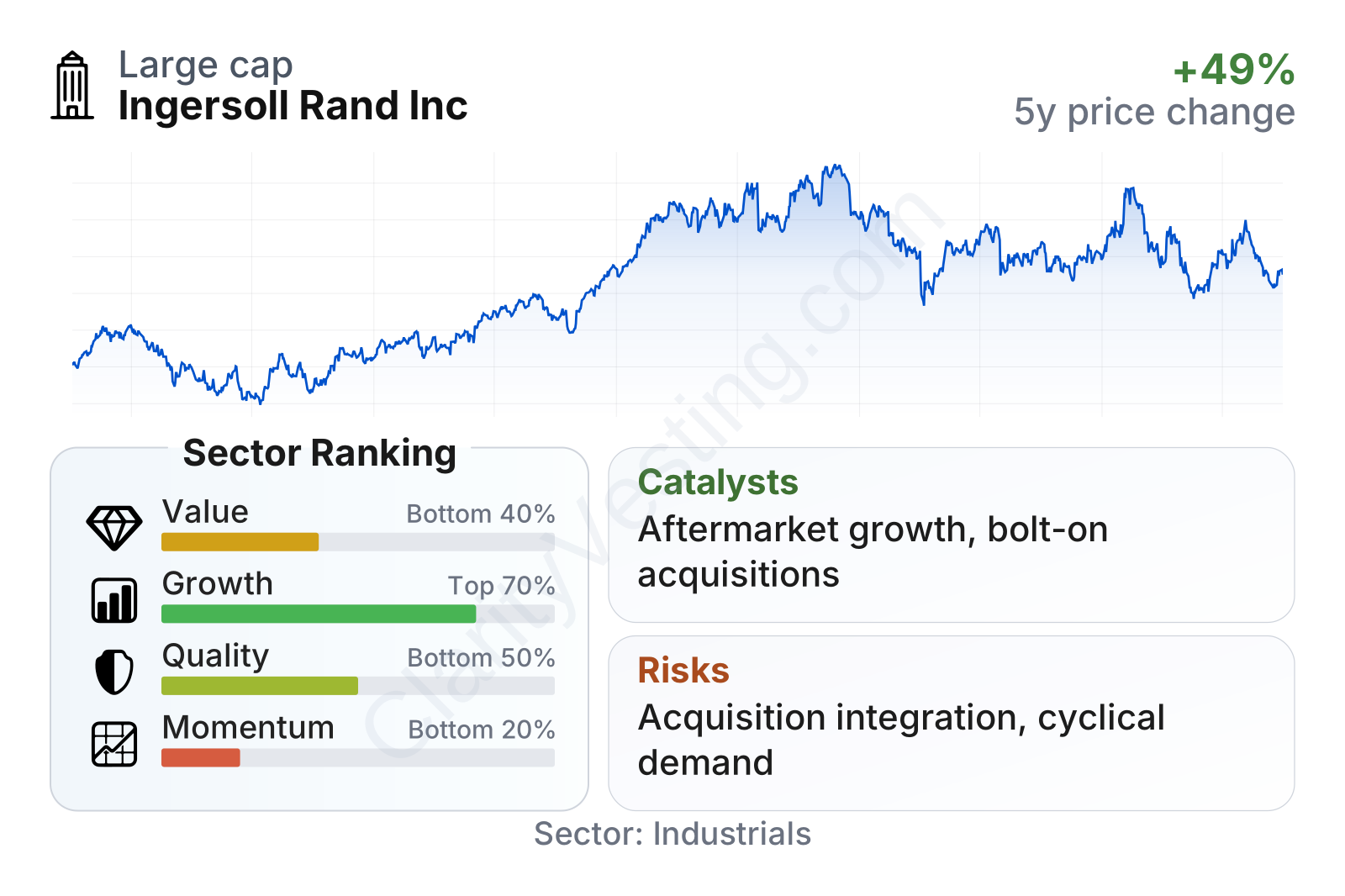
Ingersoll Rand is a large industrial company with a market value around the large-cap range and a share price history that has been volatile rather than smooth. The factor snapshot looks mixed. Growth metrics are generally better than many sector peers, especially on five-year revenue per share and free cash flow expansion. Profitability is also stronger than the sector median on operating margin and net margin. On the other hand, valuation metrics remain on the expensive side versus the broader industrial peer group, while recent stock momentum has been weak. Financial leverage is not excessive for an industrial business, but debt-related measures are somewhat less conservative than the strongest companies in the sector.
Growth
Ingersoll Rand operates in markets that benefit from long-duration industrial demand. Compressed air, vacuum, precision pumping, and flow-control equipment are used across manufacturing, food and beverage, pharmaceuticals, electronics, energy efficiency projects, and healthcare-related applications. These are not niche markets dependent on one end customer. They are broad infrastructure-like categories that tend to grow with industrial automation, stricter process requirements, sustainability spending, and demand for higher uptime in production facilities.
The company’s strategy is coherent for future growth. Management has spent several years building a larger collection of specialized industrial brands, often through acquisitions. The logic is straightforward: buy niche leaders, improve margins, use a global distribution and service network, and increase recurring aftermarket sales. That approach can work well in this industry because customers value reliability, installed base support, and technical know-how more than low upfront pricing alone.
Recent revenue growth has moderated from the very strong double-digit pace seen in 2022 and 2023, but the business is still expanding. The more recent pattern looks closer to mid-single-digit to high-single-digit growth, which is slower than the post-pandemic rebound period but still healthy for an industrial company of this size. Over five years, revenue per share growth has outpaced the sector median, which suggests the expansion has not been purely a result of accounting noise or share issuance.
Cash generation is another important support for the growth case. Free cash flow climbed sharply over the last several years before pulling back from a recent peak. Even with that decline, the level remains strong in absolute terms for the business. This matters because it gives the company flexibility to fund acquisitions, invest in product development, support manufacturing capacity, and manage debt without depending too heavily on outside financing.
One of the clearest catalysts is the installed base. Every compressor, pump, or vacuum system placed with a customer can lead to years of parts and service revenue. Another catalyst is exposure to industries with tighter performance requirements, such as life sciences and precision process applications, where reliability and compliance can support better pricing. The company has also highlighted productivity initiatives and portfolio shaping in public communications, which may help margins over time if executed well.
Recent company updates have also pointed to continued acquisition activity and portfolio expansion as part of its standard operating model. For Ingersoll Rand, acquisitions are not occasional events; they are a central part of how the company compounds growth. That can create opportunity when acquired businesses are small, specialized, and easy to integrate into the existing commercial network.
Risks
This article is for informational purposes only and does not constitute financial advice. Some content is AI-generated. See Disclaimer