Stock Analysis · IGO Limited (IPGDF)
Overview
IGO Limited is an Australian mining company focused on metals used in electrification and battery supply chains. Its portfolio is centered on lithium and nickel, with smaller exposure to copper and cobalt through joint ventures and exploration interests. The group has repositioned itself over the past several years away from gold and toward energy-transition materials, which makes its business more tied to electric vehicles, battery storage, and industrial decarbonization trends.
The company’s revenue base has become narrower and more cyclical after the suspension of its Western Australian nickel operations and the weaker lithium market. In fiscal 2026, most reported revenue came from product sales linked to the Nova operation and other mining activities, while a large part of IGO’s economic value still depends on its stake in the Greenbushes lithium mine and the Kwinana lithium hydroxide refinery through the Tianqi Lithium Energy Australia joint venture. Accounting treatment means that this joint venture does not fully appear as ordinary revenue in the same way as wholly controlled operations, so looking only at reported sales can understate how important lithium is to the group.
Based on the latest annual disclosures, IGO’s main economic exposures can be summarized as follows:
- Lithium joint venture exposure: approximately the largest contributor to underlying asset value and long-term strategic focus. This includes IGO’s 49% interest in Tianqi Lithium Energy Australia, which owns part of the Greenbushes mine and the Kwinana refinery.
- Nickel revenue from Nova: historically a major source of reported sales, including nickel concentrate and by-products such as copper and cobalt. Nova has remained important, but the company’s broader nickel platform has weakened after operational changes elsewhere.
- Copper and cobalt by-products: a smaller share of sales, mainly linked to Nova concentrate streams.
- Other income and investment-related items: variable and not a stable operating revenue source; these can materially affect profit in mining companies from year to year.
In practical terms, IGO is no longer a broad diversified miner. It is better understood as a mid-sized Australian battery-metals company whose long-term outcome is heavily influenced by lithium prices, the quality of Greenbushes, and whether management can rebuild operating consistency after a difficult period in nickel.
The financial flow over the last several years shows a business that has become much more volatile. Revenue has trended down from the 2023 peak, margins have swung from strongly positive to negative, and profit has been heavily influenced by non-operating and valuation-related items. That pattern is typical of miners during a commodity downturn, but it also shows that IGO’s recent results have not been driven by steady operating momentum.
Key Figures
| Metric | Value | Sector ⓘ |
|---|---|---|
| Date | Oct 10, 2026 | |
| Context | ||
| Sector | Basic Materials | |
| Industry | Other Industrial Metals & Mining | |
| Market Cap ⓘ | $4.24B | |
| Beta ⓘ | 0.68 | |
Value (Cheapness) | ||
| P/E Ratio ⓘ | 43.08 | 17.36 |
| P/B Ratio ⓘ | 1.90 | 1.73 |
| FCF Yield ⓘ | 3.86% | 5.81% |
| Dividend Yield ⓘ | 0.89% | 1.98% |
| EBIT / EV ⓘ | N/A | 6.34% |
| PEG ⓘ | N/A | |
Growth (Business expansion) | ||
| Revenue Growth ⓘ | 10.30% | 11.15% |
| RPS Growth (5Y CAGR) ⓘ | -15.04% | 4.49% |
| EPS Growth (5Y CAGR) ⓘ | 80.39% | -12.80% |
| BVPS Growth (5Y CAGR) ⓘ | -10.24% | 5.49% |
| Margin Growth (5Y Trend) ⓘ | N/A | -1.54% |
| FCF Growth (5Y CAGR) ⓘ | -16.44% | 0.20% |
| DPS Growth (5Y CAGR) ⓘ | 56.50% | 5.91% |
Quality (Business durability) | ||
| ROIC (Latest) ⓘ | N/A | 9.26% |
| ROA (Latest) ⓘ | -32.86% | 4.92% |
| ROIC (5Y Median) ⓘ | -6.64% | 7.82% |
| ROA (5Y Median) ⓘ | 6.05% | 3.88% |
| Net Debt / EBIT (Latest) ⓘ | N/A | 1.37 |
| Net Debt / EBIT (5Y Median) ⓘ | N/A | 1.70 |
| Net Debt / EBITDA (Latest) ⓘ | -17.48 | 0.92 |
| Net Debt / Assets ⓘ | -15.11% | 13.56% |
| EBITDA / Interest ⓘ | 1.06 | 12.28 |
| Operating Margin (Latest) ⓘ | -52.78% | 13.20% |
| Operating Margin (5Y Median) ⓘ | -31.63% | 11.82% |
| Debt to Equity (Latest) ⓘ | 0.75% | 39.91% |
| Profit Margin (Latest) ⓘ | 31.39% | 6.43% |
| Free Cash Flow (Latest) ⓘ | $163.84M | |
Momentum (Price trend) | ||
| 3Y Return ⓘ | -9.69% | +68.93% |
| 12M Return (excl. last month) ⓘ | +71.23% | +36.53% |
| 6M Return ⓘ | +7.69% | 0.00% |
| Price vs. 200-Day MA ⓘ | +29.78% | -0.18% |
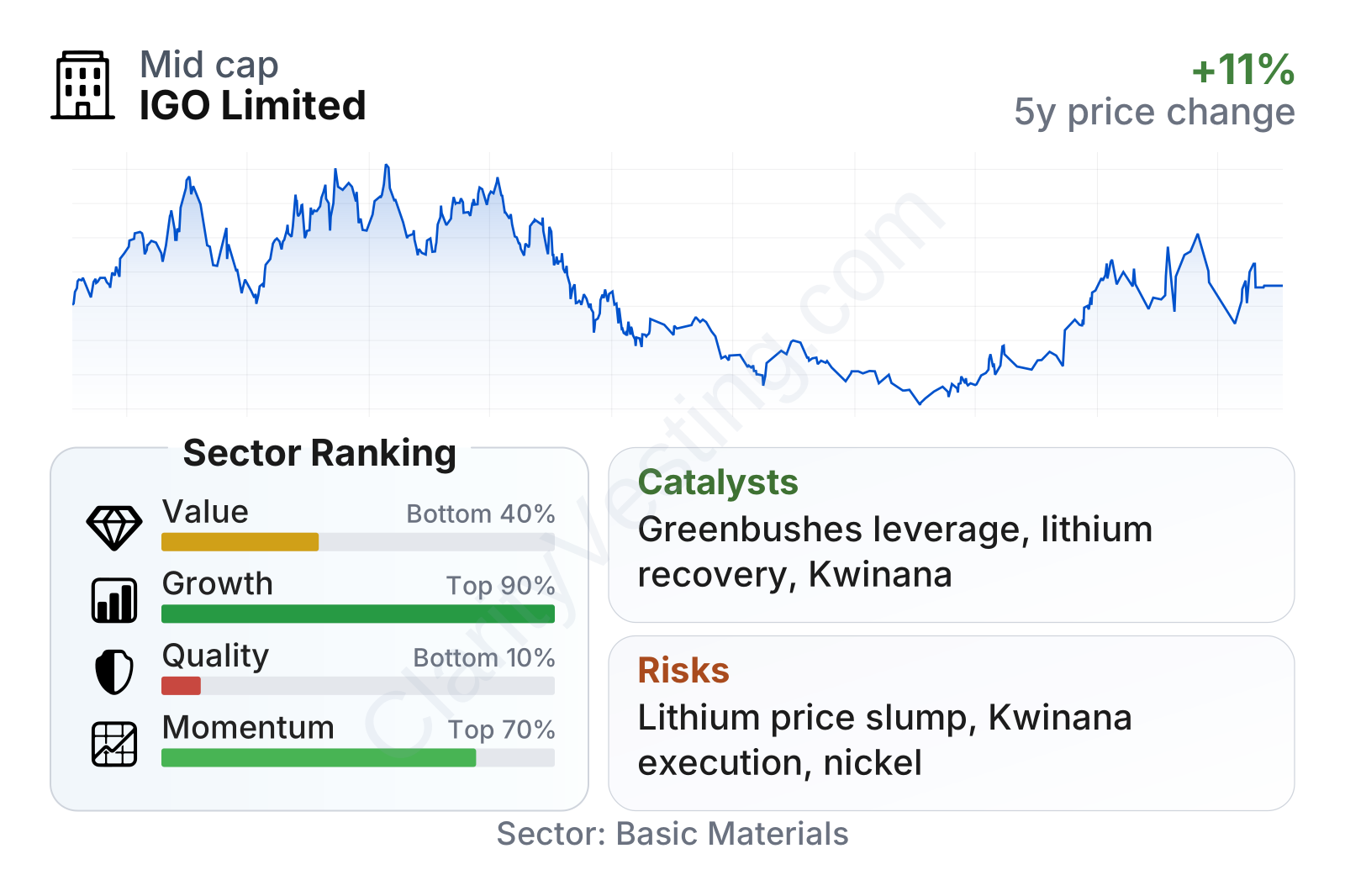
IGO currently sits in a mixed position. Growth measures look strong relative to many sector peers, helped by earnings swings and recovery effects, while quality measures remain weak because recent operating margins and asset returns have been poor. The balance sheet is a relative strength: debt is very low, net cash remains meaningful, and free cash flow is still positive. On valuation, the shares do not look obviously cheap on standard multiples, with earnings and cash flow measures weaker than many mining peers and the dividend yield below the sector median. Market behavior has improved over the last year, with the stock recovering from late-2024 lows and trading well above its long-term average level, but the longer three-year record still reflects a difficult operating cycle.
Growth
IGO operates in a sector with clear long-term structural demand support. Lithium, nickel, and related battery materials are tied to electric vehicles, grid storage, and broader electrification. That does not mean a straight line upward: these markets can move through long oversupply and undersupply cycles. For a long-term view, the main attraction is that IGO has exposure to assets linked to one of the world’s best hard-rock lithium deposits, Greenbushes, which remains strategically important even when prices are weak.
The company’s strategy still makes industrial sense. Greenbushes is widely regarded as a low-cost, high-quality lithium asset, and low-cost supply usually has the best chance of remaining competitive across the cycle. If lithium prices recover meaningfully, IGO has embedded leverage through its joint venture interest. Kwinana also offers downstream processing exposure, although that part of the business has faced operating challenges and requires better execution before it becomes a strong growth engine.
Another positive point is financial flexibility. With very modest leverage, IGO has more room than many miners to absorb weak prices, maintain investment in priority assets, and wait for better market conditions. That matters in commodity industries where downturns often pressure highly indebted operators into defensive decisions.
Recent company updates have also highlighted a portfolio reset. Management has moved to preserve value by suspending higher-cost nickel operations and concentrating on core assets. This does not create immediate growth, but it can improve the quality of future growth by reducing exposure to weaker economics. If battery-material pricing normalizes and Kwinana improves operationally, the same portfolio could look much stronger than it has in the last two years.
Risks
This article is for informational purposes only and does not constitute financial advice. Some content is AI-generated. See Disclaimer


