Stock Analysis · Inter Parfums Inc (IPAR)
Overview
Inter Parfums Inc. develops, markets, and distributes prestige fragrances and related beauty products through licensing agreements with fashion and luxury brands. In simple terms, the company takes well-known brand names such as Montblanc, Jimmy Choo, Coach, Lacoste, Karl Lagerfeld, and others, then creates and sells perfumes and, in some cases, adjacent products like body care or home fragrance. Its business model is built around brand partnerships rather than owning a large portfolio of fashion houses itself.
The company generates revenue mainly from product sales, with fragrances remaining the core category. Based on recent annual reporting, revenue is concentrated in a relatively small group of brands, while the rest comes from a broader long tail of licensed names and owned brands.
- Large established fragrance brands: approximately 60% to 70% of revenue. This group includes major names such as Montblanc, Jimmy Choo, Coach, and Lacoste, which have been the main commercial engines of the portfolio.
- Mid-sized licensed brands: approximately 20% to 30% of revenue. This includes brands such as Karl Lagerfeld, Van Cleef & Arpels, Moncler, Ferragamo, and Roberto Cavalli, depending on launch cycles and geographic performance.
- Smaller brands and owned or emerging lines: approximately 5% to 10% of revenue. This bucket includes brands with earlier-stage development or lower global scale.
- Geographic exposure: the business is international, with Europe, North America, and Asia-Pacific all contributing meaningful sales. No single country appears to dominate the entire group to the extent seen in more geographically concentrated consumer businesses.
What makes Inter Parfums distinctive is that it operates as a brand manager, product developer, and distribution specialist inside the prestige fragrance market. That allows it to benefit from luxury brand appeal without carrying the same capital intensity as a fully integrated luxury group. Over the last several years, revenue, gross profit, and net income have all moved higher, while the company has maintained healthy profitability.
The business mix has expanded steadily since 2021, with revenue rising from under $0.9 billion to nearly $1.5 billion by 2025. Gross profit has increased alongside sales, which suggests pricing power and brand strength have largely held up even as the portfolio became bigger.
Key Figures
| Metric | Value | Sector ⓘ |
|---|---|---|
| Date | Oct 17, 2026 | |
| Context | ||
| Sector | Consumer Defensive | |
| Industry | Household & Personal Products | |
| Market Cap ⓘ | $3.60B | |
| Beta ⓘ | 1.18 | |
Value (Cheapness) | ||
| P/E Ratio ⓘ | 21.52 | 17.88 |
| P/B Ratio ⓘ | 5.62 | 1.29 |
| FCF Yield ⓘ | 6.86% | 12.39% |
| Dividend Yield ⓘ | 2.85% | 2.85% |
| EBIT / EV ⓘ | 7.30% | 6.43% |
| PEG ⓘ | 3.20 | |
Growth (Business expansion) | ||
| Revenue Growth ⓘ | 2.10% | 4.10% |
| RPS Growth (5Y CAGR) ⓘ | 13.79% | 6.18% |
| EPS Growth (5Y CAGR) ⓘ | -12.41% | -13.59% |
| BVPS Growth (5Y CAGR) ⓘ | 12.57% | 3.20% |
| Margin Growth (5Y Trend) ⓘ | 1.22% | -0.15% |
| FCF Growth (5Y CAGR) ⓘ | N/A | 4.10% |
| DPS Growth (5Y CAGR) ⓘ | 33.86% | 6.79% |
Quality (Business durability) | ||
| ROIC (Latest) ⓘ | 19.83% | 12.34% |
| ROA (Latest) ⓘ | 10.98% | 6.30% |
| ROIC (5Y Median) ⓘ | 21.62% | 10.49% |
| ROA (5Y Median) ⓘ | 11.24% | 5.44% |
| Net Debt / EBIT (Latest) ⓘ | -0.02 | 1.96 |
| Net Debt / EBIT (5Y Median) ⓘ | 0.24 | 2.35 |
| Net Debt / EBITDA (Latest) ⓘ | -0.02 | 1.38 |
| Net Debt / Assets ⓘ | -0.32% | 21.51% |
| EBITDA / Interest ⓘ | 43.49 | 9.46 |
| Operating Margin (Latest) ⓘ | 18.07% | 8.87% |
| Operating Margin (5Y Median) ⓘ | 18.72% | 9.53% |
| Debt to Equity (Latest) ⓘ | 18.95% | 72.35% |
| Profit Margin (Latest) ⓘ | 11.17% | 5.40% |
| Free Cash Flow (Latest) ⓘ | $246.85M | |
Momentum (Price trend) | ||
| 3Y Return ⓘ | +1.02% | +20.92% |
| 12M Return (excl. last month) ⓘ | +8.57% | +2.13% |
| 6M Return ⓘ | +21.26% | +1.26% |
| Price vs. 200-Day MA ⓘ | +12.49% | +1.39% |
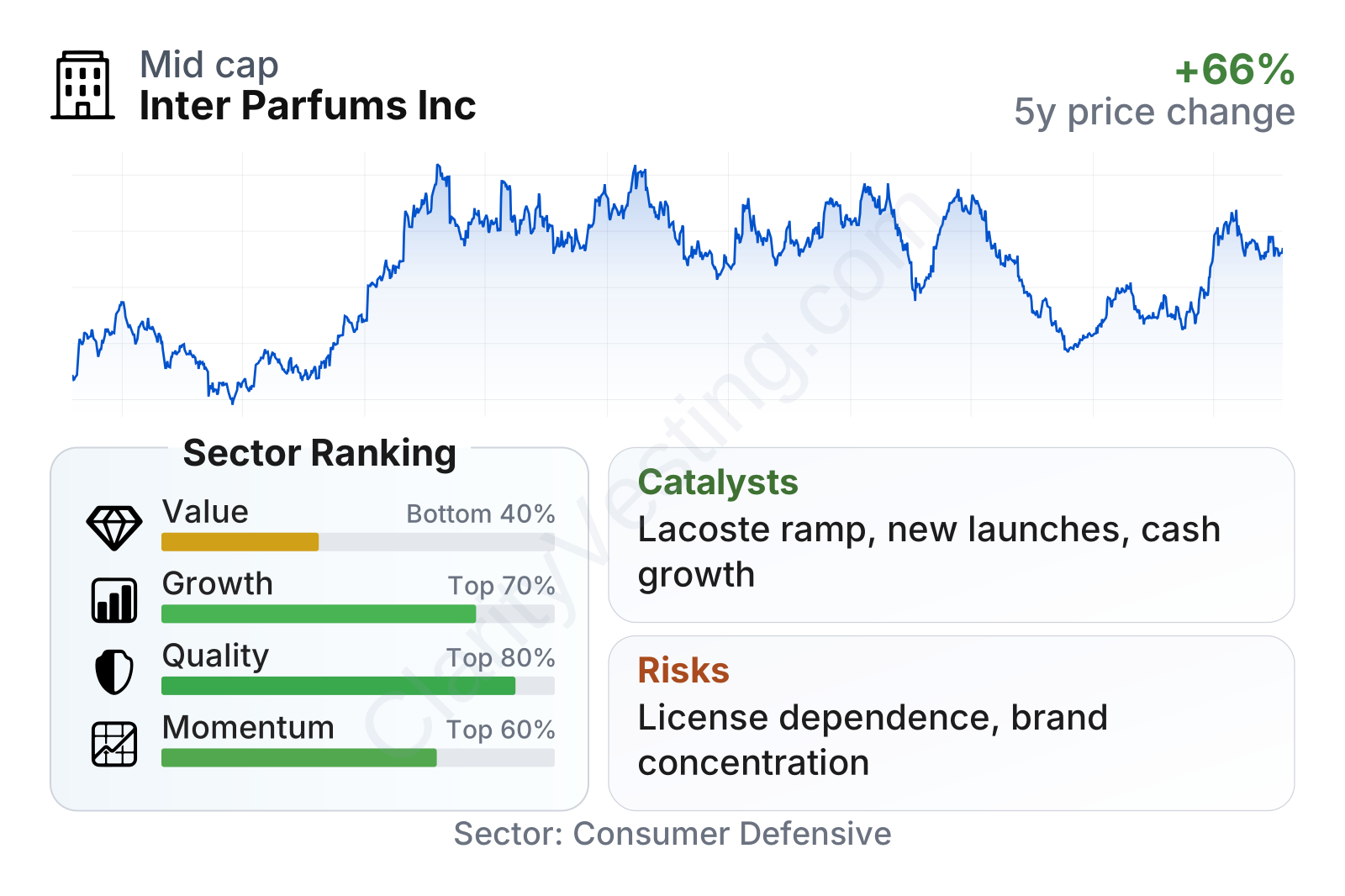
Inter Parfums is a mid-sized consumer company with above-average business quality relative to much of its sector. Profitability metrics are notably strong, returns on capital are high, and balance sheet leverage is low. Growth has been solid over a multi-year period, although the most recent year-over-year revenue pace is slower than the sector median. On valuation, the shares trade above the sector median on earnings and far above it on book value, which means the market is still assigning a premium to the company’s brand portfolio and operating consistency.
The share price history also shows that this is not a low-volatility consumer staple in the traditional sense. The stock has experienced large swings over the last few years, including strong rebounds after pullbacks. That pattern reflects the market’s tendency to re-rate premium branded businesses as growth expectations change.
Growth
Prestige fragrance is part of a consumer category that has shown attractive long-term characteristics. Fragrance often behaves better than many other discretionary products because it sits at the intersection of beauty, gifting, personal identity, and affordable luxury. Consumers may reduce spending on larger luxury items during weaker periods, while smaller premium purchases can remain more resilient. That backdrop supports continued industry growth, especially in travel retail, younger demographics, and emerging markets.
Inter Parfums’ strategy fits this environment well. The company does not rely on a single blockbuster label. Instead, it builds a portfolio of licensed brands, supports them with product launches, and uses broad distribution to extend their reach. This approach can create repeat opportunities: a successful fragrance line can be refreshed with flankers, gift sets, seasonal launches, and expansion into new regions.
Revenue growth has moderated from the very strong post-pandemic surge seen in 2022 and 2023, but the broader trend still points upward. More recently, growth appears to have cooled into the low-single-digit range after periods of double-digit expansion. That slowdown matters, yet it comes after several years of unusually strong gains, so it looks more like normalization than a clear break in the business model.
Cash generation has improved meaningfully. After weaker and more uneven free cash flow earlier in the period, trailing cash flow turned sharply positive and has stayed at a much higher level. For a licensing-driven consumer company, that is important because it provides flexibility for marketing support, new launches, dividends, and potential acquisitions or license deals without putting pressure on the balance sheet.
One of the clearest catalysts is the company’s continuing brand pipeline. New launches under existing licenses can lift sales without requiring a complete redesign of the business. Inter Parfums has also been active in securing and extending brand relationships, which is crucial because the fragrance business rewards continuity, shelf presence, and long-lived franchise development. The addition and scaling of newer names such as Lacoste and Moncler, alongside the durability of Coach, Montblanc, and Jimmy Choo, provide multiple avenues for expansion rather than depending on just one hit product.
Another positive factor is execution quality. Operating margins around the high teens are strong for the sector, and margin trends over five years have improved instead of deteriorating. That suggests management has been able to scale the portfolio without giving away most of the gains through higher overhead or financing costs.
Risks
This article is for informational purposes only and does not constitute financial advice. Some content is AI-generated. See Disclaimer


