Stock Analysis · Iovance Biotherapeutics Inc (IOVA)
Overview
Iovance Biotherapeutics is a biotechnology company focused on cancer treatments made from a patient’s own immune cells. Its main approach is tumor-infiltrating lymphocyte therapy, often shortened to TIL therapy. In simple terms, the company takes immune cells from a patient’s tumor, expands them in a manufacturing facility, and sends them back for treatment. This is a personalized form of cell therapy and is aimed at patients with difficult-to-treat solid tumors.
The company’s business changed meaningfully after the commercial launch of Amtagvi, its TIL therapy for advanced melanoma. Before that, Iovance operated mainly as a research-stage company with very little revenue. It now has a commercial product, but the company is still in a transition period where operating costs remain high because it is funding manufacturing, clinical development, and market expansion at the same time.
Based on recent annual results, revenue is heavily concentrated in one product area.
- Product revenue from Amtagvi and related commercial activity: approximately 99%+ of revenue. This includes sales tied to the company’s approved cell therapy and associated treatment delivery.
- Collaboration and other revenue: less than 1% of revenue. This has historically included small amounts from partnerships, services, or non-core activities.
This concentration makes the business easy to understand, but it also means current performance depends overwhelmingly on the early commercial adoption of a single therapy platform. Financially, the biggest visible shift has been the move from almost no revenue to a few hundred million dollars of annual sales, while research and commercialization spending remains substantial.
The operating profile shows a company that has successfully created meaningful revenue after years of development, but has not yet converted that progress into profits. Research and development remains a major expense, and selling and administrative costs have also risen as the commercial infrastructure has expanded.
Key Figures
| Metric | Value | Sector ⓘ |
|---|---|---|
| Date | Oct 24, 2026 | |
| Context | ||
| Sector | Healthcare | |
| Industry | Biotechnology | |
| Market Cap ⓘ | $6.62B | |
| Beta ⓘ | 0.76 | |
Value (Cheapness) | ||
| P/E Ratio ⓘ | N/A | 25.42 |
| P/B Ratio ⓘ | 8.65 | 3.08 |
| FCF Yield ⓘ | -4.48% | 3.12% |
| Dividend Yield ⓘ | N/A | 1.85% |
| EBIT / EV ⓘ | -6.51% | 0.56% |
| PEG ⓘ | N/A | |
Growth (Business expansion) | ||
| Revenue Growth ⓘ | 65.70% | 7.50% |
| RPS Growth (5Y CAGR) ⓘ | N/A | 8.60% |
| EPS Growth (5Y CAGR) ⓘ | -43.08% | -17.73% |
| BVPS Growth (5Y CAGR) ⓘ | -16.66% | 3.72% |
| Margin Growth (5Y Trend) ⓘ | N/A | -0.57% |
| FCF Growth (5Y CAGR) ⓘ | N/A | 0.96% |
| DPS Growth (5Y CAGR) ⓘ | N/A | 6.69% |
Quality (Business durability) | ||
| ROIC (Latest) ⓘ | N/A | 3.17% |
| ROA (Latest) ⓘ | -31.81% | 2.98% |
| ROIC (5Y Median) ⓘ | -45.10% | 4.56% |
| ROA (5Y Median) ⓘ | -44.02% | 1.87% |
| Net Debt / EBIT (Latest) ⓘ | N/A | 1.34 |
| Net Debt / EBIT (5Y Median) ⓘ | N/A | 1.86 |
| Net Debt / EBITDA (Latest) ⓘ | N/A | 1.00 |
| Net Debt / Assets ⓘ | -7.07% | 5.06% |
| EBITDA / Interest ⓘ | N/A | 9.55 |
| Operating Margin (Latest) ⓘ | -91.14% | 9.25% |
| Operating Margin (5Y Median) ⓘ | -18933.29% | 7.33% |
| Debt to Equity (Latest) ⓘ | 6.25% | 26.68% |
| Profit Margin (Latest) ⓘ | -89.09% | 3.34% |
| Free Cash Flow (Latest) ⓘ | -$296.39M | |
Momentum (Price trend) | ||
| 3Y Return ⓘ | +309.86% | +51.61% |
| 12M Return (excl. last month) ⓘ | +401.89% | +19.90% |
| 6M Return ⓘ | +300.57% | +10.10% |
| Price vs. 200-Day MA ⓘ | +155.47% | +6.44% |
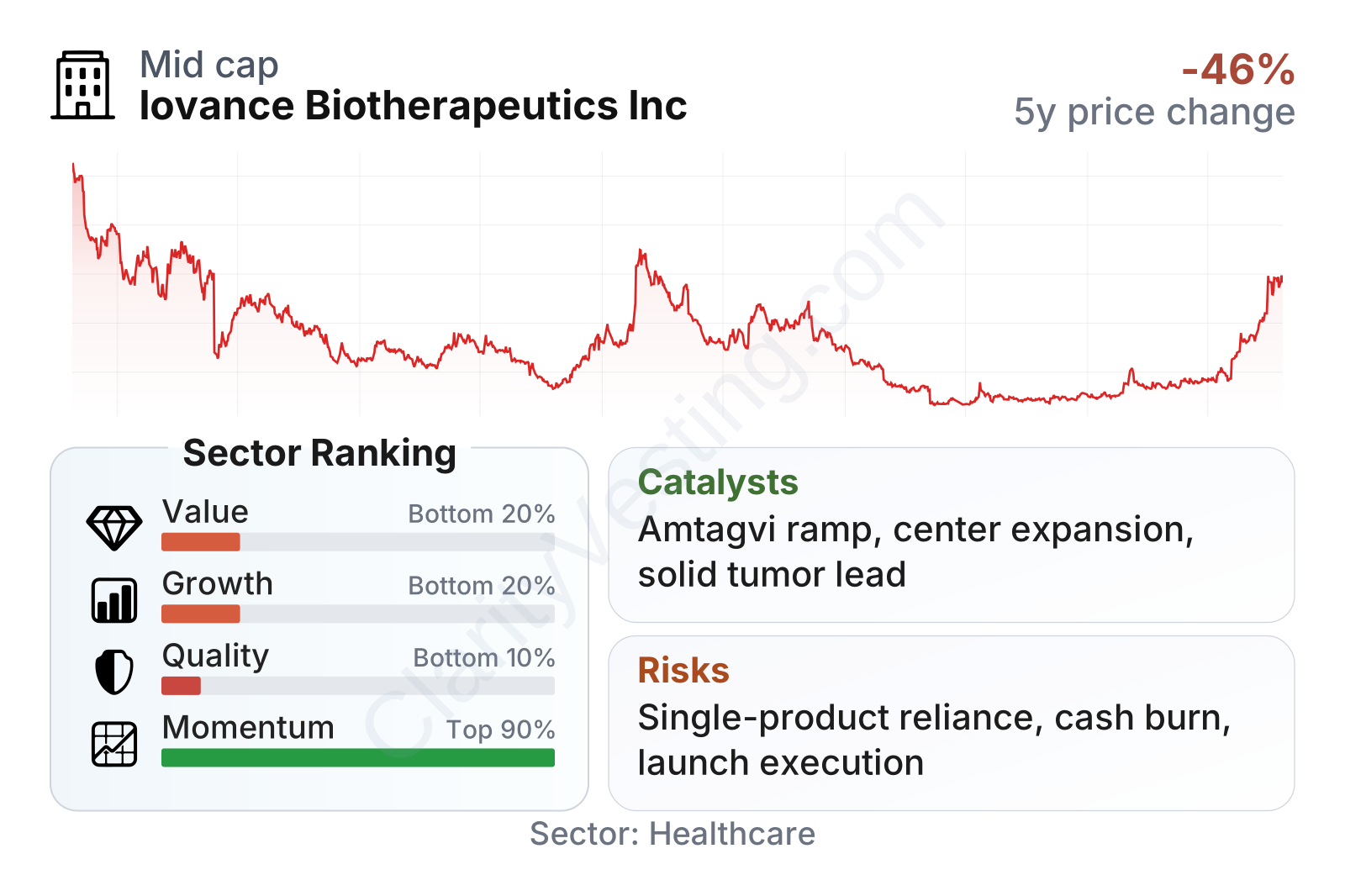
The overall picture is mixed. Market momentum has been much stronger than the typical healthcare stock, which suggests expectations improved sharply after commercialization progress. At the same time, value, quality, and growth rankings remain weak relative to the sector because profitability is still negative, free cash flow remains deeply in the red, and traditional valuation measures are difficult to justify with current earnings. The balance sheet is one of the more stable parts of the case: leverage is low, and the stock’s beta below 1.0 suggests price swings have not been as extreme as many early-stage biotech names, even though the share price history still shows large moves.
Growth
Iovance operates in one of the more ambitious areas of oncology: personalized cell therapy for solid tumors. That matters because many earlier cell therapies had more success in blood cancers than in solid tumors. If TIL therapy can become more widely adopted in solid tumors, the long-term addressable market could be meaningful. The sector itself is growing, driven by oncology demand, continued interest in immunotherapy, and the need for new options after standard treatments fail.
The company’s strategy has a clear industrial logic. It is not only developing therapies but also building the manufacturing and treatment network required to deliver them. That is important in cell therapy, where scaling production is often as hard as proving the medicine works. A company that can combine regulatory approval, physician adoption, reimbursement progress, and reliable manufacturing has a better chance of creating a durable position.
Revenue growth has remained strong, although the pattern is changing. The earliest comparisons were exceptionally high because sales were ramping from a very small base. More recent year-over-year growth is still positive and remains well above the sector median, but it has naturally moderated. That is typical after the first commercial step-up. The next question is whether growth can broaden through more treatment centers, smoother patient throughput, and potential expansion into additional tumor types.
Cash generation is improving from the worst levels, but the business is still consuming large amounts of cash. That is not unusual for a recently launched biotech platform, yet it remains central to the long-term outlook. For growth to become more durable, revenue must keep rising faster than operating costs, especially manufacturing, clinical, and launch-related spending.
Recent company updates have centered on commercialization progress for Amtagvi, expansion of authorized treatment centers, manufacturing readiness, and work on combination approaches involving interleukin-2 and checkpoint inhibitors. These are important catalysts because they affect both near-term revenue execution and the longer-term possibility of turning TIL therapy into a broader oncology platform. The strongest opportunity is straightforward: if the first approved indication establishes physician confidence and operational consistency, Iovance gains a foundation for label expansion rather than remaining a one-product launch story.
Risks
This article is for informational purposes only and does not constitute financial advice. Some content is AI-generated. See Disclaimer


