Stock Analysis · Invitation Homes Inc (INVH)
Overview
Invitation Homes is a residential real estate investment trust focused on single-family rental homes in the United States. In simple terms, it buys, owns, renovates, leases, and manages houses, mainly in large metropolitan areas where population growth, job creation, and limited housing supply support demand for rentals. The company emphasizes markets in the Western U.S., the Sun Belt, and Florida, and it uses a centralized operating platform to manage a very large portfolio at scale.
The business is built around recurring rental income rather than one-time home sales. Based on recent company filings, revenue is heavily concentrated in leasing homes and related resident charges, with a much smaller contribution from management and other property-related activities.
- Single-family property rental revenue: approximately 94% to 96% of total revenue. This is the core business and includes monthly rent from occupied homes.
- Other property income: approximately 3% to 5%. This typically includes fees paid by residents, such as late fees, smart-home or utility-related charges, and other ancillary property income.
- Management and other revenue: approximately 1% to 2%. This is the smallest segment and can include third-party management-related activities and miscellaneous items.
What stands out is the predictability of the model. Once homes are occupied, cash flow tends to be steadier than in more cyclical real estate categories such as offices or hotels. Over the past several years, revenue expanded consistently, and operating profitability remained solid even as interest costs rose. One caution: one of the 2025 flow figures appears inconsistent with the earlier trend, so the broader multi-year pattern is more useful than that single point. The main takeaway is still clear: revenue has grown steadily, while interest expense remains a meaningful drag that long-term readers should keep in view.
Key Figures
| Metric | Value | Sector ⓘ |
|---|---|---|
| Date | Oct 24, 2026 | |
| Context | ||
| Sector | Real Estate | |
| Industry | REIT - Residential | |
| Market Cap ⓘ | $15.83B | |
| Beta ⓘ | 0.83 | |
Value (Cheapness) | ||
| P/E Ratio ⓘ | 24.60 | 17.85 |
| P/B Ratio ⓘ | 1.81 | 0.87 |
| FCF Yield ⓘ | 6.83% | 7.30% |
| Dividend Yield ⓘ | 4.41% | 4.83% |
| EBIT / EV ⓘ | 4.02% | 3.78% |
| PEG ⓘ | 12.92 | |
Growth (Business expansion) | ||
| Revenue Growth ⓘ | 10.10% | 5.35% |
| RPS Growth (5Y CAGR) ⓘ | 6.60% | 6.02% |
| EPS Growth (5Y CAGR) ⓘ | 1.74% | -10.65% |
| BVPS Growth (5Y CAGR) ⓘ | -2.19% | 0.43% |
| Margin Growth (5Y Trend) ⓘ | -2.76% | -0.69% |
| FCF Growth (5Y CAGR) ⓘ | 6.65% | 5.40% |
| DPS Growth (5Y CAGR) ⓘ | 14.35% | 5.07% |
Quality (Business durability) | ||
| ROIC (Latest) ⓘ | 4.29% | 5.69% |
| ROE (Latest) ⓘ | 7.10% | 7.37% |
| ROA (Latest) ⓘ | 3.55% | 2.85% |
| ROIC (5Y Median) ⓘ | 3.83% | 4.26% |
| ROE (5Y Median) ⓘ | 4.58% | 6.04% |
| ROA (5Y Median) ⓘ | 2.39% | 2.45% |
| Net Debt / EBIT (Latest) ⓘ | 8.65 | 7.55 |
| Net Debt / EBIT (5Y Median) ⓘ | 10.90 | 8.26 |
| Net Debt / EBITDA (Latest) ⓘ | 4.86 | 5.26 |
| Net Debt / Assets ⓘ | 45.92% | 37.45% |
| EBITDA / Interest ⓘ | 4.70 | 4.11 |
| Operating Margin (Latest) ⓘ | 34.29% | 33.86% |
| Operating Margin (5Y Median) ⓘ | 30.78% | 37.49% |
| Debt to Equity (Latest) ⓘ | 94.39% | 88.76% |
| Profit Margin (Latest) ⓘ | 23.20% | 18.94% |
| Free Cash Flow (Latest) ⓘ | $1.08B | |
Momentum (Price trend) | ||
| 3Y Return ⓘ | +1.56% | +36.33% |
| 12M Return (excl. last month) ⓘ | -4.54% | +4.32% |
| 6M Return ⓘ | +5.42% | -1.74% |
| Price vs. 200-Day MA ⓘ | +0.94% | -1.42% |
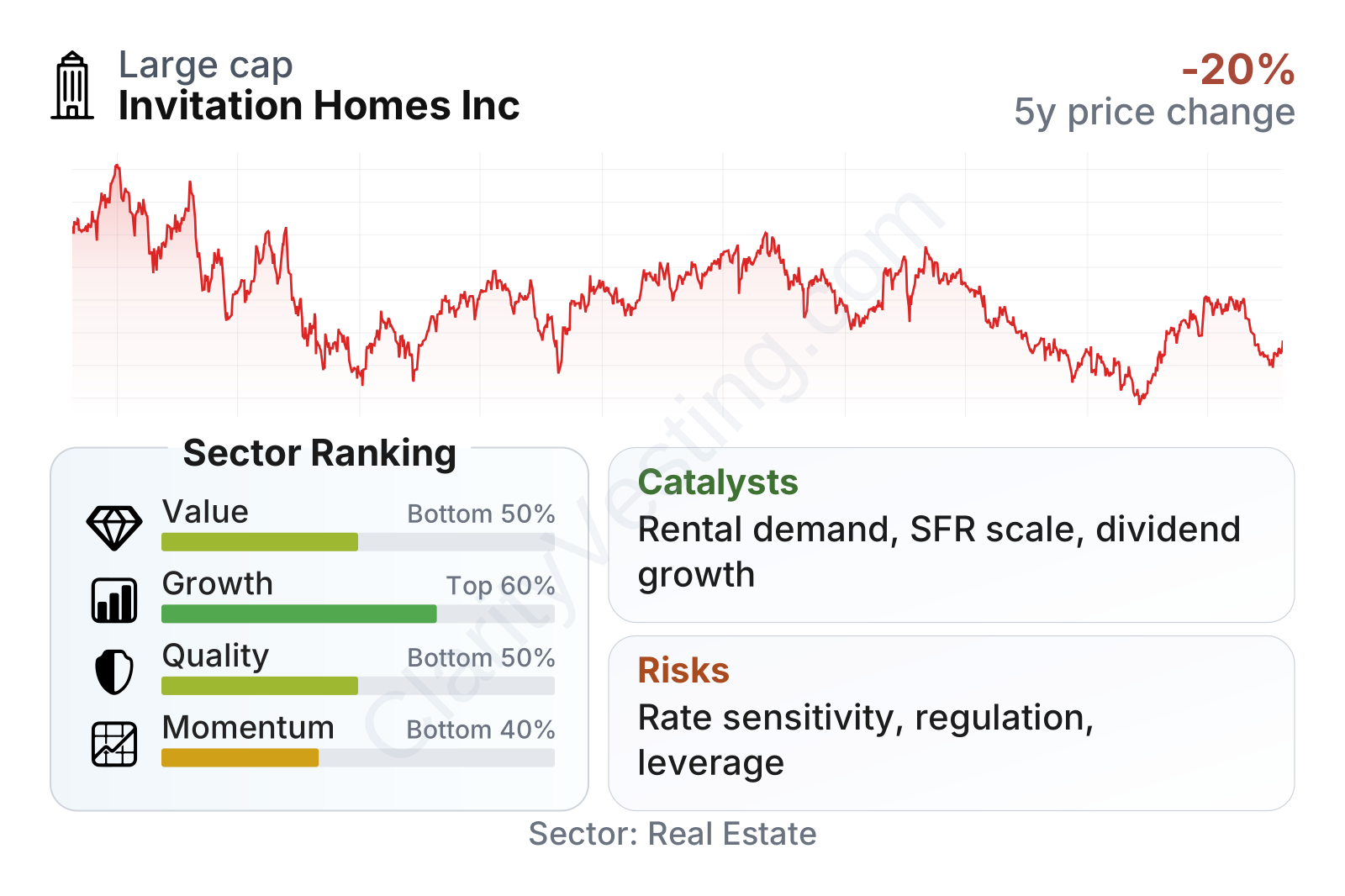
Invitation Homes is a large residential REIT with a market value in the mid-teens of billions of dollars and a beta below 1, which suggests the stock has been somewhat less volatile than the broader equity market. The stock’s recent trading history shows that it has not delivered strong momentum over the last few years, even though there has been some recovery in the most recent months.
The metrics table points to a mixed profile. Growth measures are generally above the sector median, especially revenue growth and dividend growth over the last five years. Quality is more uneven: profitability is respectable, with operating margin around the sector median and profit margin above it, but returns on capital are not especially strong. On valuation, the shares do not screen as cheap relative to the real estate sector, particularly on price-to-book and earnings multiples.
Growth
Invitation Homes operates in a part of real estate that still benefits from durable demand drivers. Homeownership affordability remains under pressure in many U.S. markets because of elevated home prices, mortgage rates, and limited housing supply. That pushes many households toward renting for longer, especially families seeking more space than a traditional apartment offers. Single-family rentals sit directly in that gap between apartment living and homeownership.
The company’s strategy broadly fits that backdrop. It focuses on markets with favorable demographics, employment growth, and supply constraints. It also benefits from scale: a large portfolio supports centralized leasing, maintenance, procurement, and resident services, which can improve efficiency and keep occupancy high. This operating platform is not easy for smaller landlords to replicate.
The long-term growth record supports that logic. Revenue per share has moved upward consistently over the last five years, growing at a mid-single-digit annual pace and slightly ahead of the sector median. That matters because it suggests growth has not depended only on issuing more shares or buying more homes at any price; on a per-share basis, the business still expanded.
Dividend per share has also risen strongly over the same period, with growth well above the sector median. For a REIT, that is an important signal because it reflects the company’s ability to turn rental income into distributable cash over time. The current yield is close to the sector norm, but the growth in the payout has been notably stronger than many peers.
Recent company updates have also pointed to ongoing demand resilience, supported by occupancy, renewal rate increases, and disciplined rent setting. Another potential catalyst is the continued fragmentation of the single-family rental market. Many homes are still owned by individual landlords, leaving room for large operators to gain share through acquisitions, partnerships, and more efficient property management. In addition, as new single-family housing supply remains constrained in many target markets, existing portfolios like Invitation Homes’ can become more valuable operationally.
Risks
This article is for informational purposes only and does not constitute financial advice. Some content is AI-generated. See Disclaimer


