Stock Analysis · Innoviva Inc (INVA)
Overview
Innoviva Inc. is a healthcare company that combines two business models. First, it collects royalty income from partnered respiratory medicines that were developed with GlaxoSmithKline. Second, it owns commercial-stage infectious disease businesses and product rights through subsidiaries such as Entasis Therapeutics and La Jolla Pharma. In simple terms, part of Innoviva’s business behaves like a cash-generating royalty owner, while another part looks more like a specialty pharmaceutical company trying to build and expand its own product portfolio.
Based on the company’s latest annual reporting for 2025, revenue is concentrated in a few areas, with royalties still important but no longer the only driver. Approximate revenue sources are:
- Product sales and other direct commercial revenue: about 58%. This mainly reflects medicines sold through Innoviva’s operating subsidiaries, including anti-infective and hospital-focused products.
- Respiratory royalties: about 42%. These royalties come primarily from partnered products such as RELVAR/BREO ELLIPTA, ANORO ELLIPTA, and TRELEGY ELLIPTA.
That mix matters. A few years ago, Innoviva was much more dependent on royalties alone. Today, the company is more diversified, but it has also taken on the added complexity and execution risk of running commercial pharmaceutical operations.
The longer financial trend shows a business with very high gross profitability but some uneven earnings as the model evolved. Revenue declined from 2021 through 2023, then recovered in 2024 and reached a higher level again in 2025. That rebound suggests the newer commercial assets are starting to offset pressure from the older royalty base, although the path has not been smooth.
The financial flow also shows a notable shift: revenue has recovered from earlier declines, but costs became heavier in 2024 and 2025 as the company leaned more into owned products and operating businesses. Even so, operating income rebounded strongly in 2025, which points to a company still capable of producing substantial earnings when its product mix and expenses line up well.
Key Figures
| Metric | Value | Sector ⓘ |
|---|---|---|
| Date | Oct 17, 2026 | |
| Context | ||
| Sector | Healthcare | |
| Industry | Biotechnology | |
| Market Cap ⓘ | $1.51B | |
| Beta ⓘ | 0.38 | |
Value (Cheapness) | ||
| P/E Ratio ⓘ | 4.84 | 24.79 |
| P/B Ratio ⓘ | 1.24 | 3.08 |
| FCF Yield ⓘ | 12.43% | 3.15% |
| Dividend Yield ⓘ | N/A | 1.94% |
| EBIT / EV ⓘ | 63.63% | 0.57% |
| PEG ⓘ | 0.25 | |
Growth (Business expansion) | ||
| Revenue Growth ⓘ | 19.30% | 7.45% |
| RPS Growth (5Y CAGR) ⓘ | 4.82% | 8.61% |
| EPS Growth (5Y CAGR) ⓘ | 15.38% | -17.81% |
| BVPS Growth (5Y CAGR) ⓘ | 43.99% | 3.72% |
| Margin Growth (5Y Trend) ⓘ | -27.95% | -0.62% |
| FCF Growth (5Y CAGR) ⓘ | -15.32% | 1.04% |
| DPS Growth (5Y CAGR) ⓘ | 335.84% | 6.77% |
Quality (Business durability) | ||
| ROIC (Latest) ⓘ | 41.60% | 3.24% |
| ROA (Latest) ⓘ | 22.81% | 3.01% |
| ROIC (5Y Median) ⓘ | 22.18% | 4.60% |
| ROA (5Y Median) ⓘ | 18.47% | 1.89% |
| Net Debt / EBIT (Latest) ⓘ | -0.41 | 1.34 |
| Net Debt / EBIT (5Y Median) ⓘ | 0.84 | 1.84 |
| Net Debt / EBITDA (Latest) ⓘ | -0.39 | 1.00 |
| Net Debt / Assets ⓘ | -17.66% | 5.45% |
| EBITDA / Interest ⓘ | 42.26 | 9.64 |
| Operating Margin (Latest) ⓘ | 165.43% | 9.27% |
| Operating Margin (5Y Median) ⓘ | 80.81% | 7.38% |
| Debt to Equity (Latest) ⓘ | 21.87% | 28.58% |
| Profit Margin (Latest) ⓘ | 81.19% | 3.59% |
| Free Cash Flow (Latest) ⓘ | $188.32M | |
Momentum (Price trend) | ||
| 3Y Return ⓘ | +55.56% | +42.80% |
| 12M Return (excl. last month) ⓘ | +6.60% | +18.50% |
| 6M Return ⓘ | -12.79% | +7.57% |
| Price vs. 200-Day MA ⓘ | -4.37% | +5.12% |
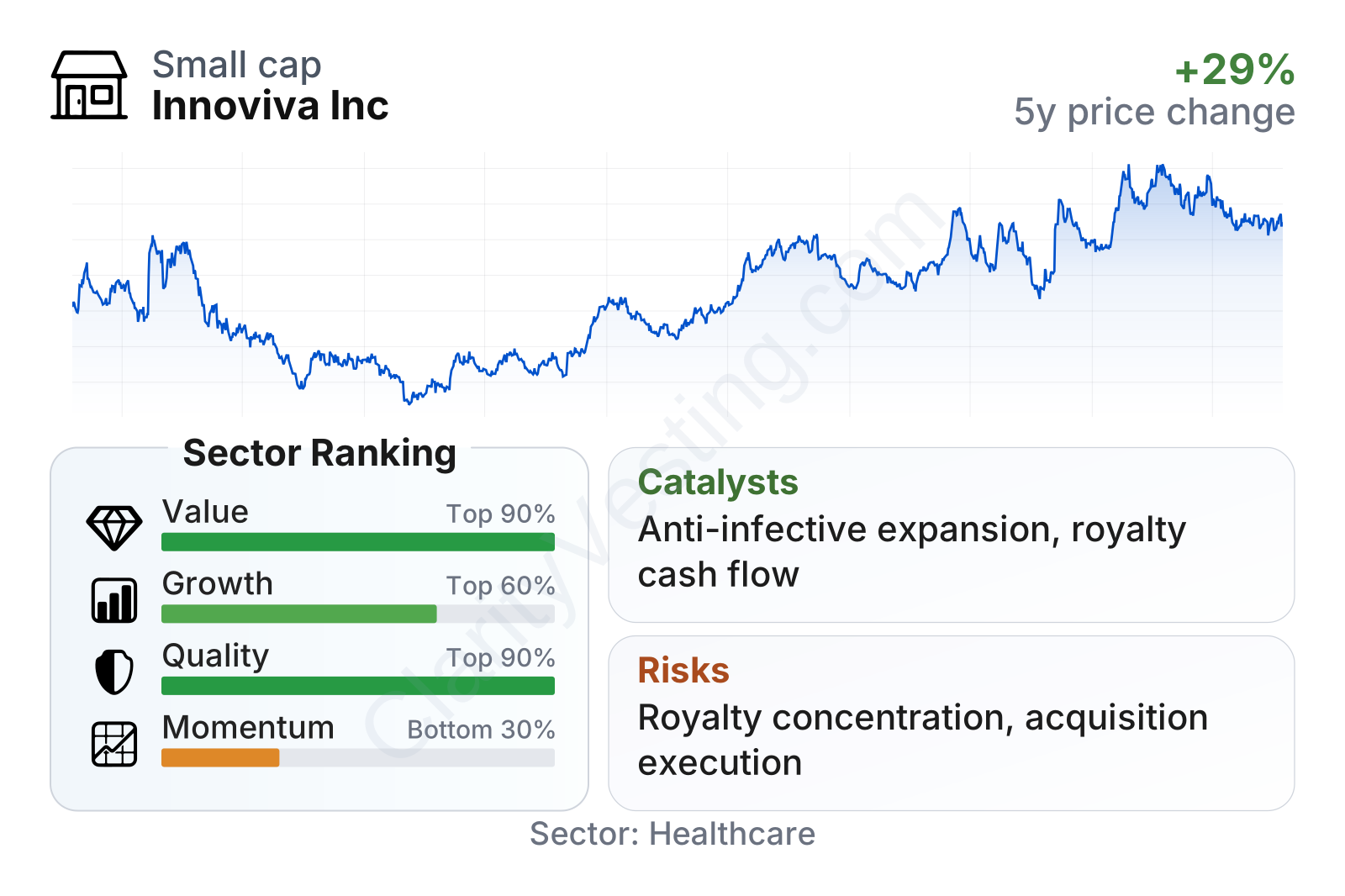
Innoviva stands out as a mid-sized healthcare company with unusually strong profitability and valuation metrics for its sector. Its value and quality measures rank near the top of the biotechnology group, helped by a very low earnings multiple, strong free cash flow yield, high returns on capital, and a balance sheet that has improved meaningfully. The weaker area is recent share-price momentum, which has lagged much of the sector despite solid operating performance.
The stock-price history reflects that mixed picture. Over the last several years, the shares have been volatile, with a sharp drop in 2022 followed by a recovery that accelerated into 2026. Even after that rebound, the market still appears to be assigning a cautious multiple to the business, likely because investors are weighing the durability of royalties against the uncertainty of the newer operating assets.
Growth
Innoviva operates in healthcare niches that remain strategically relevant over the long term. Respiratory disease remains a large global treatment area, and anti-infectives are gaining attention again as antibiotic resistance becomes a bigger public health priority. That does not guarantee rapid expansion, but it does mean the company is not tied to a fading industry.
The current strategy is logical on paper. Royalty income from established respiratory drugs provides cash generation, while acquisitions and subsidiary development give Innoviva the chance to build a broader commercial platform. This is a major change from a pure royalty company. It creates more moving parts, but it also opens the door to growth that is less dependent on mature respiratory products alone.
Recent revenue growth supports that idea. After a weak period in 2022 and parts of 2023, growth turned positive again and remained healthy into 2026, with recent year-over-year gains around the high-single-digit to high-teen range and some quarters materially stronger. Compared with much of the biotechnology sector, that places Innoviva on a better-than-average recent growth trajectory.
Cash generation is another important part of the growth picture. Free cash flow has remained solid over time, staying around the high eight-figure to low nine-figure range in recent periods. For a company of Innoviva’s size, that is meaningful because it gives management flexibility to fund acquisitions, expand products, reduce debt, repurchase shares, or support dividends without relying heavily on new equity issuance.
One recent opportunity is the company’s increasing exposure to hospital and anti-infective medicines through its operating subsidiaries. If these assets continue to scale, Innoviva could gradually become less reliant on a limited set of respiratory royalty streams. In addition, the broader medical need for new anti-infective treatments remains a supportive backdrop, especially for products addressing serious resistant infections.
Risks
This article is for informational purposes only and does not constitute financial advice. Some content is AI-generated. See Disclaimer


