Stock Analysis · Ingredion Incorporated (INGR)
Overview
Ingredion Incorporated is a global ingredient solutions company that turns crops such as corn, tapioca, potatoes, stevia, and pulses into ingredients used by food, beverage, animal nutrition, brewing, and industrial customers. In simple terms, it helps manufacturers improve texture, sweetness, shelf life, nutrition, and cost in everyday products ranging from soft drinks and sauces to snacks, dairy alternatives, and paper products.
The business is organized by geography rather than by product line, but the underlying economics are driven by specialty ingredients and more traditional starch sweetener businesses. Based on the company’s latest annual reporting and segment disclosures, revenue is roughly split as follows:
- North America: approximately 59% of revenue. This is the company’s largest business and includes starches, sweeteners, texturizers, and specialty ingredients sold into food, beverage, brewing, and industrial markets.
- South America: approximately 16% of revenue. This includes similar ingredient categories, with exposure to local food and beverage customers and some more volatile currency and input-cost dynamics.
- Asia-Pacific: approximately 13% of revenue. This region is tied to demand for specialty starches, clean-label solutions, and texture systems in faster-growing consumer markets.
- Europe, Middle East and Africa: approximately 12% of revenue. This business serves packaged food, beverage, and industrial customers with a mix of starch-based and higher-value formulation solutions.
From a product perspective, specialty ingredients have become increasingly important to the company’s profit profile. These include texture systems, clean-label starches, plant-based proteins, and sugar-reduction solutions such as stevia. Traditional sweeteners and industrial starches still represent a meaningful part of sales, but specialty ingredients generally carry better margins and are more aligned with changing consumer preferences.
One important trend in Ingredion’s financial structure is that revenue has come down from the 2022 peak as commodity prices normalized, but profitability has remained strong because the mix shifted toward better-margin products and costs became more manageable. That matters because it suggests the company is not relying only on volume growth; it is also improving what it sells and how efficiently it sells it.
The financial flow shows a useful pattern: sales have moderated since 2022, yet operating income and net income have held up much better than revenue. That points to stronger execution, lower interest burden, and a healthier product mix than in earlier years.
Key Figures
| Metric | Value | Sector ⓘ |
|---|---|---|
| Date | Oct 17, 2026 | |
| Context | ||
| Sector | Consumer Defensive | |
| Industry | Packaged Foods | |
| Market Cap ⓘ | $6.07B | |
| Beta ⓘ | 0.64 | |
Value (Cheapness) | ||
| P/E Ratio ⓘ | 10.47 | 17.88 |
| P/B Ratio ⓘ | 1.37 | 1.29 |
| FCF Yield ⓘ | 10.76% | 12.39% |
| Dividend Yield ⓘ | 3.45% | 2.85% |
| EBIT / EV ⓘ | 12.14% | 6.43% |
| PEG ⓘ | 1.13 | |
Growth (Business expansion) | ||
| Revenue Growth ⓘ | 0.90% | 4.10% |
| RPS Growth (5Y CAGR) ⓘ | 2.15% | 6.18% |
| EPS Growth (5Y CAGR) ⓘ | -9.33% | -13.59% |
| BVPS Growth (5Y CAGR) ⓘ | 9.50% | 3.20% |
| Margin Growth (5Y Trend) ⓘ | 9.33% | -0.15% |
| FCF Growth (5Y CAGR) ⓘ | 53.52% | 4.10% |
| DPS Growth (5Y CAGR) ⓘ | 4.50% | 6.79% |
Quality (Business durability) | ||
| ROIC (Latest) ⓘ | 9.96% | 12.34% |
| ROA (Latest) ⓘ | 7.45% | 6.30% |
| ROIC (5Y Median) ⓘ | 11.88% | 10.49% |
| ROA (5Y Median) ⓘ | 8.46% | 5.44% |
| Net Debt / EBIT (Latest) ⓘ | 0.99 | 1.96 |
| Net Debt / EBIT (5Y Median) ⓘ | 2.10 | 2.35 |
| Net Debt / EBITDA (Latest) ⓘ | 0.78 | 1.38 |
| Net Debt / Assets ⓘ | 10.35% | 21.51% |
| EBITDA / Interest ⓘ | 13.32 | 9.46 |
| Operating Margin (Latest) ⓘ | 11.67% | 8.87% |
| Operating Margin (5Y Median) ⓘ | 11.68% | 9.53% |
| Debt to Equity (Latest) ⓘ | 39.41% | 72.35% |
| Profit Margin (Latest) ⓘ | 8.20% | 5.40% |
| Free Cash Flow (Latest) ⓘ | $653.00M | |
Momentum (Price trend) | ||
| 3Y Return ⓘ | +15.31% | +20.92% |
| 12M Return (excl. last month) ⓘ | -17.88% | +2.13% |
| 6M Return ⓘ | -12.87% | +1.26% |
| Price vs. 200-Day MA ⓘ | -7.29% | +1.39% |
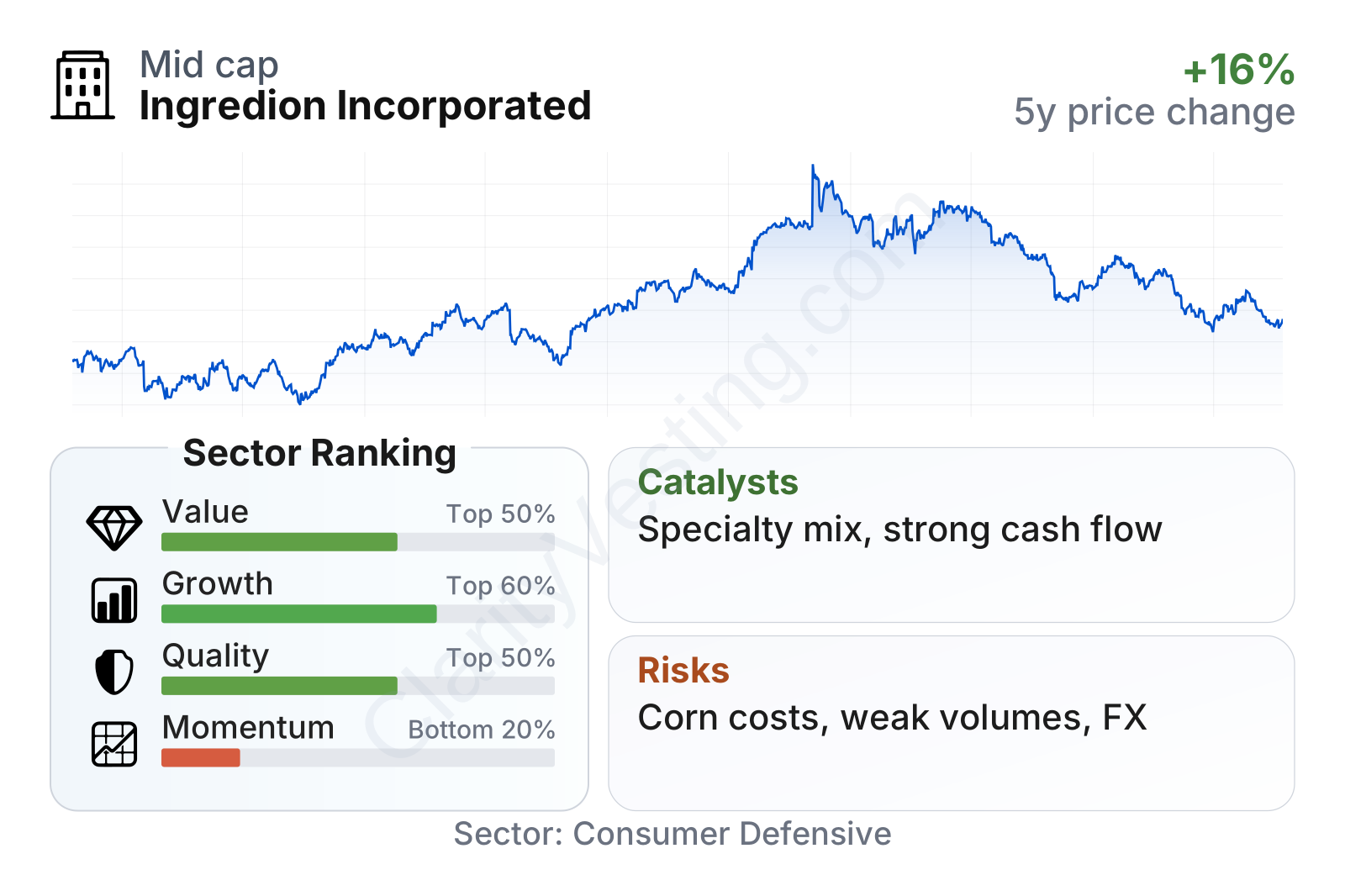
Ingredion sits in the middle of the consumer staples universe by size, with a relatively low share-price volatility profile. The table points to a business that looks solid rather than fast-moving: valuation measures are generally more favorable than the sector median, profitability is above average, balance-sheet leverage is conservative, and recent stock momentum has been weak. In other words, the market is currently giving more credit to the company’s stability and cash generation than to any expectation of rapid growth.
Growth
Ingredion operates in a mature industry, but not a stagnant one. The broader food ingredient market is supported by several long-term trends: reformulation to reduce sugar, demand for cleaner labels, demand for texture and shelf-life improvement, rising use of plant-based proteins, and steady packaged food consumption across economic cycles. These are not explosive growth drivers, but they are durable and well suited to a company that already has manufacturing scale and long customer relationships.
The company’s strategy for future growth is sensible. Management has spent several years shifting the business toward specialty ingredients, where customers care more about formulation expertise and performance than about pure commodity pricing. That shift matters because specialty ingredients tend to be harder to replace and can support better margins. Ingredion has also expanded its capabilities in texture, sugar reduction, and plant-based formulations, which fit current product-development priorities at large food and beverage companies.
Recent sales growth has been uneven. Ingredion moved from strong price-driven expansion in 2022 and early 2023 into a period of declines as input costs normalized and comparisons became harder. More recently, growth has moved back toward roughly flat to slightly positive territory. That pattern suggests the company is past the sharp reset phase, but it also shows that top-line growth is likely to remain moderate unless volumes improve more clearly or specialty ingredients accelerate further.
Cash generation is a more encouraging part of the growth picture. Free cash flow improved dramatically after the weaker period in 2022 and 2023 and remains strong even after coming off its peak. That gives Ingredion room to fund capital projects, support dividends, reduce debt, and invest in higher-value categories without putting unusual pressure on the balance sheet.
A practical catalyst is continued mix improvement. If specialty ingredients keep taking a larger share of the business, Ingredion may be able to grow earnings faster than revenue. Another supportive factor is customer reformulation activity: large packaged food and beverage companies continue to work on sugar reduction, texture improvement, and label simplification, all areas where Ingredion has relevant product offerings. Recent company updates have also emphasized productivity programs and network optimization, which could support margins even in a slower volume environment.
Risks
This article is for informational purposes only and does not constitute financial advice. Some content is AI-generated. See Disclaimer


