Stock Analysis · Inhibrx Biosciences Inc (INBX)
Overview
Inhibrx Biosciences Inc is a clinical-stage biotechnology company focused on developing antibody-based medicines, mainly for cancer and rare diseases. In practical terms, it is not a mature drug company selling multiple approved products at scale. Its value depends largely on the progress of its research programs, the quality of its clinical trial results, and its ability to strike partnerships or eventually bring medicines to market.
The company has gone through a major transition in recent years. After the previously announced transaction involving INBRX-101 and related assets, the remaining business became more concentrated around a smaller set of pipeline programs and a cash position shaped by that deal. That makes Inhibrx Biosciences easier to understand than many diversified biotech groups, but it also means the company is more dependent on a limited number of development assets.
Its current revenue base is very small and does not reflect a traditional commercial pharmaceutical model. Based on recent filings, revenue appears to come primarily from collaboration-related and other limited operating sources rather than recurring product sales.
- Collaboration, licensing, and other research-related revenue: approximately most of total revenue when revenue is present. This can include amortization of upfront payments, development support, or other partner-related items.
- Product sales: approximately 0% of revenue at this stage, as the company does not currently operate as a broad commercial seller of approved drugs.
- Other income outside core revenue: financially important in some periods, but generally recognized below revenue. This can include transaction-related accounting effects and investment income, which may strongly affect reported earnings without representing recurring sales.
That distinction is important for long-term analysis: reported profit can occasionally look unusually strong because of one-time events, while the underlying business still operates like a development-stage biotech with heavy research spending and limited recurring revenue.
The income profile has been highly uneven. Research and development has historically been the largest expense, which is typical for a biotech company still funding trials. The one exceptionally profitable year was driven by a large non-recurring item rather than a lasting shift to self-sustaining operations, and losses resumed afterward.
Key Figures
| Metric | Value | Sector ⓘ |
|---|---|---|
| Date | Oct 17, 2026 | |
| Context | ||
| Sector | Healthcare | |
| Industry | Biotechnology | |
| Market Cap ⓘ | $1.25B | |
| Beta ⓘ | 3.82 | |
Value (Cheapness) | ||
| P/E Ratio ⓘ | N/A | 24.79 |
| P/B Ratio ⓘ | N/A | 3.08 |
| FCF Yield ⓘ | -10.51% | 3.15% |
| Dividend Yield ⓘ | N/A | 1.94% |
| EBIT / EV ⓘ | -8.04% | 0.57% |
| PEG ⓘ | N/A | |
Growth (Business expansion) | ||
| Revenue Growth ⓘ | -100.00% | 7.45% |
| RPS Growth (5Y CAGR) ⓘ | -18.20% | 8.61% |
| EPS Growth (5Y CAGR) ⓘ | N/A | -17.81% |
| BVPS Growth (5Y CAGR) ⓘ | -21.77% | 3.72% |
| Margin Growth (5Y Trend) ⓘ | N/A | -0.62% |
| FCF Growth (5Y CAGR) ⓘ | N/A | 1.04% |
| DPS Growth (5Y CAGR) ⓘ | N/A | 6.77% |
Quality (Business durability) | ||
| ROIC (Latest) ⓘ | -73.23% | 3.24% |
| ROA (Latest) ⓘ | -83.32% | 3.01% |
| ROIC (5Y Median) ⓘ | N/A | 4.60% |
| ROA (5Y Median) ⓘ | -73.22% | 1.89% |
| Net Debt / EBIT (Latest) ⓘ | N/A | 1.34 |
| Net Debt / EBIT (5Y Median) ⓘ | N/A | 1.84 |
| Net Debt / EBITDA (Latest) ⓘ | N/A | 1.00 |
| Net Debt / Assets ⓘ | -83.00% | 5.45% |
| EBITDA / Interest ⓘ | N/A | 9.64 |
| Operating Margin (Latest) ⓘ | N/A | 9.27% |
| Operating Margin (5Y Median) ⓘ | -5795.71% | 7.38% |
| Debt to Equity (Latest) ⓘ | -10.08% | 28.58% |
| Profit Margin (Latest) ⓘ | N/A | 3.59% |
| Free Cash Flow (Latest) ⓘ | -$131.87M | |
Momentum (Price trend) | ||
| 3Y Return ⓘ | N/A | +42.80% |
| 12M Return (excl. last month) ⓘ | +288.49% | +18.50% |
| 6M Return ⓘ | +8.26% | +7.57% |
| Price vs. 200-Day MA ⓘ | -1.07% | +5.12% |
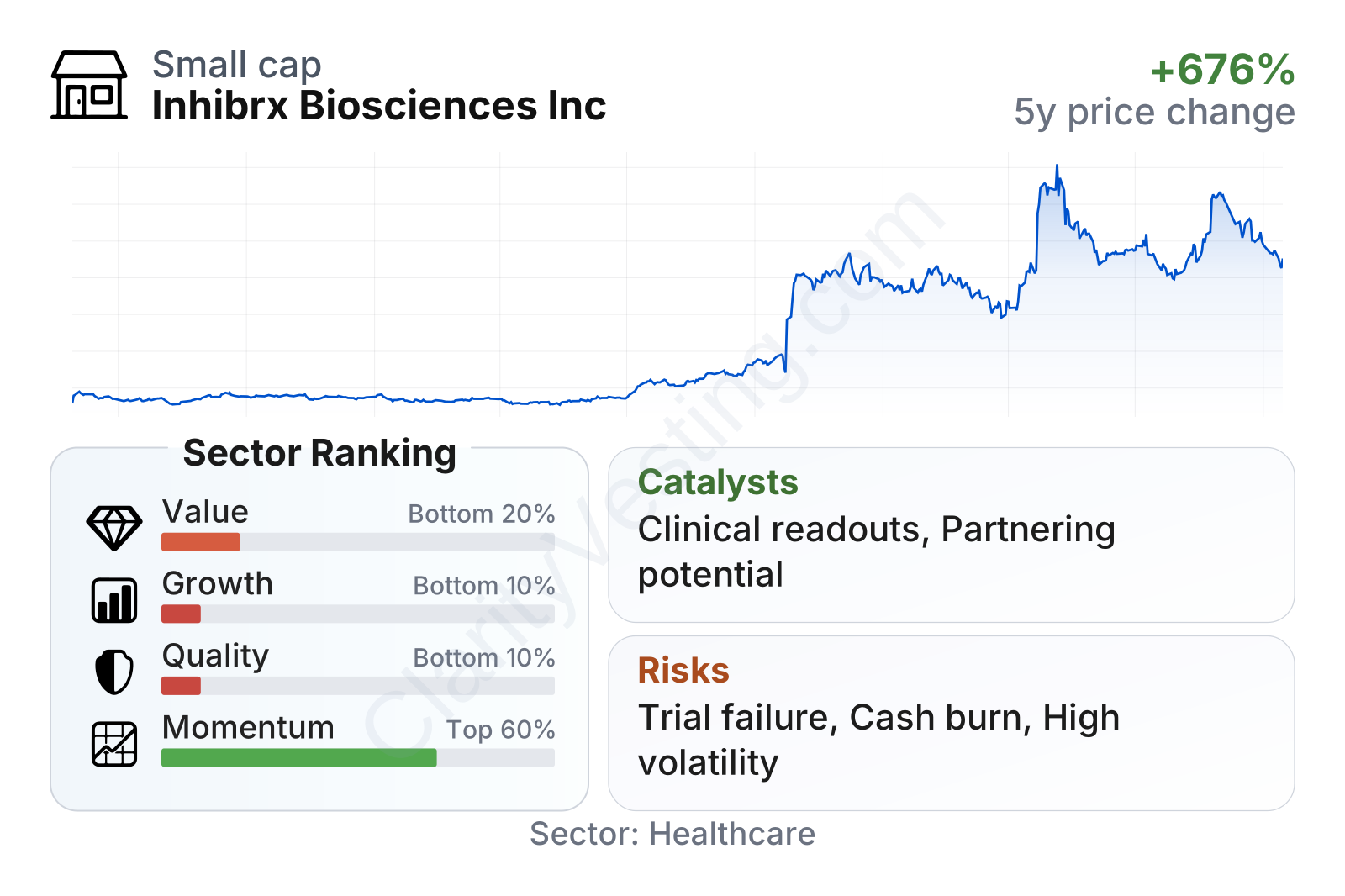
Inhibrx Biosciences is currently a mid-sized biotech by market value, but its operating profile looks much weaker than the sector on value, growth, and quality measures. Revenue trends remain poor, profitability is still absent on an underlying basis, and free cash flow is negative. The main bright spot is market momentum: the stock has far outperformed much of the healthcare sector over the last year, showing that expectations around pipeline progress have improved sharply.
Growth
Biotechnology remains a growth sector because successful new therapies can create very large markets and attract premium pricing, especially in oncology and rare diseases. Inhibrx Biosciences is operating in exactly those areas, which gives it exposure to attractive long-term demand drivers. Cancer treatment continues to be one of the biggest research priorities in medicine, and rare disease programs can benefit from faster regulatory pathways and focused commercial launches if data are compelling.
The company’s strategy also makes sense for a development-stage biotech: concentrate capital on a limited number of differentiated antibody programs rather than trying to build a broad commercial infrastructure too early. That approach can preserve flexibility and makes positive trial data especially meaningful, since a good result can support partnering, additional financing on better terms, or a larger strategic transaction.
A major recent opportunity comes from continued clinical progress in its lead programs, especially assets tied to solid tumor treatment. For a company of this size, meaningful trial updates can change expectations quickly because the business is not spread across dozens of products. The sharp stock-price rerating over the past year suggests the market has already begun assigning more value to that possibility.
Cash generation is still negative, but the burn rate has improved from the deeply negative level seen earlier. That matters because a biotech company does not need to be cash-flow positive in its development phase, but it does need enough financial runway to reach major clinical milestones without repeatedly raising capital under pressure.
Another growth support is the company’s cleaner post-transaction structure. A more focused pipeline can help management direct spending toward the assets with the highest potential payoff. If upcoming development milestones are favorable, the company could gain leverage in negotiations with larger pharmaceutical companies looking for external innovation.
Risks
This article is for informational purposes only and does not constitute financial advice. Some content is AI-generated. See Disclaimer


