Stock Analysis · Immunovant Inc (IMVT)
Overview
Immunovant is a clinical-stage biotechnology company focused on autoimmune diseases. Its goal is to develop antibody-based medicines that lower harmful IgG antibodies, which play a role in several serious autoimmune conditions. The company’s lead platform targets the neonatal Fc receptor, or FcRn, a pathway already validated by approved medicines in the broader industry. Immunovant’s pipeline is centered on IMVT-1402, a next-generation FcRn inhibitor being studied across multiple diseases, and on batoclimab, an earlier FcRn program that helped establish the company’s clinical direction.
At this stage, Immunovant is still a development-stage business rather than a commercial pharmaceutical company. Based on its latest public filings for fiscal 2026, it has not yet generated product revenue, so its operating model is still funded mainly by cash raised from shareholders and strategic financing rather than from medicine sales.
Main sources of revenue are currently very limited:
- Product revenue: approximately 0%. Immunovant does not yet have an approved product on the market.
- Collaboration or licensing revenue: no meaningful recurring contribution disclosed in the latest fiscal reporting.
- Interest and other income: the only meaningful reported inflow outside financing, driven mainly by returns on cash and investments, but not a core business revenue source.
That means the business today should be understood as a pipeline company: its value depends much more on clinical progress, regulatory milestones, and future commercialization potential than on current sales.
The financial profile reflects that development-stage status. Over the last several years, operating expenses have risen sharply while revenue has remained near zero, with research and development representing by far the largest use of cash. That is typical for a biotech company advancing multiple clinical programs, but it also shows how much future success depends on converting research spending into approved products.
Key Figures
| Metric | Value | Sector ⓘ |
|---|---|---|
| Date | Oct 10, 2026 | |
| Context | ||
| Sector | Healthcare | |
| Industry | Biotechnology | |
| Market Cap ⓘ | $6.62B | |
| Beta ⓘ | 0.84 | |
Value (Cheapness) | ||
| P/E Ratio ⓘ | N/A | 24.79 |
| P/B Ratio ⓘ | 8.46 | 2.97 |
| FCF Yield ⓘ | -6.26% | 3.11% |
| Dividend Yield ⓘ | N/A | 2.04% |
| EBIT / EV ⓘ | -8.65% | 0.57% |
| PEG ⓘ | N/A | |
Growth (Business expansion) | ||
| Revenue Growth ⓘ | N/A | 7.35% |
| RPS Growth (5Y CAGR) ⓘ | N/A | 8.61% |
| EPS Growth (5Y CAGR) ⓘ | -20.97% | -18.43% |
| BVPS Growth (5Y CAGR) ⓘ | 2.20% | 3.94% |
| Margin Growth (5Y Trend) ⓘ | N/A | -0.61% |
| FCF Growth (5Y CAGR) ⓘ | N/A | 0.88% |
| DPS Growth (5Y CAGR) ⓘ | N/A | 6.74% |
Quality (Business durability) | ||
| ROIC (Latest) ⓘ | -54.35% | 3.34% |
| ROA (Latest) ⓘ | -74.99% | 2.95% |
| ROIC (5Y Median) ⓘ | -41.18% | 4.60% |
| ROA (5Y Median) ⓘ | -48.36% | 1.89% |
| Net Debt / EBIT (Latest) ⓘ | N/A | 1.36 |
| Net Debt / EBIT (5Y Median) ⓘ | N/A | 1.86 |
| Net Debt / EBITDA (Latest) ⓘ | N/A | 1.02 |
| Net Debt / Assets ⓘ | -93.58% | 5.85% |
| EBITDA / Interest ⓘ | N/A | 9.60 |
| Operating Margin (Latest) ⓘ | -7595.70% | 9.19% |
| Operating Margin (5Y Median) ⓘ | N/A | 7.53% |
| Debt to Equity (Latest) ⓘ | N/A | 29.44% |
| Profit Margin (Latest) ⓘ | N/A | 3.52% |
| Free Cash Flow (Latest) ⓘ | -$414.31M | |
Momentum (Price trend) | ||
| 3Y Return ⓘ | -18.74% | +34.80% |
| 12M Return (excl. last month) ⓘ | +141.72% | +19.33% |
| 6M Return ⓘ | +22.36% | +7.18% |
| Price vs. 200-Day MA ⓘ | -4.98% | +3.20% |
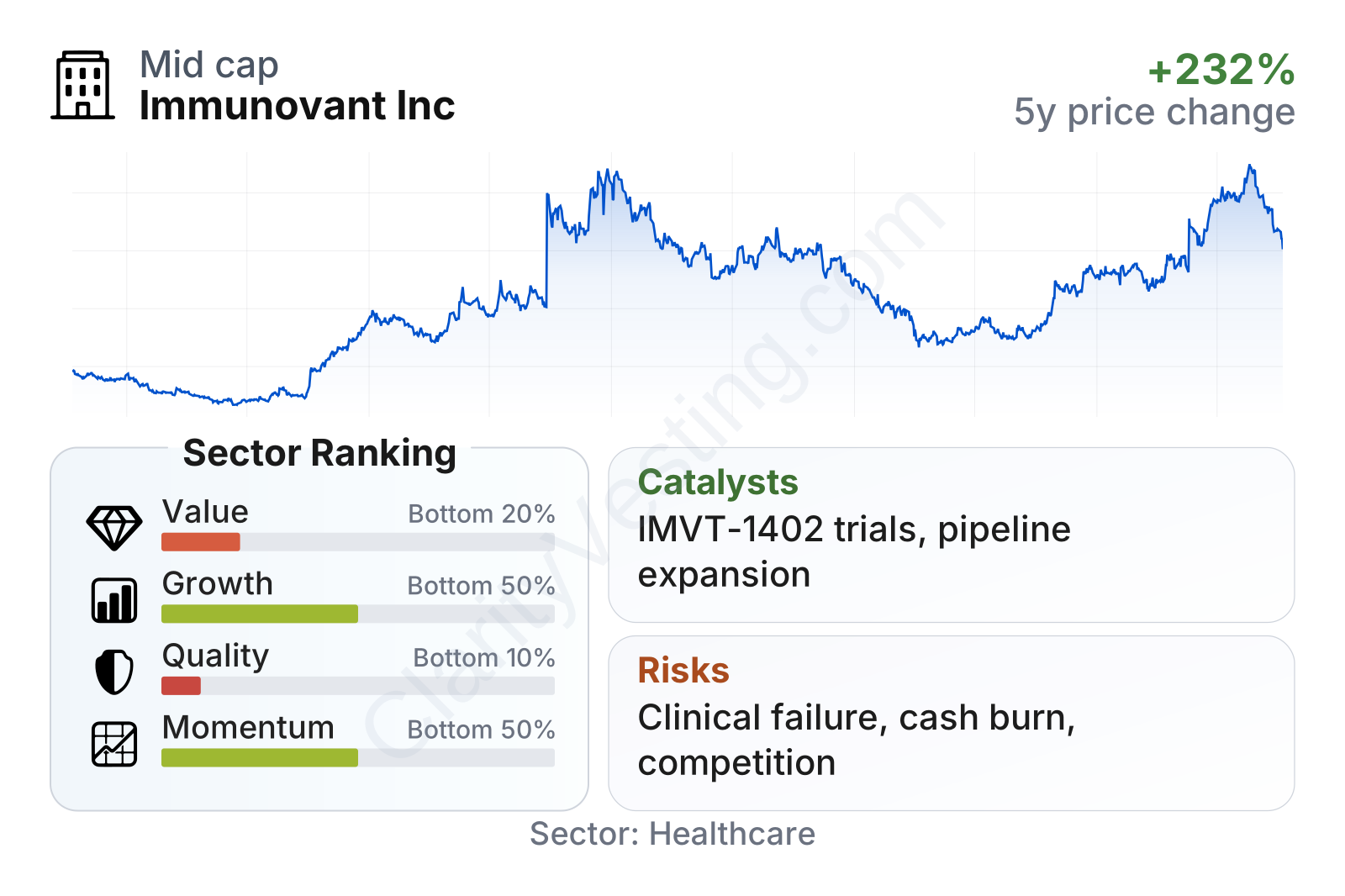
Immunovant sits in the mid-cap range and has shown strong recent share-price momentum, especially over the last 12 months, although the longer history has been volatile. On valuation, traditional metrics look weak relative to the healthcare sector because the company has no earnings and no commercial revenue yet, while price-to-book is elevated. Quality and growth scores also rank in the lower part of the sector, which is common for pre-revenue biotech firms but still important: the company is being valued more on pipeline expectations than on current business economics.
The balance sheet is a notable exception. Debt is extremely low, beta is below 1, and the company holds a large cash position relative to liabilities. That does not remove development risk, but it does reduce near-term financial strain compared with many biotechnology peers that rely more heavily on borrowing.
Growth
Immunovant operates in a sector with meaningful long-term growth potential. Autoimmune diseases affect millions of patients, many conditions still lack convenient and highly effective treatment options, and FcRn inhibition has emerged as an important treatment class because it can reduce pathogenic IgG antibodies across several diseases. This creates a large potential market if a company can show strong efficacy, manageable safety, and practical dosing.
Immunovant’s strategy is built around exactly that opportunity: instead of pursuing only one narrow indication, it is developing a platform that could expand across multiple autoimmune diseases. The strategic logic is straightforward. If IMVT-1402 can demonstrate a cleaner safety profile and more flexible dosing while preserving strong IgG reduction, the same mechanism could be reused in several high-value indications, giving the company multiple shots at creating a future commercial franchise.
A major catalyst has been the transition toward IMVT-1402, which management has positioned as a potentially best-in-class FcRn asset. The company has highlighted its subcutaneous delivery approach and clinical development plans across neurology, hematology, and rheumatology-related indications. For long-term analysis, this matters because platform breadth can create more value than a single-asset biotech if execution remains strong.
Recent company updates have also pointed to continued pipeline expansion and study progress, including advancement into diseases such as myasthenia gravis, chronic inflammatory demyelinating polyneuropathy, and Graves’ disease. The significance is less about any one trial headline and more about portfolio architecture: each new indication broadens the addressable market and reduces reliance on one binary event.
At the same time, growth is not showing up in accounting revenue yet. Cash burn has increased materially over time, with free cash flow becoming more negative as trials expanded. That trend is normal for a company moving deeper into clinical development, but it means growth currently exists in scientific scope and optionality rather than in reported sales.
Risks
This article is for informational purposes only and does not constitute financial advice. Some content is AI-generated. See Disclaimer