Stock Analysis · Ingles Markets Incorporated (IMKTA)
Overview
Ingles Markets Incorporated is a regional supermarket operator focused on the southeastern United States. The company runs grocery stores, pharmacies, fuel centers, and a distribution network that supports its retail footprint. Its stores are concentrated in states such as North Carolina, Georgia, South Carolina, Tennessee, Virginia, and Alabama, giving it a strong presence in many smaller cities and suburban markets where national competitors are not always as dominant.
The business is built primarily around food retailing, which makes Ingles part of the consumer defensive sector. That usually means demand is more stable than in discretionary retail because groceries remain essential in most economic environments. Ingles also owns a meaningful portion of its real estate, which is an important characteristic because it can reduce occupancy risk and provide asset backing that is less common in some retail models.
Revenue is generated mainly from supermarket sales, with additional income from pharmacy, fuel, and other store-based activities. Based on company disclosures, the mix is heavily weighted toward grocery and related consumables.
- Grocery sales: approximately 75% to 80% of revenue. This includes packaged food, produce, meat, dairy, frozen items, and other everyday supermarket categories.
- Non-food merchandise: approximately 10% to 15% of revenue. This generally includes health and beauty, household products, general merchandise, and seasonal items.
- Pharmacy: approximately 5% to 10% of revenue. This covers prescription services and related health products.
- Fuel and other income: a smaller contribution, generally below 5%. This includes gasoline sales, rental income, and other ancillary activities.
The broader financial flow shows a familiar supermarket pattern: very large sales volumes, high cost of goods sold, and relatively thin margins. Over the last few years, revenue has moved down from its pandemic-influenced peak, while operating income and net income have compressed more sharply than sales, highlighting how sensitive grocery earnings can be to small changes in pricing, product mix, and operating costs.
Key Figures
| Metric | Value | Sector ⓘ |
|---|---|---|
| Date | Oct 17, 2026 | |
| Context | ||
| Sector | Consumer Defensive | |
| Industry | Grocery Stores | |
| Market Cap ⓘ | $1.62B | |
| Beta ⓘ | 0.57 | |
Value (Cheapness) | ||
| P/E Ratio ⓘ | 15.63 | 17.88 |
| P/B Ratio ⓘ | 0.96 | 1.29 |
| FCF Yield ⓘ | 9.21% | 12.39% |
| Dividend Yield ⓘ | 0.77% | 2.85% |
| EBIT / EV ⓘ | 9.31% | 6.43% |
| PEG ⓘ | 0.85 | |
Growth (Business expansion) | ||
| Revenue Growth ⓘ | 1.60% | 4.10% |
| RPS Growth (5Y CAGR) ⓘ | 2.51% | 6.18% |
| EPS Growth (5Y CAGR) ⓘ | -25.32% | -13.59% |
| BVPS Growth (5Y CAGR) ⓘ | 14.14% | 3.20% |
| Margin Growth (5Y Trend) ⓘ | -4.63% | -0.15% |
| FCF Growth (5Y CAGR) ⓘ | -30.08% | 4.10% |
| DPS Growth (5Y CAGR) ⓘ | 0.08% | 6.79% |
Quality (Business durability) | ||
| ROIC (Latest) ⓘ | 5.47% | 12.34% |
| ROA (Latest) ⓘ | 4.00% | 6.30% |
| ROIC (5Y Median) ⓘ | 16.98% | 10.49% |
| ROA (5Y Median) ⓘ | 8.84% | 5.44% |
| Net Debt / EBIT (Latest) ⓘ | 0.46 | 1.96 |
| Net Debt / EBIT (5Y Median) ⓘ | 1.31 | 2.35 |
| Net Debt / EBITDA (Latest) ⓘ | 0.26 | 1.38 |
| Net Debt / Assets ⓘ | 2.71% | 21.51% |
| EBITDA / Interest ⓘ | 14.87 | 9.46 |
| Operating Margin (Latest) ⓘ | 2.86% | 8.87% |
| Operating Margin (5Y Median) ⓘ | 5.10% | 9.53% |
| Debt to Equity (Latest) ⓘ | 31.25% | 72.35% |
| Profit Margin (Latest) ⓘ | 1.92% | 5.40% |
| Free Cash Flow (Latest) ⓘ | $149.58M | |
Momentum (Price trend) | ||
| 3Y Return ⓘ | +13.78% | +20.92% |
| 12M Return (excl. last month) ⓘ | +20.97% | +2.13% |
| 6M Return ⓘ | -7.27% | +1.26% |
| Price vs. 200-Day MA ⓘ | +0.39% | +1.39% |
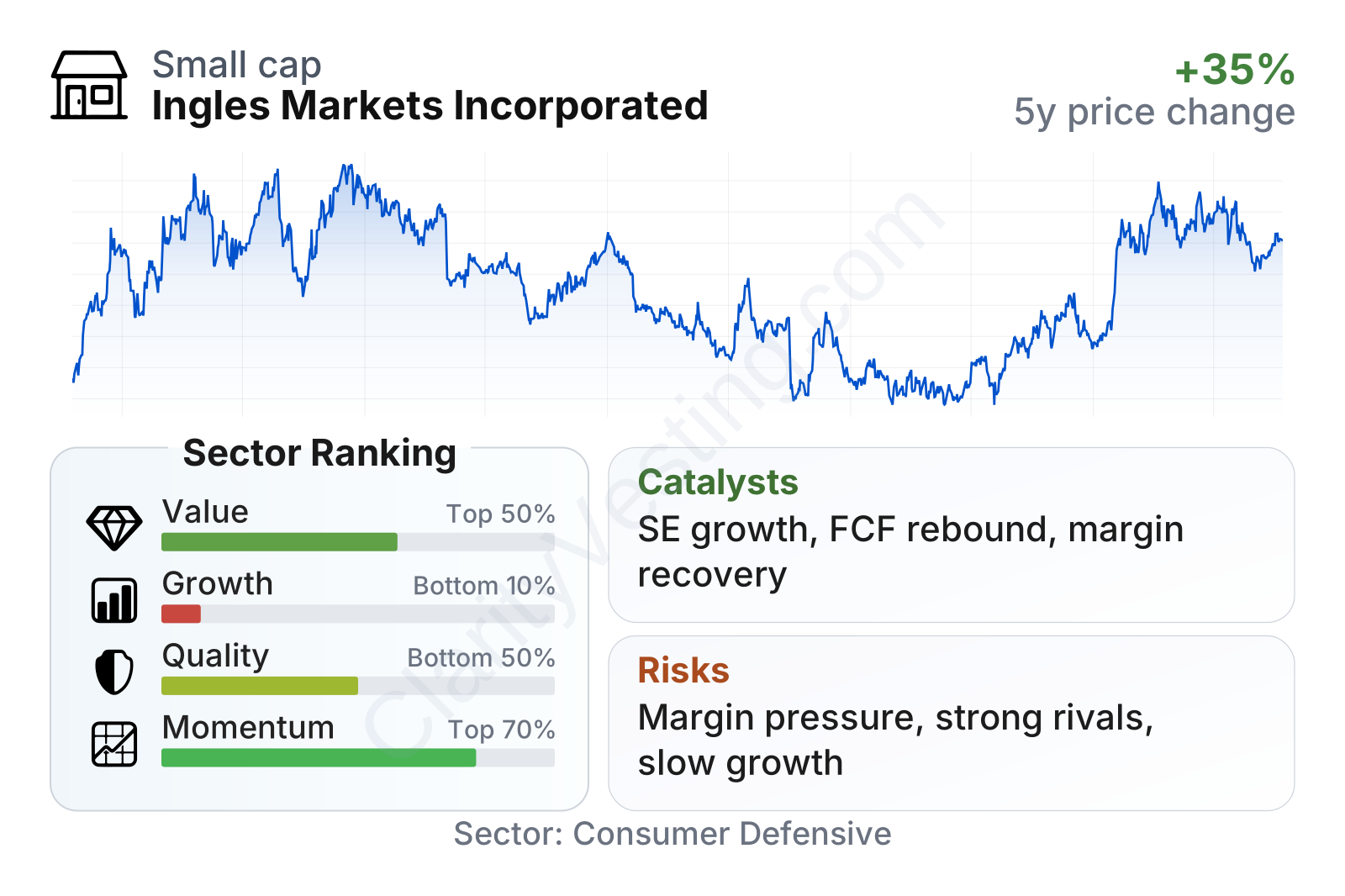
Ingles is a mid-sized public company with a stock that has historically moved less than the broader market, as reflected by its low beta. The latest factor summary points to a mixed picture. Valuation measures are not stretched relative to the sector, and the balance sheet looks conservative, but growth and current profitability rank weaker than many peers. That combination helps explain why the shares have traded at lower valuation multiples than much of the consumer defensive universe for long periods.
The share price history also shows that the market has treated Ingles as a cyclical defensive name rather than a steady compounder. The stock surged during the inflation-heavy grocery environment of 2021 to 2023, then corrected as earnings normalized, before recovering strongly in 2026. That pattern suggests sentiment is closely tied to margin expectations and not just to revenue growth.
Growth
The grocery sector is mature, but it remains structurally important. Long-term demand is supported by population growth, recurring food consumption, and the need for convenient local shopping. In Ingles’ case, the growth question is less about entering a rapidly expanding industry and more about whether it can steadily gain sales, protect margins, and use its regional footprint effectively.
Its strategy remains sensible for a regional chain. Ingles benefits from local density in the Southeast, in-house distribution capabilities, pharmacies inside stores, and a meaningful owned real estate base. Those elements can support store productivity and give the company more control over operations than retailers that rely more heavily on leased locations or outside logistics partners.
Recent revenue growth has been uneven. After very strong gains earlier in the period, sales growth turned negative for several quarters before returning to low positive territory more recently, around 2% year over year. That is below the sector median and shows that Ingles is currently operating in a low-growth phase. For a supermarket chain, that is not unusual, but it limits how much the investment case can rely on top-line expansion alone.
Free cash flow is an area worth watching closely. It fell sharply from the unusually strong levels seen a few years ago, then rebounded meaningfully in the latest trailing period. That improvement matters because cash generation gives Ingles flexibility to reinvest in stores, reduce debt, support dividends, and maintain financial resilience even when earnings are under pressure. A sustained recovery in free cash flow would be one of the clearest signs that operations are stabilizing after a weaker earnings stretch.
As for catalysts, the most credible ones are company-specific rather than transformational. Continued population growth in Southeastern markets can support traffic over time. Better cost control, improved merchandising mix, and a more normal comparison base after weaker results could also help earnings recover faster than revenue. In addition, the company’s real estate ownership provides optionality, even if that value is not always fully reflected in supermarket earnings multiples.
There does not appear to be a major headline-driven growth event redefining the business model. The opportunity is more incremental: modest same-store sales progress, operating discipline, and a rebound from compressed profitability rather than a dramatic expansion story.
Risks
This article is for informational purposes only and does not constitute financial advice. Some content is AI-generated. See Disclaimer


