Stock Analysis · IMI plc (IMIAF)
Overview
IMI plc is a British engineering company focused on highly specialized flow-control and motion-control products. In simple terms, it makes the valves, actuators, regulators, and related systems that help industrial customers control pressure, temperature, and the movement of liquids and gases. These products are often used in demanding environments where reliability matters, such as factories, energy systems, transport equipment, and industrial automation.
The business is organized around three main divisions. Based on the latest annual reporting, revenue is spread as follows:
- Industrial Automation: approximately 40% of revenue. This division supplies pneumatic and electric motion-control products, valves, actuators, air treatment equipment, and automation solutions used in factory automation, life sciences, transportation, and process industries.
- Climate Control: approximately 31% of revenue. This segment provides hydronic balancing and control systems used in commercial buildings and heating and cooling networks, helping improve energy efficiency in buildings.
- Process Automation: approximately 29% of revenue. This business serves sectors such as energy, chemicals, marine, and industrial processing with severe-service valves and other products designed for harsh operating conditions.
That mix matters because it gives IMI exposure to several long-term industrial themes at once: factory automation, energy efficiency in buildings, and more complex process control in energy and industrial facilities. It also means the group is not dependent on one single customer market.
Over the last several years, revenue has climbed from about £1.9 billion equivalent in 2021 to roughly £2.3 billion in 2025, while operating profit and net income have increased faster than sales. This suggests that the company has not only grown, but has also improved profitability as it scaled and managed costs.
The longer-term pattern is especially notable in profitability. Sales have risen steadily, but operating income has expanded even faster, pointing to better mix, pricing discipline, and efficiency. Gross profit has also improved over time, while operating expenses have grown more slowly than revenue in the most recent year.
Key Figures
| Metric | Value | Sector ⓘ |
|---|---|---|
| Date | Oct 31, 2026 | |
| Context | ||
| Sector | Industrials | |
| Industry | Specialty Industrial Machinery | |
| Market Cap ⓘ | $9.16B | |
| Beta ⓘ | 1.01 | |
Value (Cheapness) | ||
| P/E Ratio ⓘ | 21.44 | 21.91 |
| P/B Ratio ⓘ | 9.96 | 1.97 |
| FCF Yield ⓘ | 7.34% | 6.34% |
| Dividend Yield ⓘ | 0.90% | 1.88% |
| EBIT / EV ⓘ | N/A | 4.83% |
| PEG ⓘ | 1.96 | |
Growth (Business expansion) | ||
| Revenue Growth ⓘ | 6.20% | 9.50% |
| RPS Growth (5Y CAGR) ⓘ | 7.22% | 7.67% |
| EPS Growth (5Y CAGR) ⓘ | -15.11% | -11.63% |
| BVPS Growth (5Y CAGR) ⓘ | 11.11% | 6.14% |
| Margin Growth (5Y Trend) ⓘ | 5.50% | 0.71% |
| FCF Growth (5Y CAGR) ⓘ | 9.18% | 11.01% |
| DPS Growth (5Y CAGR) ⓘ | 8.70% | 9.31% |
Quality (Business durability) | ||
| ROIC (Latest) ⓘ | 35.14% | 10.70% |
| ROA (Latest) ⓘ | 22.95% | 5.45% |
| ROIC (5Y Median) ⓘ | 15.81% | 9.33% |
| ROA (5Y Median) ⓘ | 9.65% | 4.94% |
| Net Debt / EBIT (Latest) ⓘ | 0.85 | 2.03 |
| Net Debt / EBIT (5Y Median) ⓘ | 1.97 | 2.28 |
| Net Debt / EBITDA (Latest) ⓘ | 0.67 | 1.37 |
| Net Debt / Assets ⓘ | 27.16% | 19.16% |
| EBITDA / Interest ⓘ | 21.79 | 9.73 |
| Operating Margin (Latest) ⓘ | 17.44% | 10.49% |
| Operating Margin (5Y Median) ⓘ | 15.17% | 10.30% |
| Debt to Equity (Latest) ⓘ | 80.30% | 65.91% |
| Profit Margin (Latest) ⓘ | 14.09% | 6.61% |
| Free Cash Flow (Latest) ⓘ | $672.55M | |
Momentum (Price trend) | ||
| 3Y Return ⓘ | +139.36% | +69.18% |
| 12M Return (excl. last month) ⓘ | +25.75% | +12.04% |
| 6M Return ⓘ | +6.65% | +0.22% |
| Price vs. 200-Day MA ⓘ | +18.06% | +0.19% |
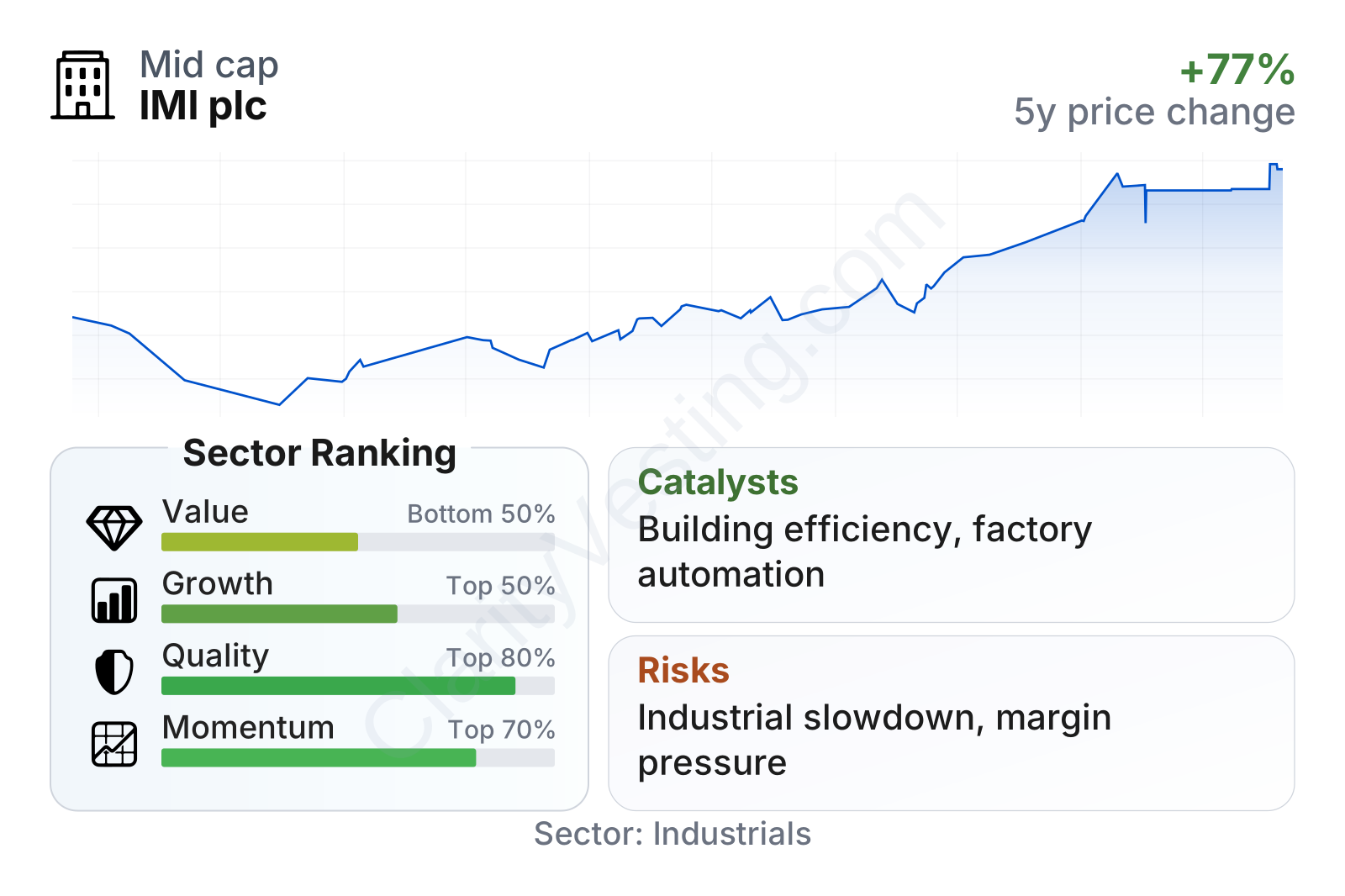
IMI sits in the large mid-cap range within industrials and shows a balanced risk profile in market behavior, with a beta close to 1. On valuation measures, it looks mixed rather than obviously cheap: earnings valuation is near the sector median, but the price-to-book ratio is far above the sector norm. On quality, the picture is much stronger. Returns on capital and assets are well above typical industrial peers, profit margins are meaningfully higher than the sector median, and leverage remains manageable with net debt below 1 times EBIT and strong interest coverage. Growth metrics are more moderate than outstanding, with revenue and cash flow expanding at a healthy pace over five years, though not dramatically faster than the broader sector. Share-price performance has been strong, outperforming much of the industrial universe over one, three, and six months, which shows that the market has already recognized some of this improvement.
Growth
IMI operates in parts of the industrial economy that have structural tailwinds, even if they are not always fast-growing every single year. Industrial automation continues to benefit from manufacturers seeking higher productivity, better precision, and lower labor intensity. Building climate systems are supported by tighter energy-efficiency standards, retrofits, and electrification trends. Process automation can gain from investment in cleaner, safer, and more efficient industrial operations, including upgrades to existing infrastructure.
The company’s strategy also appears coherent for long-term growth. IMI has been concentrating on applications where product failure is costly and customers are less likely to switch suppliers based only on price. That tends to support margins and recurring aftermarket demand. The business has also been reshaped over time toward higher-value niches rather than broad, low-margin industrial hardware.
A potentially important catalyst is the continued push for energy efficiency in commercial buildings. IMI’s Climate Control products are tied to heating and cooling optimization, which can reduce energy usage in large buildings and district systems. That positions the company in a market where regulation and cost savings can work in the same direction.
Another catalyst is automation spending. In Industrial Automation, demand can benefit from investments in smarter factories, medical equipment, rail, and precision manufacturing. If industrial capital spending remains stable, IMI’s exposure to specialized control components gives it room to expand with customers’ automation needs rather than simply with general industrial output.
Recent company reporting has also shown that margin improvement remains a meaningful part of the growth case. Revenue growth has been steady rather than spectacular, but earnings have advanced more quickly, and the operating margin trend over five years is clearly positive. For long-term analysis, that matters because compounding can come from better economics as much as from higher sales.
Risks
This article is for informational purposes only and does not constitute financial advice. Some content is AI-generated. See Disclaimer


