Stock Analysis · Permanent TSB Group Holdings PLC (ILPMY)
Overview
Permanent TSB Group Holdings PLC is an Irish retail bank. Its business is centered on everyday banking for households and small businesses, with a strong focus on residential mortgages, customer deposits, personal lending, credit cards, and current accounts. Compared with large universal banks, Permanent TSB is much more concentrated in the domestic Irish market and in traditional banking activities.
The company’s revenue mainly comes from core banking income rather than from complex capital-markets businesses. Based on recent annual reporting, the mix is broadly driven by the following sources:
- Net interest income: approximately 75% to 85% of total operating income. This is the spread between interest earned on mortgages and other loans and interest paid on deposits and funding.
- Fee and commission income: approximately 10% to 15%. This includes account fees, card-related income, transaction services, and other routine banking charges.
- Other operating income: approximately 5% to 10%. This can include treasury-related items, servicing income, and smaller non-core banking lines.
The business remains simple to understand: gather deposits, lend mainly into the Irish housing market, and earn a margin while trying to control costs and credit losses. That simplicity is helpful for long-term analysis, but it also means performance is heavily tied to Irish interest rates, the health of the housing market, and competition for deposits and mortgages.
Over the last few years, revenue has moved up meaningfully, while profitability has been more uneven. The broad pattern shows a bank that benefited from higher rates and balance-sheet expansion, but whose earnings can still swing noticeably from year to year.
The operating picture has improved from the weak 2021 period, with revenue rising from roughly €0.4 billion to more than €0.8 billion by 2025. Even so, net income has not climbed in a straight line, showing how sensitive banking results are to funding costs, operating expenses, and credit charges.
Key Figures
| Metric | Value | Sector ⓘ |
|---|---|---|
| Date | Oct 24, 2026 | |
| Context | ||
| Sector | Financial Services | |
| Industry | Banks - Regional | |
| Market Cap ⓘ | $2.00B | |
| Beta ⓘ | 0.46 | |
Value (Cheapness) | ||
| P/E Ratio ⓘ | 15.23 | 12.46 |
| P/B Ratio ⓘ | 0.81 | 1.25 |
| FCF Yield ⓘ | -18.61% | 9.82% |
| Dividend Yield ⓘ | 0.64% | 2.94% |
| EBIT / EV ⓘ | N/A | 8.11% |
| PEG ⓘ | N/A | |
Growth (Business expansion) | ||
| Revenue Growth ⓘ | 5.00% | 9.10% |
| RPS Growth (5Y CAGR) ⓘ | 18.81% | 12.31% |
| EPS Growth (5Y CAGR) ⓘ | N/A | -6.97% |
| BVPS Growth (5Y CAGR) ⓘ | 1.04% | 5.02% |
| Margin Growth (5Y Trend) ⓘ | 6.98% | -4.00% |
| FCF Growth (5Y CAGR) ⓘ | -35.53% | 4.71% |
| DPS Growth (5Y CAGR) ⓘ | 34.35% | 8.92% |
Quality (Business durability) | ||
| ROIC (Latest) ⓘ | N/A | 9.18% |
| ROE (Latest) ⓘ | 10.67% | 13.93% |
| ROA (Latest) ⓘ | 0.86% | 1.57% |
| ROIC (5Y Median) ⓘ | 2.19% | 7.80% |
| ROE (5Y Median) ⓘ | 4.59% | 12.15% |
| ROA (5Y Median) ⓘ | 0.37% | 1.28% |
| Net Debt / EBIT (Latest) ⓘ | 176.46 | 1.02 |
| Net Debt / EBIT (5Y Median) ⓘ | -2.98 | 0.72 |
| Net Debt / EBITDA (Latest) ⓘ | 16.11 | 0.88 |
| Operating Margin (Latest) ⓘ | 0.81% | 22.30% |
| Operating Margin (5Y Median) ⓘ | 13.52% | 24.50% |
| Debt to Equity (Latest) ⓘ | 107.37% | 59.34% |
| Profit Margin (Latest) ⓘ | 19.86% | 26.42% |
| Free Cash Flow (Latest) ⓘ | -$371.78M | |
Momentum (Price trend) | ||
| 3Y Return ⓘ | +67.60% | +95.73% |
| 12M Return (excl. last month) ⓘ | +31.59% | +17.30% |
| 6M Return ⓘ | +0.30% | +6.07% |
| Price vs. 200-Day MA ⓘ | -4.68% | +5.36% |
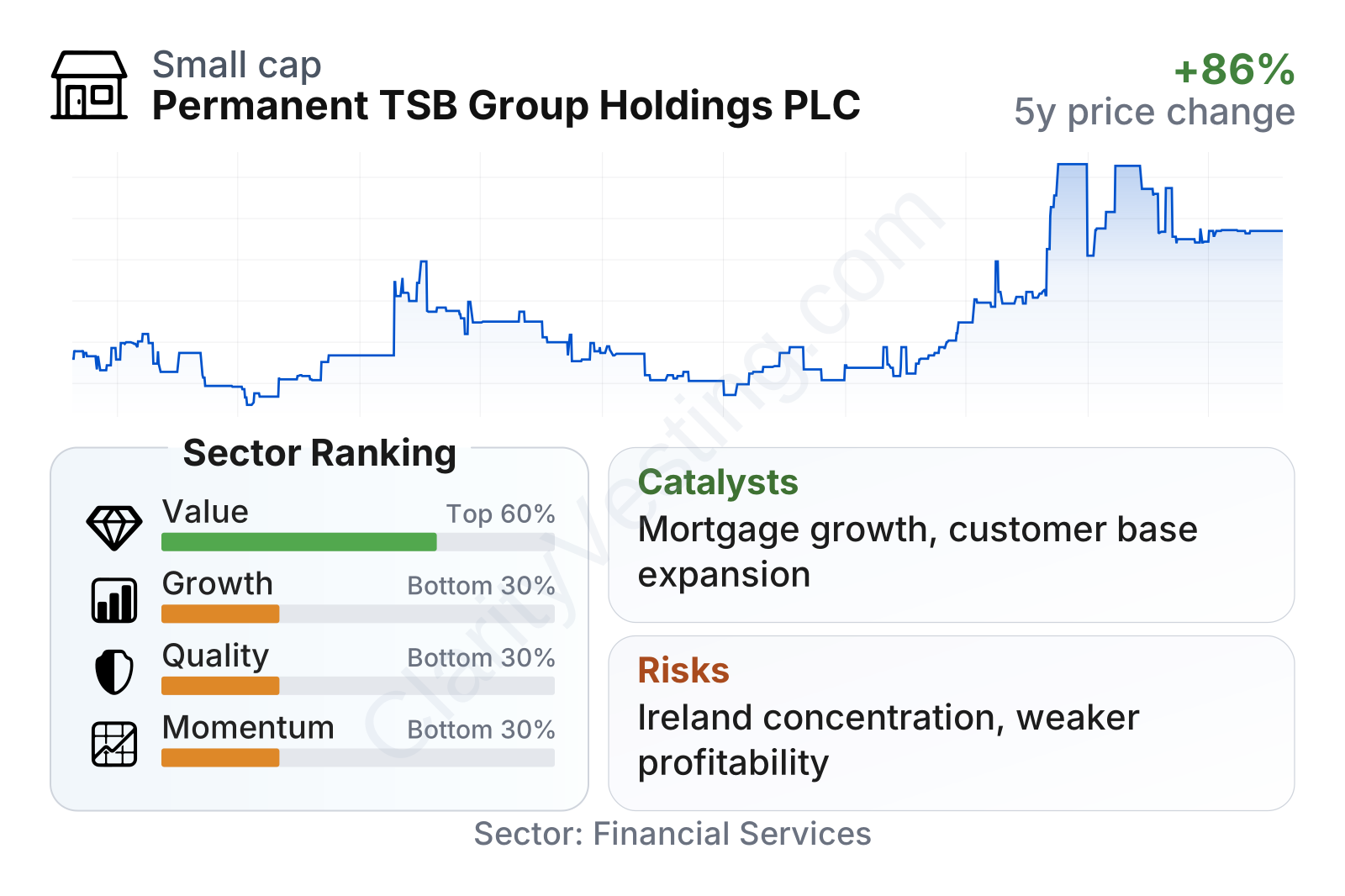
Permanent TSB is a relatively small listed bank by global standards, with a market value around $2 billion and a low beta, which suggests the shares have historically moved less than many peers. On valuation, the shares trade at a price-to-earnings ratio above the sector median, while the price-to-book ratio remains below the sector median. That combination usually signals that the market is recognizing some recovery, but still not assigning the company a full premium relative to bank peers.
The quality and growth profile is less convincing than the valuation picture alone might suggest. Revenue growth is positive but modest versus the sector median, profitability ratios sit below typical regional bank levels, and free cash flow is negative. Momentum has also cooled after a strong prior run, with shorter-term share performance weaker than the broader banking group.
Growth
Permanent TSB operates in a sector that is mature rather than fast-growing, but parts of its market still offer room for expansion. Irish banking has become more concentrated after years of restructuring, and that creates opportunities for surviving domestic players to gather deposits, add customers, and expand lending relationships. Mortgage demand is also supported by Ireland’s structural housing shortage, which can keep loan demand resilient over long periods, even if year-to-year activity fluctuates with rates.
The company’s strategy has centered on deepening its position as a full-service retail bank in Ireland. That includes integrating acquired customer relationships and assets, improving digital capabilities, and using a larger branch and customer base to sell more products per household. In principle, that strategy makes sense: a bigger deposit base can lower funding risk, while a broader customer relationship can improve fee income and retention.
Earnings per share show a recovery from loss-making levels to positive territory, but the absolute level remains modest. That means the direction has improved, yet the bank still needs stronger and more consistent profitability before the earnings trend looks firmly established.
Book value per share has been uneven rather than steadily compounding. For a bank, book value matters because it represents the capital base that supports lending and absorbs shocks. The company has preserved a meaningful equity cushion, but the pace of book value growth has lagged many peers, which limits how strong the long-term compounding case looks today.
A major catalyst is execution on the larger customer and asset base built in recent years. If management can convert that scale into better efficiency, steadier margins, and more cross-selling, earnings could become less volatile. Another positive factor is that the group remains focused on plain-vanilla retail banking rather than riskier trading-heavy activities, which can support more predictable long-term operating performance.
Risks
This article is for informational purposes only and does not constitute financial advice. Some content is AI-generated. See Disclaimer


