Stock Analysis · Iluka Resources Ltd (ILKAY)
Overview
Iluka Resources Ltd is an Australian mining and refining company focused on mineral sands and critical materials. Its traditional business is producing zircon, rutile, and synthetic rutile, which are used in ceramics, pigments, and industrial applications. The company also has a growing strategic focus on rare earths, especially through its Eneabba rare earths refinery project in Western Australia. In simple terms, Iluka has long been a mineral sands producer, but it is trying to add a second growth engine in materials that are important for electric vehicles, wind turbines, electronics, and defense supply chains.
The company’s revenue is still mainly tied to mineral sands. Based on recent annual reporting, the broad sources of revenue can be summarized as follows:
- Zircon: about 37% of revenue. Zircon is mainly sold into ceramics, refractories, and foundry markets.
- Rutile and synthetic rutile: about 53% of revenue combined. These are titanium feedstocks used primarily in pigment production and other industrial uses.
- Other products and services: about 10% of revenue. This includes smaller mineral sands streams and other related activities.
That mix matters because it shows Iluka is still largely exposed to industrial commodity cycles rather than already being driven by rare earths. The rare earths business is more about future positioning than current profit contribution. Another important point is that revenue has fallen from the very strong 2022 period, reflecting weaker prices and softer market conditions. Profitability followed the same direction, with a sharp deterioration by 2025 as margins compressed and the business moved into a loss-making period.
Operationally, Iluka stands out because it owns long-life mineral sands assets and has meaningful processing capability, not just raw extraction. That gives it some control over product quality and customer relationships. The strategic appeal is that management is using this base to move into a more geopolitically important segment: separated rare earth oxides and refining outside China.
The long-term pattern shows a business that was highly profitable in 2021-2024, then saw a steep earnings reset in 2025. Revenue declined from roughly $1.6 billion at the peak to just under $1.0 billion, while gross profit and operating income fell much faster. That gap suggests the current challenge is not only lower sales, but much weaker margin conversion.
Key Figures
| Metric | Value | Sector ⓘ |
|---|---|---|
| Date | Oct 03, 2026 | |
| Context | ||
| Sector | Basic Materials | |
| Industry | Other Industrial Metals & Mining | |
| Market Cap ⓘ | $1.80B | |
| Beta ⓘ | 0.80 | |
Value (Cheapness) | ||
| P/E Ratio ⓘ | N/A | 17.61 |
| P/B Ratio ⓘ | 0.88 | 1.77 |
| FCF Yield ⓘ | -50.83% | 5.87% |
| Dividend Yield ⓘ | 1.00% | 2.06% |
| EBIT / EV ⓘ | N/A | 6.43% |
| PEG ⓘ | N/A | |
Growth (Business expansion) | ||
| Revenue Growth ⓘ | -21.10% | 11.30% |
| RPS Growth (5Y CAGR) ⓘ | -11.17% | 4.46% |
| EPS Growth (5Y CAGR) ⓘ | -13.11% | -13.11% |
| BVPS Growth (5Y CAGR) ⓘ | 6.44% | 5.51% |
| Margin Growth (5Y Trend) ⓘ | -41.31% | -1.57% |
| FCF Growth (5Y CAGR) ⓘ | N/A | 0.55% |
| DPS Growth (5Y CAGR) ⓘ | -18.80% | 6.02% |
Quality (Business durability) | ||
| ROIC (Latest) ⓘ | N/A | 9.31% |
| ROA (Latest) ⓘ | -6.29% | 4.94% |
| ROIC (5Y Median) ⓘ | 17.53% | 7.91% |
| ROA (5Y Median) ⓘ | 10.82% | 3.93% |
| Net Debt / EBIT (Latest) ⓘ | N/A | 1.40 |
| Net Debt / EBIT (5Y Median) ⓘ | -0.51 | 1.70 |
| Net Debt / EBITDA (Latest) ⓘ | 4.00 | 0.91 |
| Net Debt / Assets ⓘ | 28.44% | 13.69% |
| EBITDA / Interest ⓘ | 7.78 | 11.93 |
| Operating Margin (Latest) ⓘ | -2.13% | 13.07% |
| Operating Margin (5Y Median) ⓘ | 32.79% | 11.86% |
| Debt to Equity (Latest) ⓘ | 62.99% | 40.43% |
| Profit Margin (Latest) ⓘ | -45.25% | 6.57% |
| Free Cash Flow (Latest) ⓘ | -$912.70M | |
Momentum (Price trend) | ||
| 3Y Return ⓘ | -13.39% | +65.06% |
| 12M Return (excl. last month) ⓘ | +25.26% | +36.05% |
| 6M Return ⓘ | -7.69% | +1.89% |
| Price vs. 200-Day MA ⓘ | -10.26% | +1.03% |
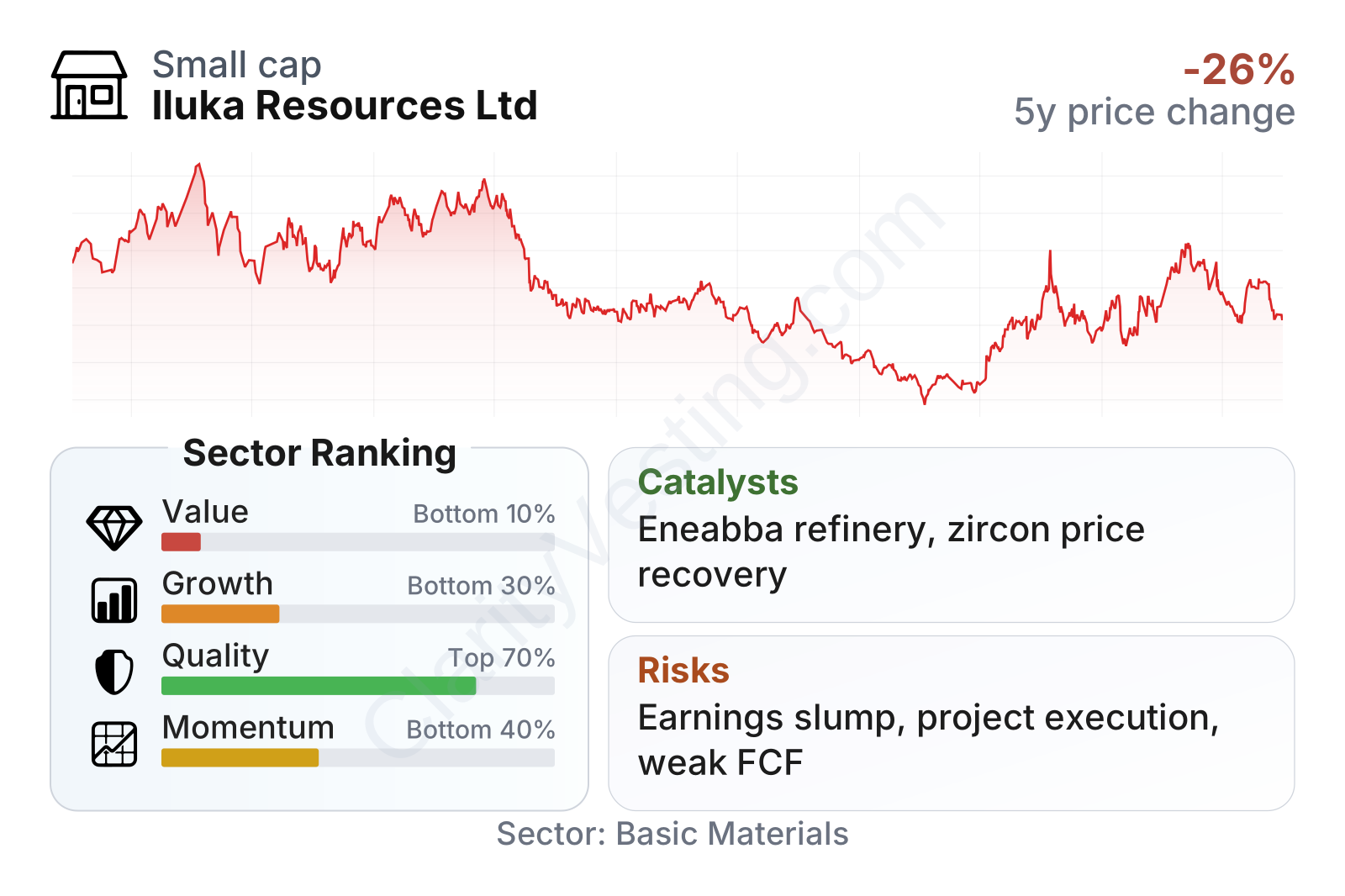
The market currently treats Iluka as a smaller basic materials company with relatively muted share-price momentum and mixed fundamentals. On valuation screens, the stock looks cheap on book value, but that signal is weakened by negative free cash flow and a recent earnings downturn. Quality is more nuanced: recent returns on assets and margins are weak, yet the five-year history still points to a business that used to earn well above sector norms during stronger commodity conditions. Growth metrics are currently soft, with declining revenue and pressure on margins, which explains why the company ranks poorly versus much of the sector on near-term growth and value composites.
The share price history also reflects that volatility. After strong levels in 2022 and 2023, the stock fell sharply into 2025 before partially recovering. That pattern is consistent with a cyclical miner whose earnings are highly sensitive to product prices, project spending, and market sentiment around future demand.
Growth
Iluka operates in two markets with very different growth profiles. Mineral sands is a mature but still essential industry tied to construction materials, ceramics, pigments, and industrial demand. It is not a structurally fast-growing segment, but supply discipline and new mine scarcity can support pricing over time. Rare earths, however, are in a more clearly expanding field because they are linked to permanent magnets used in electric vehicles, offshore wind, robotics, and defense systems. That is where Iluka’s strategy becomes more interesting for the long run.
The company’s most important growth initiative is the Eneabba rare earths refinery. This project is designed to process rare earth feedstocks into separated oxides, helping build non-Chinese supply chains for critical materials. The strategic logic is strong: many governments and manufacturers want more diversified rare earth processing capacity, and refining is often more valuable and harder to replicate than simple mining. Iluka also benefits from support from the Australian government for this effort, which lowers part of the funding burden and signals national strategic importance.
There is also optionality from the company’s mineral sands portfolio, including development pathways such as Balranald and other resource extensions. If titanium feedstock or zircon markets tighten again, Iluka has operating leverage because a large part of its cost base is already in place. In other words, better prices can have a meaningful effect on profit once volumes and utilization improve.
A recent positive theme around the company is that Western governments continue to prioritize resilient critical-minerals supply chains. That does not automatically translate into short-term profits, but it does strengthen the industrial case for Iluka’s rare earth refining push. If Eneabba moves forward on budget and into successful production, it could gradually reshape how the market views the company, from a cyclical mineral sands producer toward a more strategically positioned critical-minerals business.
Risks
This article is for informational purposes only and does not constitute financial advice. Some content is AI-generated. See Disclaimer