Stock Analysis · Iluka Resources Limited (ILKAF)
Overview
Iluka Resources Limited is an Australian mining and processing company focused on mineral sands and rare earths. In simple terms, it extracts and refines specialty minerals that are used in products such as pigments, ceramics, aerospace components, electronics, electric vehicles, wind turbines, and other industrial applications. The company has traditionally been known for zircon and high-grade titanium feedstocks, and it is now trying to build a larger position in rare earths through processing capacity in Australia.
Its business is centered on a relatively small number of mineral products rather than a highly diversified mining portfolio. That makes the company easier to understand, but it also means earnings can move sharply with commodity prices and project timing.
Based on recent annual reporting, Iluka’s revenue is mainly generated from the following sources, ranked from largest to smallest:
- Zircon – approximately 35% to 45% of revenue in recent years. Zircon is used mainly in ceramics, foundry applications, and some chemical uses.
- Rutile and synthetic rutile – approximately 25% to 35%. These are titanium feedstocks used in pigments, welding, metal, and specialty industrial markets.
- Ilmenite and other mineral sands products – approximately 10% to 20%. These sales tend to be lower value per ton than zircon or rutile but still contribute meaningful volume.
- Royalty and other revenue – typically a small share, supported in part by its royalty interest linked to the MacArthur River mine and other miscellaneous items.
- Rare earths-related activity – still limited as a revenue source compared with mineral sands, but strategically important because it could become much more material if the Eneabba rare earths refinery develops as planned.
Over the last several years, Iluka’s business mix has remained dominated by mineral sands, while the rare earths strategy has become the main long-term development theme. Financially, the company moved from very strong profitability during the 2021-2022 upcycle to weaker results as revenue and margins fell through 2024 and into a loss in 2025. That shift is important because it shows how cyclical the core business remains even before the rare earths growth plan is fully contributing.
The profit flow over time shows a clear pattern: revenue stayed above the billion-dollar mark for several years, but margins compressed sharply after 2022. Gross profit and operating income remained healthy through 2024, then dropped heavily in 2025, when the company posted an operating loss and a net loss. That highlights both commodity sensitivity and the pressure created by a more capital-intensive transition period.
Key Figures
| Metric | Value | Sector ⓘ |
|---|---|---|
| Date | Oct 03, 2026 | |
| Context | ||
| Sector | Basic Materials | |
| Industry | Other Industrial Metals & Mining | |
| Market Cap ⓘ | $1.80B | |
| Beta ⓘ | 0.80 | |
Value (Cheapness) | ||
| P/E Ratio ⓘ | N/A | 17.61 |
| P/B Ratio ⓘ | 0.88 | 1.77 |
| FCF Yield ⓘ | -67.76% | 5.87% |
| Dividend Yield ⓘ | 1.41% | 2.06% |
| EBIT / EV ⓘ | N/A | 6.43% |
| PEG ⓘ | N/A | |
Growth (Business expansion) | ||
| Revenue Growth ⓘ | -21.10% | 11.30% |
| RPS Growth (5Y CAGR) ⓘ | -10.41% | 4.46% |
| EPS Growth (5Y CAGR) ⓘ | N/A | -13.11% |
| BVPS Growth (5Y CAGR) ⓘ | 6.46% | 5.51% |
| Margin Growth (5Y Trend) ⓘ | -41.31% | -1.57% |
| FCF Growth (5Y CAGR) ⓘ | N/A | 0.55% |
| DPS Growth (5Y CAGR) ⓘ | -18.10% | 6.02% |
Quality (Business durability) | ||
| ROIC (Latest) ⓘ | N/A | 9.31% |
| ROA (Latest) ⓘ | -5.32% | 4.94% |
| ROIC (5Y Median) ⓘ | 17.53% | 7.91% |
| ROA (5Y Median) ⓘ | 10.82% | 3.93% |
| Net Debt / EBIT (Latest) ⓘ | 56.14 | 1.40 |
| Net Debt / EBIT (5Y Median) ⓘ | -0.51 | 1.70 |
| Net Debt / EBITDA (Latest) ⓘ | 2.92 | 0.91 |
| Net Debt / Assets ⓘ | 28.48% | 13.69% |
| EBITDA / Interest ⓘ | 10.26 | 11.93 |
| Operating Margin (Latest) ⓘ | 1.10% | 13.07% |
| Operating Margin (5Y Median) ⓘ | 32.79% | 11.86% |
| Debt to Equity (Latest) ⓘ | 63.08% | 40.43% |
| Profit Margin (Latest) ⓘ | -45.25% | 6.57% |
| Free Cash Flow (Latest) ⓘ | -$1.22B | |
Momentum (Price trend) | ||
| 3Y Return ⓘ | -12.04% | +65.06% |
| 12M Return (excl. last month) ⓘ | +21.82% | +36.05% |
| 6M Return ⓘ | -11.29% | +1.89% |
| Price vs. 200-Day MA ⓘ | -9.96% | +1.03% |
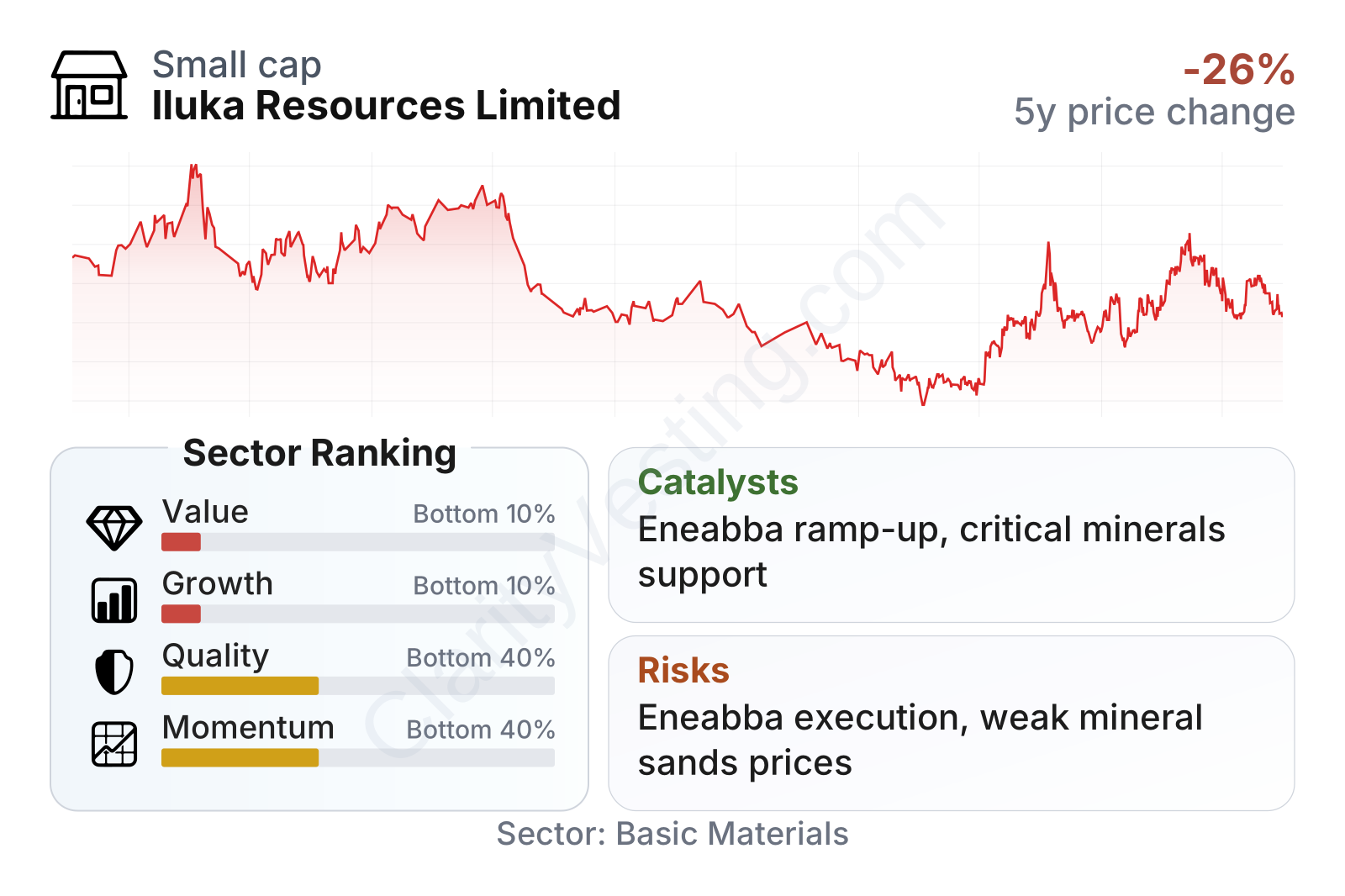
Iluka is currently a mid-sized materials company with a share price history that has been volatile rather than steadily compounding. The stock fell significantly from its earlier highs, then staged a partial recovery in 2026, which fits the pattern of a cyclical mining name tied to changing mineral prices and shifting expectations around future projects.
The metrics point to a mixed profile. On valuation ratios tied to book value, the shares look low relative to the sector, with price-to-book below the industry median. However, that discount comes with weaker near-term fundamentals: free cash flow is deeply negative, recent revenue growth is negative, and profitability has fallen well below sector norms. Quality indicators also show a split picture. Long-term historical returns on capital and assets were solid, suggesting the company has operated a strong business in better parts of the cycle, but current returns, margins, and leverage measures are much weaker. In short, the market is not placing a premium valuation on the company because the latest operating picture is under pressure and cash demands are high.
Growth
Iluka operates in two areas with very different growth profiles. Mineral sands is a mature but still relevant market. Demand for zircon and titanium feedstocks is linked to construction, ceramics, coatings, industrial production, and global manufacturing. That does not make it a high-growth market every year, but it remains important and can produce strong pricing during tighter supply periods.
The more interesting long-term growth angle is rare earths. These materials are increasingly important for permanent magnets used in electric vehicles, wind turbines, robotics, and defense technologies. Governments in Australia, the United States, Europe, and Japan have been supporting non-Chinese supply chains for critical minerals, and that gives Iluka a strategic opening. Its Eneabba rare earths refinery project is designed to process separated rare earth oxides and could place the company in a more valuable part of the supply chain than simply mining raw material.
This strategy makes industrial sense because it builds on Iluka’s resource and processing background while moving toward a market with stronger structural demand and geopolitical support. It also matters that rare earth separation capacity outside China is still limited, so a successful commissioning could create a meaningful new earnings stream over time.
A major catalyst has been public support for Eneabba through Australian government financing arrangements and broader policy interest in critical minerals development. Another positive element is the company’s established mineral sands base, which can still generate cash in stronger pricing environments and potentially support the transition. If mineral sands pricing improves at the same time that Eneabba advances toward operation, Iluka’s earnings profile could look very different from the recent trough period.
Risks
This article is for informational purposes only and does not constitute financial advice. Some content is AI-generated. See Disclaimer